

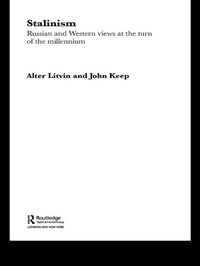
Stalinism
Russian and Western Views at the Turn of the Millenium
Published on 15. December 2004
264 pages
978-1-134-26687-6 (ISBN)
Description

Stalinism surveys the efforts made in recent years by professional historians, in Russia and the West, to better understand what really went on in the USSR between 1929 and 1953, when the country's affairs were shrouded in secrecy.
The opening of the Soviet archives in 1991 has led to a profusion of historical studies, whose strengths and weaknesses are assessed here impartially though not uncritically. While Joseph Stalin now emerges as a less omnipotent figure than he seemed to be at the time, most serious writers accept that the system over which he ruled was despotic and totalitarian. Some nostalgic nationalists in Russia, along with some Western post-modernists, disagree. Their arguments are carefully dissected here. Stalinism was of course much more than state sponsored terror, and so due attention is paid to a wide range of socio-economic and cultural problems. Keep and Litvin applaud the efforts of Soviet citizens to express dissenting views.
The opening of the Soviet archives in 1991 has led to a profusion of historical studies, whose strengths and weaknesses are assessed here impartially though not uncritically. While Joseph Stalin now emerges as a less omnipotent figure than he seemed to be at the time, most serious writers accept that the system over which he ruled was despotic and totalitarian. Some nostalgic nationalists in Russia, along with some Western post-modernists, disagree. Their arguments are carefully dissected here. Stalinism was of course much more than state sponsored terror, and so due attention is paid to a wide range of socio-economic and cultural problems. Keep and Litvin applaud the efforts of Soviet citizens to express dissenting views.
Reviews / Votes
'Keep constantly seeks to draw attanetion to what has been found by historians, traditional and postmodernist alike, while maintaining a running debate with the postmodernist writers. This produces an informative and interesting text. Anyone seeking a guide to recent writing in these areas will find much of interest.' - Michael Ellamn, IRSHThe outpouring of articles and books on Stalin and Stalinism is ongoing. This book offers a well-informed survey of recent work in this area in four areas. In view of the central importance of Stalinism in the twentieth century this is undoubtedly a useful project.' - Michael Ellman, IRSH 'Keep constantly seeks to draw attanetion to what has been found by historians, traditional and postmodernist alike, while maintaining a running debate with the postmodernist writers. This produces an informative and interesting text. Anyone seeking a guide to recent writing in these areas will find much of interest.' - Michael Ellamn, IRSH
The outpouring of articles and books on Stalin and Stalinism is ongoing. This book offers a well-informed survey of recent work in this area in four areas. In view of the central importance of Stalinism in the twentieth century this is undoubtedly a useful project.' - Michael Ellman, IRSH
More details
Series
Language
English
Place of publication
London
United Kingdom
Publishing group
Taylor & Francis Ltd
Target group
College/higher education
Product notice
Reflowable
File size
0,41 MB
ISBN-13
978-1-134-26687-6 (9781134266876)
Copyright in bibliographic data and cover images is held by Nielsen Book Services Limited or by the publishers or by their respective licensors: all rights reserved.
Schweitzer Classification
Other editions
Additional editions
Book
12/2004
1st Edition
Routledge
€231.90
Shipment within 15-20 days
Book
12/2004
1st Edition
Routledge
€96.40
Shipment within 15-20 days
Persons
Alter L. Litvin is professor of history and historiography at Kazan State University, Tatarstan. He has written many books dealing with the Russian civil war, the Volga region, and political terror, and has also helped to edit a number of documentary collections. He has won awards for his distinguished professional achievements.
John L. H. Keep was from 1970 to 1988 a professor of history at the University of Toronto. He is author of works on the Russian revolution, the social history of the Russian army (15th-19th centuries), and the post-Stalin USSR. He recently translated and edited A.L. Litvin's Writing History in Twentieth Century Russia: A view from within.
John L. H. Keep was from 1970 to 1988 a professor of history at the University of Toronto. He is author of works on the Russian revolution, the social history of the Russian army (15th-19th centuries), and the post-Stalin USSR. He recently translated and edited A.L. Litvin's Writing History in Twentieth Century Russia: A view from within.
Content
Introduction, List of abbreviations, PART I, PART II, Conclusions, Glossary, Bibliography, Index
