

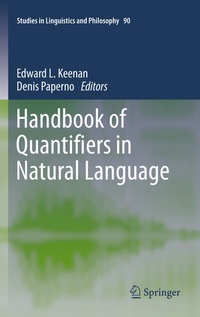
Handbook of Quantifiers in Natural Language
Description

Covering a strikingly diverse range of languages from 12 linguistic families, this handbook is based on responses to a questionnaire constructed by the editors. Focusing on the formation, distribution and semantic interpretation of quantificational expressions, the book explores 17 languages including German, Italian, Russian, Mandarin Chinese, Malagasy, Hebrew, Pima, Basque, and more. The language data sets enable detailed crosslinguistic comparison of numerous features. These include semantic classes of quantifiers (generalized existential, generalized universal, proportional, partitive), syntactically complex quantifiers (intensive modification, Boolean compounding, exception phrases) and several others such as quantifier scope ambiguities, quantifier float, and binary quantifiers. Its theory-independent content extends earlier work by Matthewson (2008) and Bach et al. (1995), making this handbook suitable for linguists, semanticians, philosophers of language and logicians alike.
More details
Other editions
Additional editions
Persons
Edward L. Keenan is Distinguished Professor of linguistics at theUniversity of California at Los Angeles. He received his PhD in Formal Linguistics from The University of Pennsylvania in 1969 for a thesis on A Presupposition Logic for Natural Language. He is a member of the American Academy of Arts and Sciences as well as the American Association for the Advancement of Science. He has published in numerous areas of linguistics, including syntactic typology, formal semantics, theoretical syntax, historical syntax, and Austronesian linguistics. He has co-authored two books: Boolean Semantics for Natural Language (1985), with Leonard Faltz, and Bare Grammar: Lectures on Linguistic Invariants, with Edward P. Stabler (2003).
Denis Paperno is a graduate of the Moscow State University andcurrently a PhD candidate at the University of California at Los Angeles. He has done fieldwork in the Komi Republic, the Udmurt Republic, the Caucasus, and W. Africa and has written agrammar of Beng (Mande; Co^te d'Ivoire) (in Russian). In addition to African linguistics he has published in semantics and syntactic typology.
Content
Introduction .- Chapter 1 The Quantifier Questionnaire .- Chapter 2 Quantifiers in Adyghe .- Chapter 3 Quantification in Basque .- Chapter 4 Garifuna Quantification .- Chapter 5 Quantification in German .- Chapter 6 The landscape of Quantificational expressions in Greek .- Chapter 7 Quantifiers in Modern Hebrew .- Chapter 8 Quantification in Hungarian .- Chapter 9 Quantifiers in Italian .- Chapter 10 Quantity expressions in Japanese .- Chapter 11 Malagasy Quantifiers .- Chapter 12 Taiwan Mandarin Quantifiers .- Chapter 13 Pima Quantifiers .- Chapter 14 Quantification in Standard Russian .- Chapter 15 Quantification in Telugu .- Chapter 16 Quantification in Western Armenian .- Chapter 17 Wolof Quantifiers .- Chapter 18 Overview .- Subject Index.
