

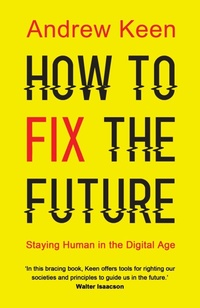
How to Fix the Future
Staying Human in the Digital Age
Published on 1. March 2018
368 pages
978-1-78649-167-1 (ISBN)
Description

Internet entrepreneur Andrew Keen was among the earliest to write about the dangers that the Internet poses to our culture and society. His 2007 book The Cult of the Amateur was critical in helping advance the conversation around the Internet, which has now morphed from a tool providing efficiencies and opportunities for consumers and business to a force that is profoundly reshaping our societies and our world.
In his new book, How to Fix the Future, Keen focuses on what we can do about this seemingly intractable situation. Looking to the past to learn how we might change our future, he describes how societies tamed the excesses of the Industrial Revolution, which, like its digital counterpart, demolished long-standing models of living, ruined harmonious environments and altered the business world beyond recognition.
Travelling across the globe, from India to Estonia, Germany to Singapore, he investigates the best (and worst) practices in five key areas - regulation, innovation, social responsibility, consumer choice and education - and concludes by examining whether we are seeing the beginning of the end of the America-centric digital world.
Powerful, urgent and deeply engaging, How to Fix the Future vividly depicts what we must do if we are to try to preserve human values in an increasingly digital world and what steps we might take as societies and individuals to make the future something we can again look forward to.
In his new book, How to Fix the Future, Keen focuses on what we can do about this seemingly intractable situation. Looking to the past to learn how we might change our future, he describes how societies tamed the excesses of the Industrial Revolution, which, like its digital counterpart, demolished long-standing models of living, ruined harmonious environments and altered the business world beyond recognition.
Travelling across the globe, from India to Estonia, Germany to Singapore, he investigates the best (and worst) practices in five key areas - regulation, innovation, social responsibility, consumer choice and education - and concludes by examining whether we are seeing the beginning of the end of the America-centric digital world.
Powerful, urgent and deeply engaging, How to Fix the Future vividly depicts what we must do if we are to try to preserve human values in an increasingly digital world and what steps we might take as societies and individuals to make the future something we can again look forward to.
Reviews / Votes
A truly important book and the most significant work so far in an emerging body of literature in which technology's smartest thinkers are raising alarm bells about the state of the Internet, and laying groundwork for how to fix it. * Fortune * How to Fix the Future, by longtime tech critic Andrew Keen, avoids simplistic condemnations, offering instead a progressive plan to ease the growing discomfort with emerging technologies that only a few years ago were being celebrated. The book provides compelling examples of ongoing experiments addressing new ways of developing and integrating socially responsible technology into our lives, especially in media, government, and education . . . Keen genuinely believes that, yes, we can fix the future. -- Larry Downes * Washington Post * With his new book, Keen switches from sarcasm to a kind of pragmatic optimism . . . Like Churchill, he offers mostly blood, sweat and tears; but at least he has a program of what needs to be done . . . It makes sense, as Keen seeks to do, to take the long view of our current dilemmas. -- John Naughton * Observer * In [Keen's] acerbic, articulate global survey of human-centered solutions, he examines best practice in consumer choice, education, innovation, regulation and social responsibility . . . An invigorating mix of principle and vision. * Nature * After years of giddiness about the wonders of technology, a new realization is dawning: the future is broken... In this bracing book, Keen offers tools for righting our societies and principles to guide us in the future. * Walter Isaacson * In this engaging, provocative book, [Keen] outlines five strategies - regulation, competitive innovation, consumer choice, civic responsibility, and education - that, working in collaboration, can help ensure an open, decentralized digital future... Valuable insights on preserving our humanity in a digital world. * Kirkus Reviews (Starred Review) * Keen, has spent his career warning of the dangers of the Internet, takes a more positive turn in this complex yet accessible study. Comparing our current situation to the Industrial Revolution, he stresses the importance of keeping humanity at the center of technology. * Booklist * Eschewing much of the over-the-top luddism that now fills the New York Times, the Guardian, and other mainstream media outlets, Keen proffers practical solutions to a wide range of tech-related woes. * TechCrunch *More details
Edition
Main
Language
English
Place of publication
London
United Kingdom
File size
1,32 MB
ISBN-13
978-1-78649-167-1 (9781786491671)
Copyright in bibliographic data and cover images is held by Nielsen Book Services Limited or by the publishers or by their respective licensors: all rights reserved.
Schweitzer Classification
Other editions
Additional editions
Book
09/2018
Atlantic Books
€32.37
Shipment within 3-4 weeks
Book
03/2018
Atlantic Books
€44.76
Shipment within 3-4 weeks
Person
Andrew Keen is one of the world's best-known and controversial commentators on the digital revolution. He is the author of three acclaimed and prescient books: The Cult of the Amateur, Digital Vertigo and The Internet Is Not The Answer. He is also a serial tech entrepreneur who has founded many start-ups, including Audiocafe, AfterTV and the Silicon Valley innovation salon Futurecast.
Content
- Intro
- Title
- Copyright
- Contents
- Preface: An Internet of People
- Introduction: We've Been Here Before
- 1 More's Law
- 2 Five Tools for Fixing the Future
- 3 What Is Broken
- 4 Utopia: A Case Study (Book One)
- 5 Utopia: A Case Study (Book Two)
- 6 Regulation
- 7 Competitive Innovation
- 8 Social Responsibility
- 9 Worker and Consumer Choice
- 10 Education
- Conclusion: Our Kids
- Acknowledgments
- Notes
- Index
