

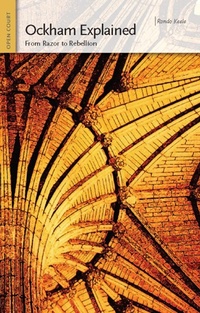
Ockham Explained
Published on 1. May 2010
192 pages
978-0-8126-9710-0 (ISBN)
Description

Ockham Explained is an important and much-needed resource on William of Ockham, one of the most important philosophers of the Middle Ages. His eventful and controversial life was marked by sharp career moves and academic and ecclesiastical battles. At 28, Ockham was a conservative English theologian focused obsessively on the nature of language, but by 40, he had transformed into a fugitive friar, accused of heresy, and finally protected by the German emperor as he composed incendiary treatises calling for strong limits on papal authority. This book provides a thorough grounding in Ockham's life and his many contributions to philosophy. It begins with an overview of the philosopher's youth and the Aristotelian philosophy he studied as a boy. Subsequent chapters cover his ideas on language and logic; his metaphysics and vaunted "razor," as well as his opponents' "anti-razor" theories; his invention of the church-state separation; and much more. The concluding chapter sums up Ockham's compelling philosophical personality and explains his modern appeal.
More details
Other editions
Additional editions
Book
06/2010
Open Court Publishing Co ,U.S.
€24.00
Shipment within 10-20 days
Person
Rondo Keele is Assistant Professor of Philosophy at Louisiana Scholars' College.
Content
- Intro
- Title Page
- Volume 7 in the Ideas ExplainedT Series
- Dedication
- Acknowledgements
- 1 - Student, Teacher, Thief, Exile
- Some Basic Dates in Ockham's Life
- An Outline of This Book
- The Fate of the Seal
- 2 - The Young Man (Birth -1302)
- Aristotle
- Form
- Essence, Accident, Genus, Species
- Language, the Ten Categories, and Real Definition
- Cognition, Universals, and the Soul
- The Church
- Background, Books, and Bishops
- Top Ten List: Some Philosophically Important Christian Doctrines
- The Church and Aristotle
- Medieval Universities, Studia, and Theology Study
- Language, Truth, and Logic
- 3 - The Student (1302-1317)
- What Is a Term?
- Divisions of Terms
- The Behavior of Terms
- The Uses of Terms
- Quiz Time!
- Answers to Quiz
- Some Types of Terms
- Ready to Clean House in Metaphysics
- 4 - The Teacher at Oxford (1302 -1317)
- Realists
- Interpreting the Tree
- The Realist Interpretation Extended
- The Basic Ockhamist Approach
- Remember Your Logic . . .
- Ockham's Grand Nominalism
- Stage I. The Tree of Language
- Stage II. Rejection of Universal Essences
- Stage III. Connotation Theory
- Is Simpler Better?
- 5 - The Teacher Attacked (1319-1321)
- Principles of Parsimony (and Plurality)
- What Ockham's Razor Is
- Ockham's Razor and Chatton's Anti-Razor
- Modern Misunderstandings: What Ockham's Razor Is Not
- Medieval Misunderstandings: Ordained versus Absolute Power
- Sliding from Nominalism to Heresy?
- 6 - The Teacher Responds (1321-1323)
- The Aristotelian View of Motion and the Science of Motion (= Physics)
- The Mediaeval Realists' Theory of Local Motion
- Ockham's Rejection
- Anti-Realism and Ockham's Alternative
- What Causes Local Motion?
- Critique of Ockham's Theory of Motion
- The Nature of Physics
- A General Critique of Connotative Reduction
- Ockham Asked to Explain Himself
- 7 - The Teacher Interrupted (1323 -1328)
- Philosophy of Mind and Action in the Middle Ages
- Aristotle's Basic Picture of Intellection and Some Problems with It
- Intellective Part
- Ockham's Basic Outlook on Cognition: The Fictum Theory and the Intellectio Theory
- Intuitive and Abstractive Cognition
- Can God Fool Us?
- Aristotle's Basic Picture of Ethics: Eudaimonism
- Mediaeval Christian Reactions to Aristotle
- Ockham and Moral Luck
- Ockham Is Drawn into the Poverty Controversy
- 8 - The Exile in Munich (1328 -1347)
- The Poverty Controversy
- From The Work of Ninety Days to Eight Questions on the Power of the Pope
- Natural Rights in The Work of Ninety Days
- Political Dualism in Eight Questions
- Did Ockham Recant?
- 9 - Afterword
- Immediate Influence
- Lasting Legacy
- Glossary
- What to Read Next
- Index
- Copyright Page
