

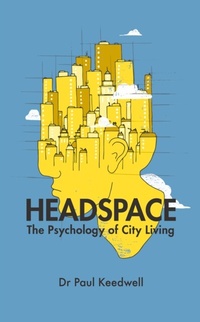
Headspace
The Psychology of City Living
1st Edition
Published on 16. March 2017
304 pages
978-1-78131-712-9 (ISBN)
Description

More and more of us are choosing to live in the man-made environment of the city. The mismatch between this artificial world and our nature-starved souls can contribute to the stresses of city living in a way that is barely noticed - but is crucially important.
What does the science of architectural psychology tell us about how the world of brick and concrete affects how we think, feel and behave? In an increasingly crowded urban world, how does good urban architecture inspire, restore and bring us together. Conversely, how does bad architecture cause anxiety, alienation and depression?
Dr Paul Keedwell uncovers the secret psychology of the city, and how it affects our daily happiness. Starting with the home and reaching out to the street, neighbourhood and wider city landscape, Headspace teaches us how to see our cities differently, and how we can best adapt to our rapidly changing urban world.
What does the science of architectural psychology tell us about how the world of brick and concrete affects how we think, feel and behave? In an increasingly crowded urban world, how does good urban architecture inspire, restore and bring us together. Conversely, how does bad architecture cause anxiety, alienation and depression?
Dr Paul Keedwell uncovers the secret psychology of the city, and how it affects our daily happiness. Starting with the home and reaching out to the street, neighbourhood and wider city landscape, Headspace teaches us how to see our cities differently, and how we can best adapt to our rapidly changing urban world.
All prices
More details
Language
English
Place of publication
New York
United Kingdom
Publishing group
Quarto Publishing PLC
ISBN-13
978-1-78131-712-9 (9781781317129)
Copyright in bibliographic data and cover images is held by Nielsen Book Services Limited or by the publishers or by their respective licensors: all rights reserved.
Schweitzer Classification
Other editions
Additional editions
Book
03/2017
Aurum
€23.00
Article exhausted; check different version
Person
Dr Paul Keedwell studied Medicine and Psychology at Leeds University and is a member of the Royal College of Psychiatrists. He has a PhD on the neuroscience of mood disorder, with a keen interest in how evolution has shaped our emotions. He has written widely on many aspects of psychology and mental health, also appearing on national radio and television. His more artistic side has been drawn to architecture and design, which he studied part time at London Metropolitan University. This led to a dissertation on the psychological history of architecture. He has conducted a survey on emotional attachments to the home and contributed to the Channel Four TV series, The Secret Life of Buildings.
Content
- Intro
- Title Page
- Contents
- Introduction: The psychology of the city
- Part One: The Home, From Inside Out
- Chapter 1: Refuge versus prospect
- Chapter 2: Mystery and complexity
- Chapter 3: Closure
- Chapter 4: Nature in the home
- Part Two: Home and Identity
- Chapter 5: Status objects versus personal objects
- Chapter 6: Space sharing
- Chapter 7: The stamp of personality
- Chapter 8: Tailor-made homes
- Part Three: Neighbourhood
- Chapter 9: Street life
- Chapter 10: Protecting the territory
- Chapter 11: The spirit of place
- Part Four: High-rise Living
- Chapter 12: Vertigo and other fears
- Chapter 13: Making better high-rises
- Part Five: Public Places: Places for Play
- Chapter 14: Child's play
- Chapter 15: Adults are kids, too: green spaces
- Chapter 16: Recreational buildings
- Part Six: The Workplace
- Chapter 17: Open-plan?
- Chapter 18: Self-expression
- Part Seven: Healing Spaces
- Chapter 19: A healthy atmosphere
- Chapter 20: End of life
- Epilogue: The ideal city
- Endnotes
- Index
- Image Credits
- Acknowledgements
- Copyright
