

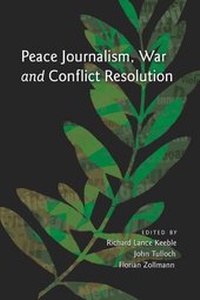
Peace Journalism, War and Conflict Resolution
1st Edition
Published on 19. February 2010
XII, 373 pages
978-1-4539-0104-5 (ISBN)
Description

Peace Journalism, War and Conflict Resolution draws together the work of over twenty leading international writers, journalists, theorists and campaigners in the field of peace journalism. Mainstream media tend to promote the interests of the military and governments in their coverage of warfare. This major new text aims to provide a definitive, up-to-date, critical, engaging and accessible overview exploring the role of the media in conflict resolution. Sections focus in detail on theory, international practice, and critiques of mainstream media performance from a peace perspective; countries discussed include the U.S., U.K., Germany, Cyprus, Sweden, Canada, India, Pakistan, Papua New Guinea and the Philippines. Chapters examine a wide variety of issues including mainstream newspapers, indigenous media, blogs and radical alternative websites. The book includes a foreword by award-winning investigative journalist John Pilger and a critical afterword by cultural commentator Jeffery Klaehn.
More details
Other editions
Additional editions
Richard Lance Keeble | John Tulloch | Florian Zollmann
Peace Journalism, War and Conflict Resolution
Book
03/2010
Peter Lang Verlag
€145.20
Shipment within 7-9 days
Richard Lance Keeble | John Tulloch | Florian Zollmann
Peace Journalism, War and Conflict Resolution
Book
02/2010
Peter Lang Verlag
€44.45
Shipment within 7-9 days
Persons
The Editors: Richard Lance Keeble is Professor of Journalism at the University of Lincoln, United Kingdom. He has written or edited fifteen books including The Newspapers Handbook (2005, fourth edition); Ethics for Journalists (2008, second edition) and Secret State, Silent Press: New Militarism, the Gulf and the Modern Image of Warfare (1997). He is the joint editor of the academic quarterly Ethical Space: The International Journal of Communication Ethics.
John Tulloch is Professor of Journalism and Head of the School of Journalism at the University of Lincoln, United Kingdom. He is Co-Director of the Centre for Media Policy, Regulation and Ethics (CEMPRE). From 1997-2003 Tulloch was Chair of the Department of Journalism and Mass Communication at the University of Westminster. He has taught, designed and validated journalism programmes in a number of international settings including India, Yemen, Oman, Tunisia, Uzbekistan, Kyrgyzstan, and nine European countries. In 1984 he set up the first positive action journalism diploma in a U.K. university, backed by the CRE and the BBC. In 1995-2003 and 2006-2007 he designed and managed the British Chevening programme for young Indian newspaper journalists for the Foreign and Commonwealth Office. Tulloch has edited two books and authored numerous journal articles and chapters on media subjects.
Florian Zollmann is studying for a Ph.D. at Lincoln University's School of Journalism. His main research interests are press coverage of Western foreign policy in the Middle East and propaganda studies. He has recently written for Ethical Space: The International Journal of Communication Ethics, and is also a contributor to the German independent magazine Publik-Forum where he is a blogger as well as a regular writer and editor for its young adult supplement Provo.
John Tulloch is Professor of Journalism and Head of the School of Journalism at the University of Lincoln, United Kingdom. He is Co-Director of the Centre for Media Policy, Regulation and Ethics (CEMPRE). From 1997-2003 Tulloch was Chair of the Department of Journalism and Mass Communication at the University of Westminster. He has taught, designed and validated journalism programmes in a number of international settings including India, Yemen, Oman, Tunisia, Uzbekistan, Kyrgyzstan, and nine European countries. In 1984 he set up the first positive action journalism diploma in a U.K. university, backed by the CRE and the BBC. In 1995-2003 and 2006-2007 he designed and managed the British Chevening programme for young Indian newspaper journalists for the Foreign and Commonwealth Office. Tulloch has edited two books and authored numerous journal articles and chapters on media subjects.
Florian Zollmann is studying for a Ph.D. at Lincoln University's School of Journalism. His main research interests are press coverage of Western foreign policy in the Middle East and propaganda studies. He has recently written for Ethical Space: The International Journal of Communication Ethics, and is also a contributor to the German independent magazine Publik-Forum where he is a blogger as well as a regular writer and editor for its young adult supplement Provo.
Content
Contents: John Pilger: Foreword - Richard Lance Keeble/John Tulloch/Florian Zollmann: Introduction: Why peace journalism matters - Clifford G. Christians: Non-violence in philosophical and media ethics - Oliver Boyd-Barrett: Recovering agency for the propaganda model: The implications for reporting war and peace - Richard Lance Keeble: Peace journalism as political practice: A new, radical look at the theory - Jake Lynch: Propaganda, war, peace and the media - Annabel McGoldrick/Jake Lynch: A global standard for reporting conflict and peace - Agneta Söderberg Jacobson: When peace journalism and feminist theory join forces: A Swedish case study - Valerie Alia: Crossing borders: The global influence of Indigenous media - Florian Zollmann: Iraq and Dahr Jamail: War reporting from a peace perspective - Pratap Rughani: Are you a vulture? Reflecting on the ethics and aesthetics of atrocity coverage and its aftermath - Donald Matheson/Stuart Allan: Social networks and the reporting of conflict - Jean Lee C. Patindol: Building a peace journalists' network from the ground: The Philippine experience - Milan Rai: Peace journalism in practice - Peace News: For non-violent revolution - Sarah Maltby: Mediating peace? Military radio in the Balkans and Afghanistan - Susan Dente Ross/Sevda Alankus: Conflict gives us identity: Media and the 'Cyprus problem' - Marlis Prinzing: The Peace Counts project: A promoter of real change or mere idealism? - John Tulloch: Conscience and the press: Newspaper treatment of pacifists and conscientious objectors 1939-40 - James Winter: War as peace: The Canadian media in Afghanistan - David Edwards: Normalising the unthinkable: The media's role in mass killing - Stephan Russ-Mohl: US coverage of conflict and the media attention cycle - Rukhsana Aslam: Perspectives on conflict resolution and journalistic training - Jeffery Klaehn: Afterword.
