

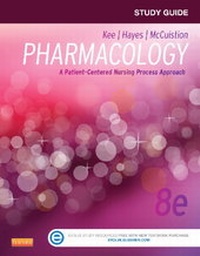
Study Guide for Pharmacology - E-Book
A Nursing Process Approach
8th Edition
Published on 24. September 2014
288 pages
978-0-323-29350-1 (ISBN)
Description

Corresponding to the chapters in Kee's Pharmacology: A Patient-Centered Nursing Process Approach, 8th Edition, this study guide offers practical activities to help you review and remember essential nursing pharmacology. Hands-on exercises include study questions, case studies, and NCLEX® review questions, making it easier to apply your knowledge to clinical practice and develop clinical reasoning skills.
- NCLEX® review questions in each chapter include application-level questions and alternate-item format questions.
- Case studies enhance your understanding of nursing responsibilities in therapeutic pharmacology.
- Medications and Calculations chapter offers additional opportunities to test your knowledge and skill in drug dosage calculation.
- 75 sample drug labels familiarize you with the real labels you will see in clinical practice.
- Answers for all exercises are provided at the back of the book to make studying easier.
- Study questions are provided in formats including matching, completion, and crossword puzzles.
- NEW! Updated content reflects the changes to Kee's Pharmacology textbook.
- NEW! Case study questions focus on developing your clinical reasoning skills.
- NEW! Rationales are added to the answer key for selected application-level questions and case study questions.
- NEW safety icons emphasize the nurse's role in patient safety.
- NEW! Case studies now feature open-ended questions to promote development of clinical reasoning skills.
More details
Other editions
Additional editions
Joyce Lefever Kee | Evelyn R. Hayes | Linda E. Mccuistion
Study Guide for Pharmacology: a Patient-Centered Nursing Process Approach
A Patient-Centered Nursing Process Approach
Book
01/2014
8th Edition
Saunders
€50.99
Article exhausted; check for reprint
Content
- Front Cover
- Study Guide Pharmacology: A Patient-Centered Nursing Process Approach
- Copyright Page
- Table of Contents
- Preface
- Chapter 1. Drug Action: Pharmaceutic, Pharmacokinetic, and Pharmacodynamic Phases
- Study Questions
- NCLEX Review Questions
- Case Study
- Chapter 2. The Drug Approval Process
- Study Questions
- NCLEX Review Questions
- Case Study
- Chapter 3. Cultural and Pharmacogenetic Considerations
- Study Questions
- NCLEX Review Questions
- Case Study
- Chapter 4. Drug Interactions and Over-the-Counter Drugs
- Study Questions
- NCLEX Review Questions
- Chapter 5. Drugs of Abuse
- Study Questions
- NCLEX Review Questions
- Case Study
- Chapter 6. Herbal Therapies
- Study Questions
- NCLEX Review Questions
- Case Study
- Chapter 7. Pediatric Pharmacology
- Study Questions
- NCLEX Review Questions
- Case Study
- Chapter 8. Geriatric Pharmacology
- Study Questions
- NCLEX Review Questions
- Case Study
- Chapter 9. Collaboration in Community Settings
- Study Questions
- NCLEX Review Questions
- Case Study
- Chapter 10. The Role of the Nurse in Drug Research
- Study Questions
- NCLEX Review Questions
- Case Study
- Chapter 11. The Nursing Process in Patient-Centered Pharmacotherapy
- Study Questions
- NCLEX Review Questions
- Case Study
- Chapter 12. Safety and Quality in Pharmacotherapy
- Study Questions
- NCLEX Review Questions
- Chapter 13. Medication Administration
- Study Questions
- NCLEX Review Questions
- Chapter 14. Medications and Calculations
- Introduction
- Section 14A-Systems of Measurement with Conversion
- Section 14B-Methods for Calculation
- Section 14C-Calculations of Oral Dosages
- Section 14D-Calculations of Injectable Dosages
- Section 14E-Calculations of Intravenous Fluids
- Section 14F-Pediatric Drug Calculations
- Chapter 15. Vitamin and Mineral Replacement
- Study Questions
- NCLEX Review Questions
- Chapter 16. Fluid and Electrolyte Replacement
- Study Questions
- NCLEX Review Questions
- Case Study
- Chapter 17. Nutritional Support
- Study Questions
- NCLEX Review Questions
- Case Study
- Chapter 18. Adrenergic Agonists and Adrenergic Blockers
- Study Questions
- NCLEX Review Questions
- Case Study
- Chapter 19. Cholinergic Agonists and Anticholinergics
- Study Questions
- NCLEX Review Questions
- Case Study
- Chapter 20. Central Nervous System Stimulants
- Study Questions
- NCLEX Review Questions
- Case Study
- Chapter 21. Central Nervous System Depressants
- Study Questions
- NCLEX Review Questions
- Case Study
- Chapter 22. Anticonvulsants
- Study Questions
- NCLEX Review Questions
- Case Study
- Chapter 23. Drugs for Neurologic Disorders: Parkinsonism and Alzheimer's Disease
- Study Questions
- NCLEX Review Questions
- Case Study
- Chapter 24. Drugs for Neuromuscular Disorders: Myasthenia Gravis, Multiple Sclerosis, and Muscle Spasms
- Study Questions
- NCLEX Review Questions
- Case Study
- Chapter 25. Antiinflammatory Drugs
- Study Questions
- NCLEX Review Questions
- Case Study
- Chapter 26. Nonopioid and Opioid Analgesics
- Study Questions
- NCLEX Review Questions
- Case Study
- Chapter 27. Antipsychotics and Anxiolytics
- Study Questions
- NCLEX Review Questions
- Case Study
- Chapter 28. Antidepressants and Mood Stabilizers
- Study Questions
- NCLEX Review Questions
- Case Study
- Chapter 29. Penicillins and Cephalosporins
- Study Questions
- NCLEX Review Questions
- Case Study
- Chapter 30. Macrolides, Tetracyclines, Aminoglycosides, and Fluoroquinolones
- Study Questions
- NCLEX Review Questions
- Case Study
- Chapter 31. Sulfonamides
- Study Questions
- NCLEX Review Questions
- Case Study
- Chapter 32. Antituberculars, Antifungals, Peptides, and Metronidazole
- Study Questions
- NCLEX Review Questions
- Case Study
- Chapter 33. Antivirals, Antimalarials, and Anthelmintics
- Study Questions
- NCLEX Review Questions
- Case Study
- Chapter 34. Drugs for Urinary Tract Disorders
- Study Questions
- NCLEX Review Questions
- Case Study
- Chapter 35. HIV- and AIDS-Related Drugs
- Study Questions
- NCLEX Review Questions
- Case Study
- Chapter 36. Vaccines
- Study Questions
- NCLEX Review Questions
- Case Study
- Chapter 37. Anticancer Drugs
- Study Questions
- NCLEX Review Questions
- Case Study
- Chapter 38. Targeted Therapies to Treat Cancer
- Study Questions
- NCLEX Review Questions
- Case Study
- Chapter 39. Biologic Response Modifiers
- Study Questions
- NCLEX Review Questions
- Case Study
- Chapter 40. Drugs for Upper Respiratory Disorders
- Study Questions
- NCLEX Review Questions
- Case Study
- Chapter 41. Drugs for Lower Respiratory Disorders
- Study Questions
- NCLEX Review Questions
- Case Study
- Chapter 42. Cardiac Glycosides, Antianginals,and Antidysrhythmics
- Study Questions
- NCLEX Review Questions
- Case Study
- Chapter 43. Diuretics
- Study Questions
- NCLEX Review Questions
- Case Study
- Chapter 44. Antihypertensives
- Study Questions
- NCLEX Review Questions
- Case Study
- Chapter 45. Anticoagulants, Antiplatelets, and Thrombolytics
- Study Questions
- NCLEX Review Questions
- Case Study
- Chapter 46. Antihyperlipidemics and Peripheral Vasodilators
- Study Questions
- NCLEX Review Questions
- Case Study
- Chapter 47. Drugs for Gastrointestinal Tract Disorders
- Study Questions
- NCLEX Review Questions
- Case Study
- Chaper 48. Antiulcer Drugs
- Study Questions
- NCLEX Review Questions
- Case Study
- Chapter 49. Drugs for Eye and Ear Disorders
- Study Questions
- NCLEX Review Questions
- Case Study
- Chapter 50. Drugs for Dermatologic Disorders
- Study Questions
- NCLEX Review Questions
- Case Study
- Chapter 51. Endocrine Drugs: Pituitary, Thyroid, Parathyroid, and Adrenal Disorders
- Study Questions
- NCLEX Review Questions
- Case Study
- Chapter 52. Antidiabetics
- Study Questions
- NCLEX Review Questions
- Case Study
- Chapter 53. Female Reproductive Cycle I: Pregnancy and Preterm Labor Drugs
- Study Questions
- NCLEX Review Questions
- Case Study
- Chapter 54. Female Reproductive Cycle II: Labor, Delivery, and Preterm Neonatal Drugs
- Study Questions
- NCLEX Review Questions
- Case Study
- Chapter 55. Postpartum and Newborn Drugs
- Study Questions
- NCLEX Review Questions
- Case Study
- Chapter 56. Drugs for Women's Reproductive Health and Menopause
- Study Questions
- NCLEX Review Questions
- Case Study
- Chapter 57. Drugs for Men's Health and Reproductive Disorders
- Study Questions
- NCLEX Review Questions
- Case Study
- Chapter 58. Drugs for Disorders in Women'sHealth, Infertility, and Sexually Transmitted Infections
- Study Questions
- NCLEX Review Questions
- Case Study
- Chapter 59. Adult and Pediatric Emergency Drugs
- Study Questions
- NCLEX Review Questions
- Case Study
- Answer Key
