

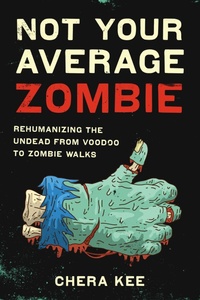
Not Your Average Zombie
Rehumanizing the Undead from Voodoo to Zombie Walks
1st Edition
Published on 5. September 2017
236 pages
978-1-4773-1319-0 (ISBN)
Description

The zombie apocalypse hasn't happened-yet-but zombies are all over popular culture. From movies and TV shows to video games and zombie walks, the undead stalk through our collective fantasies. What is it about zombies that exerts such a powerful fascination? In Not Your Average Zombie, Chera Kee offers an innovative answer by looking at zombies that don't conform to the stereotypes of mindless slaves or flesh-eating cannibals. Zombies who think, who speak, and who feel love can be sympathetic and even politically powerful, she asserts.
Kee analyzes zombies in popular culture from 1930s depictions of zombies in voodoo rituals to contemporary film and television, comic books, video games, and fan practices such as zombie walks. She discusses how the zombie has embodied our fears of losing the self through slavery and cannibalism and shows how "extra-ordinary" zombies defy that loss of free will by refusing to be dehumanized. By challenging their masters, falling in love, and leading rebellions, "extra-ordinary" zombies become figures of liberation and resistance. Kee also thoroughly investigates how representations of racial and gendered identities in zombie texts offer opportunities for living people to gain agency over their lives. Not Your Average Zombie thus deepens and broadens our understanding of how media producers and consumers take up and use these undead figures to make political interventions in the world of the living.
Kee analyzes zombies in popular culture from 1930s depictions of zombies in voodoo rituals to contemporary film and television, comic books, video games, and fan practices such as zombie walks. She discusses how the zombie has embodied our fears of losing the self through slavery and cannibalism and shows how "extra-ordinary" zombies defy that loss of free will by refusing to be dehumanized. By challenging their masters, falling in love, and leading rebellions, "extra-ordinary" zombies become figures of liberation and resistance. Kee also thoroughly investigates how representations of racial and gendered identities in zombie texts offer opportunities for living people to gain agency over their lives. Not Your Average Zombie thus deepens and broadens our understanding of how media producers and consumers take up and use these undead figures to make political interventions in the world of the living.
Reviews / Votes
"Kee provides a compelling synthesis of theory and criticism...useful for horror scholars interested in how portrayals of zombie intersect with race and gender." * Popular Culture Studies Journal * "Kee's Not Your Average Zombie is an important book...Put simply: if it's the one book you read about or cite on zombie, you've made an excellent choice." * American Quarterly * "[Not Your Average Zombie] offers a fresh theoretical framework to a fast-growing field...a fascinating contribution to the critical conversation about the zombie as a fantastic figure." * Journal of the Fantastic in the Arts * "Rather than conclude that the zombie genre is static, [Kee] highlights extraordinary examples of the zombies, zombification, and zombie culture that hint at human agency amongst those often deemed brainless pawns or dehumanized bodies...In each chapter, Kee spends several pages establishing context before she focuses on her examples of extraordinary zombies. What results is robust coverage of every possible example." * ImageTexT *All prices
More details
Language
English
Place of publication
Austin, TX
United States
Target group
Professional and scholarly
File size
7,20 MB
ISBN-13
978-1-4773-1319-0 (9781477313190)
DOI
10.7560/313176
Copyright in bibliographic data and cover images is held by Nielsen Book Services Limited or by the publishers or by their respective licensors: all rights reserved.
Schweitzer Classification
Other editions
Additional editions
Book
09/2017
University of Texas Press
€45.99
Shipment within 15-20 days
Book
09/2017
University of Texas Press
€92.50
Shipment within 15-20 days
Person
Chera Kee is an associate professor of film and media studies in the Department of English at Wayne State University. Her essays on zombies have been published in the Journal of Popular Film and Television and the edited volume Better Off Dead: The Evolution of the Zombie as Post-Human.
Content
Acknowledgments
Introduction. From the Zombi to the Zombie: The Extra-Ordinary Undead
Part I. Zombie Identities
Chapter 1. From Cannibals to Dead Men Working in the Cane Fields: Haiti, Vodou, and Early Zombie Films
Chapter 2. Racialized and Raceless: Race after Death and Zombie Revolution
Chapter 3. "You Can't Hurt Me, You Can't Destroy Me, You Can't Control Me": White Women in Zombie Films
Chapter 4. A Proud and Powerful Line: Women of Color and Voodoo
Part II. Playing the Zombie
Chapter 5. "Be Safe, Have Fun, Eat Brains": Playing the Zombie in Video Games
Chapter 6. I Walked with a Zombie: Performing the Living Dead
Conclusion. "I Think I'm Dead."
Notes
Bibliography
Index
Introduction. From the Zombi to the Zombie: The Extra-Ordinary Undead
Part I. Zombie Identities
Chapter 1. From Cannibals to Dead Men Working in the Cane Fields: Haiti, Vodou, and Early Zombie Films
Chapter 2. Racialized and Raceless: Race after Death and Zombie Revolution
Chapter 3. "You Can't Hurt Me, You Can't Destroy Me, You Can't Control Me": White Women in Zombie Films
Chapter 4. A Proud and Powerful Line: Women of Color and Voodoo
Part II. Playing the Zombie
Chapter 5. "Be Safe, Have Fun, Eat Brains": Playing the Zombie in Video Games
Chapter 6. I Walked with a Zombie: Performing the Living Dead
Conclusion. "I Think I'm Dead."
Notes
Bibliography
Index
