

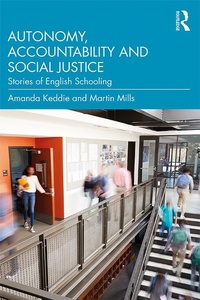
Autonomy, Accountability and Social Justice
Stories of English Schooling
1st Edition
Published on 10. April 2019
154 pages
978-1-351-59109-6 (ISBN)
Description

Autonomy, Accountability and Social Justice provides an account of recent developments in English state education, with a particular focus on the 'academisation' of schooling. It examines how head teachers, teachers and others working in diverse education settings navigate the current policy environment. The authors provide readers with insight into the complex decision-making processes that shape school responses to current educational agendas and examine the social justice implications of these responses.
The book draws on Nancy Fraser's social justice framework and her theorising of neoliberalism to explore current tensions associated with moves towards both greater autonomy for and accountability of state schooling. These tensions are presented through four case studies that centre upon 1) a group of local authority primary schools, 2) an academy 'chain', 3) a co-operative secondary school and 4) an alternative education setting. The book identifies the 'emancipatory' possibilities of these approaches amid the complex demands of autonomy and accountability seizing English schools. Informed by a consideration of market parameters and social protectionist ideals, this examination provides rich insights into how English schools have emancipatory capacity.
Autonomy, Accountability and Social Justice makes a major theoretical contribution to understandings of how the market is working alongside the regulation of schooling and the implications of this for social justice. By drawing on the experiences of those working in schools, it demonstrates that the tensions associated with autonomy and accountability within the current education policy environment can be both productive and unproductive for social justice.
The book draws on Nancy Fraser's social justice framework and her theorising of neoliberalism to explore current tensions associated with moves towards both greater autonomy for and accountability of state schooling. These tensions are presented through four case studies that centre upon 1) a group of local authority primary schools, 2) an academy 'chain', 3) a co-operative secondary school and 4) an alternative education setting. The book identifies the 'emancipatory' possibilities of these approaches amid the complex demands of autonomy and accountability seizing English schools. Informed by a consideration of market parameters and social protectionist ideals, this examination provides rich insights into how English schools have emancipatory capacity.
Autonomy, Accountability and Social Justice makes a major theoretical contribution to understandings of how the market is working alongside the regulation of schooling and the implications of this for social justice. By drawing on the experiences of those working in schools, it demonstrates that the tensions associated with autonomy and accountability within the current education policy environment can be both productive and unproductive for social justice.
Reviews / Votes
In this groundbreaking, conceptually innovative text, Keddie and Mills disentangle the messy relationship between social justice and neoliberalism by turning their critical attention to one of the most ambitious and controversial projects in education system redesign: England's academies programme. Thought provoking and boundary crossing, Keddie and Mills judiciously combine theory and evidence to grapple with the tensions and contradictions inherent to the movement of academisation as it successfully rebuffs local politics and democratic structures only to reinstate similar, albeit opaque, structures and practices of liberation and domination. Not content with some of the well-trodden platitudes of anti-academy rhetoric and related romanticisation of the past order of things, Keddie and Mills move beyond the obfuscatory language of binary thinking, of public (good) versus private (bad), to unravel the strange alignments and productive overlaps that make up the dis-embedding and re-embedding effects of academisation. This book captures the complexity of the current moment and provides a much-needed starting point for thinking through the problematics and pragmatics of achieving socially just forms of education under academisation and similar education systems undergoing market experimentation.Andrew Wilkins, Reader in Education, University of East London
This is a timely appraisal of the English education system from a social justice perspective. Documenting the rapid quasi-marketisation of schooling in England (and elsewhere), Keddie and Mills apply a social justice lens to the troubled issues of autonomy, accountability, and the educational outcomes and experiences for vulnerable students. In a climate of teacher shortages and growing questions around models of accountability, this challenging book will be important reading for those wishing to ensure that socially-just values and outcomes are at the heart of developments.
Becky Francis, Director, UCL Institute of Education, University College London
Given their relatively recent inception, England's academies have until lately remained an under-researched area. Thus, this new book by Amanda Keddie and Martin Mills makes for a great addition to the emerging body of research that has offered a voice to those working in these schools and will serve as a useful tool for helping us understand how school autonomy is being embraced, enacted, and experienced.
Craig Skerritt, Researcher, Dublin City University, Leadership and Policy in Schools Mary Leahy, Melbourne Graduate School of Education
I must admit that having read and re-read this proposal, it is probably the most finished and sophisticated proposal for a book that I have ever seen. It is extremely well written and it seems to me that the authors have thought very carefully about what can be done in work at this length. Is there a real need for this book? First, there is always a need for a well argued, cogent and nuanced account of education policy in my opinion. Second, the whole issue of context is simply ignored by policy-makers and politicians. Yes there is a real need for this book. I think this book would be highly suitable for students and I would use it as a main reading against some topics and a recommended reading for programmes that I lead.
Meg Maguire, Kings College London
This book is unique because of its focus on context. I note in each chapter, they pull the arguments together through the lens of context - so, there is no equivalent book that I know of. It must be obvious from my comments that I think this is an original and fascinating project. The empirical base is going to be a great data set from where to mine insights related to the arguments being worked through. This is a highly regarded team who are extremely experienced and will produce a quality book. I will have it on my lists and will get our library to buy multiple copies. I think this is going to one of those books that will stand the test of time and will be read by teachers as well as researchers. I just hope that some copies will make it into the hands of policy makers!
More details
Edition
1. Auflage
Language
English
Place of publication
London
United Kingdom
Publishing group
Taylor & Francis Ltd
Target group
College/higher education
Professional and scholarly
File size
3,28 MB
ISBN-13
978-1-351-59109-6 (9781351591096)
Copyright in bibliographic data and cover images is held by Nielsen Book Services Limited or by the publishers or by their respective licensors: all rights reserved.
Schweitzer Classification
Other editions
Additional editions
Amanda Keddie | Martin Mills
Autonomy, Accountability and Social Justice
Stories of English Schooling
Book
04/2019
1st Edition
Routledge
€65.10
Shipment within 10-20 days
Amanda Keddie | Martin Mills
Autonomy, Accountability and Social Justice
Stories of English Schooling
Book
04/2019
1st Edition
Routledge
€232.60
Shipment within 10-20 days
Persons
Amanda Keddie is Professor of Education, Deakin University, Australia. Her research examines gender, cultural diversity, social justice and schooling. Recent books include: Leadership, Ethics and Schooling for Social Justice (2016), The Politics of Differentiation in Schools (2017) and Supporting and Educating Young Muslim Women: Stories from Australia and the UK (2017).
Martin Mills is Professor of Education and Director of the Centre for Teachers and Teaching Research at the IOE, University College London. His work is centred on social justice issues in education. Recent books include: The Politics of Differentiation in Schools (2017), Reimagining Schooling for Education (2017) and Alternative Education: International Perspectives on Policy and Practice (2018).
Martin Mills is Professor of Education and Director of the Centre for Teachers and Teaching Research at the IOE, University College London. His work is centred on social justice issues in education. Recent books include: The Politics of Differentiation in Schools (2017), Reimagining Schooling for Education (2017) and Alternative Education: International Perspectives on Policy and Practice (2018).
Content
Acknowledgements
Chapter 1. English Schooling, Social Justice and Neoliberalism
Chapter 2. School Autonomy, School Accountability and Social Justice in English Education
Chapter 3. Academisation and School Collaboration: A Story of Six Primary School Leaders
Chapter 4. New Modalities of State Power: Neoliberal Responsibilisation and the Work of Academy Chains
Chapter 5. Co-Operating in a Competitive Marketplace
Chapter 6. Alternative Provision: A Destination of Last Resort or Convenient Dumping Ground?
Chapter 7. The Ambivalences of Emancipation for Social Justice
Chapter 1. English Schooling, Social Justice and Neoliberalism
Chapter 2. School Autonomy, School Accountability and Social Justice in English Education
Chapter 3. Academisation and School Collaboration: A Story of Six Primary School Leaders
Chapter 4. New Modalities of State Power: Neoliberal Responsibilisation and the Work of Academy Chains
Chapter 5. Co-Operating in a Competitive Marketplace
Chapter 6. Alternative Provision: A Destination of Last Resort or Convenient Dumping Ground?
Chapter 7. The Ambivalences of Emancipation for Social Justice
