

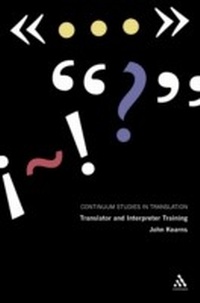
Translator and Interpreter Training
Issues, Methods and Debates
1st Edition
Published on 12. May 2008
240 pages
978-1-4411-4057-9 (ISBN)
Description

As a research area, education in the fields of translation and interpreting has received growing attention in recent years, with the increasing professionalization of the language-mediation sector demanding ever more highly trained employees with broader repertoires. This trend is evidenced in the present collection, which addresses issues in pedagogy in a variety of translation and interpreting domains. A global range of contributors discuss teaching, evaluation, professionalization and competence as they apply to an array of educational and linguistic situations.
Translator and Interpreter Training: Issues, Methods and Debates presents an in-depth consideration of the issues involved in this area of translation and interpreting studies, and will be of interest to all students and academics working and researching in the field.
Translator and Interpreter Training: Issues, Methods and Debates presents an in-depth consideration of the issues involved in this area of translation and interpreting studies, and will be of interest to all students and academics working and researching in the field.
Reviews / Votes
This comprehensive volume comprises a number of excellent contributions on a variety of quite specific but always exemplary topics related to translator education, sandwiched between highly thought-provoking seminal chapters by Kearns and Seguinot. This is a compilation of first-rate scholarly work in translation studies by both well-established and up-and-coming researchers. The panoply of innovative research methods introduced and the disparate yet smoothly interwoven facets of translation studies discussed make this volume an indispensable compendium for anyone interested in state-of-the-art research in translator education "Although the underlying subject of the papers is that of translator (and interpreter) training, they explore a fascinating range of different types of translation and different types of translation skills, which will certainly be of interest to anyone working in the field of Translation Studies today ... a collection of papers which set out to encourage trainers and researchers to break down the boundaries of what John Kearns calls the "academic/vocational dichotomy" and to question the ideology which has hitherto governed curricular planning in the field of Translation Studies. The volume presents a selection of well-researched and cogently argued papers which make a valuable contribution to current thinking around Translation, a discipline which emerges as broader and more far reaching than might otherwise have been imagined." --The Journal of Specialised Translation Instead of reaffirming the importance and necessity of translator training which characterized discourse in the field for several years, the selected articles... proceed to more challenging issues of what and how we should be teaching.More details
Series
Edition
1. Auflage
Language
English
Place of publication
New York
United States
ISBN-13
978-1-4411-4057-9 (9781441140579)
Copyright in bibliographic data and cover images is held by Nielsen Book Services Limited or by the publishers or by their respective licensors: all rights reserved.
Schweitzer Classification
Other editions
Additional editions
Book
05/2008
Continuum International Publishing Group Ltd.
€234.10
Shipment within 15-20 days
Book
05/2008
Continuum International Publishing Group Ltd.
€78.70
Shipment within 15-20 days
Person
Dr John Kearns is a lecturer in translation at the Kazimierz Wielki University in Bydgoszcz, Poland. He has also worked as a professional translator and translator trainer, and chairs the Training Committee of the International Association for Translation and Intercultural Studies.
Content
Introduction
1. Professionalization and Intervention, Candace Seguinot, (York University, USA)
2. Teaching Interpreting and Interpreting Teaching: A Conference Interpreter's Overview on Second Language Acquisition, Alessandro Zannirato (John Hopkins University, USA)
3. Training Editors in Universities: Considerations, Challenges and Strategies, Haidee Kruger (North-West University, South Africa)
4. Mobility Programmes as a Learning Experience for Translation Students: Development and Assessment of Specific Translations and Transferable Generic Compentences in Study Abroad Contexts, Dorothy Kelly (University of Granada, Spain)
5. Systematic Assessment of Translator Competence: In Search of Achilles' Heel, Catherine Way (University of Granada, Spain)
6. First Results of a Translation Competence Experiment: 'Knowledge of Translation' and 'Efficacy of the Translation Process', PACTE Group
7. SLIP - A Toll of the Trade Married to an Educational Space: Making BSL Dictionaries, Christine W. L. Wilson (Heriot-Watt University, Scotland) and Rita McDade (Heriot-Watt University, Scotland)
8. Fan Translation Networks: An Accidental Translator Training Environment, Minako O'Hagan (Dublin City University, Ireland)
9. The Academic and the Vocational in Translator Education, John Kearns (Dublin City University, Ireland)
Bibliography
Index
1. Professionalization and Intervention, Candace Seguinot, (York University, USA)
2. Teaching Interpreting and Interpreting Teaching: A Conference Interpreter's Overview on Second Language Acquisition, Alessandro Zannirato (John Hopkins University, USA)
3. Training Editors in Universities: Considerations, Challenges and Strategies, Haidee Kruger (North-West University, South Africa)
4. Mobility Programmes as a Learning Experience for Translation Students: Development and Assessment of Specific Translations and Transferable Generic Compentences in Study Abroad Contexts, Dorothy Kelly (University of Granada, Spain)
5. Systematic Assessment of Translator Competence: In Search of Achilles' Heel, Catherine Way (University of Granada, Spain)
6. First Results of a Translation Competence Experiment: 'Knowledge of Translation' and 'Efficacy of the Translation Process', PACTE Group
7. SLIP - A Toll of the Trade Married to an Educational Space: Making BSL Dictionaries, Christine W. L. Wilson (Heriot-Watt University, Scotland) and Rita McDade (Heriot-Watt University, Scotland)
8. Fan Translation Networks: An Accidental Translator Training Environment, Minako O'Hagan (Dublin City University, Ireland)
9. The Academic and the Vocational in Translator Education, John Kearns (Dublin City University, Ireland)
Bibliography
Index
