

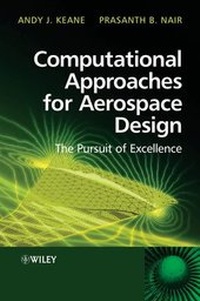
Computational Approaches for Aerospace Design
Description

More details
Other editions
Additional editions
Persons
Andy Keane is the author of Computational Approaches for Aerospace Design: The Pursuit of Excellence, published by Wiley.
Prasanth Nair is the author of Computational Approaches for Aerospace Design: The Pursuit of Excellence, published by Wiley.
Content
Preface.
Acknowledgments.
I Preliminaries.
1 Introduction.
1.1 Objectives.
1.2 Road Map -What is Covered and What is Not.
1.3 An Historical Perspective on Aerospace Design.
1.4 Traditional Manual Approaches to Design and Design Iteration, Design Teams.
1.5 Advances in Modeling Techniques: Computational Engineering.
1.6 Trade-offs in Aerospace System Design.
1.7 Design Automation, Evolution and Innovation.
1.8 Design Search and Optimization (DSO).
1.9 The Take-up of Computational Methods.
2 Design-oriented Analysis.
2.1 Geometry Modeling and Design Parameterization.
2.2 Computational Mesh Generation.
2.3 Analysis and Design of Coupled Systems.
3 Elements of Numerical Optimization.
3.1 Single Variable Optimizers - Line Search.
3.2 Multivariable Optimizers.
3.3 Constrained Optimization.
3.4 Metamodels and Response Surface Methods.
3.5 Combined Approaches - Hybrid Searches, Metaheuristics.
3.6 Multiobjective Optimization.
3.7 Robustness.
II Sensitivity Analysis and Approximation Concepts.
4 Sensitivity Analysis.
4.1 Finite-difference Methods.
4.2 Complex Variable Approach.
4.3 Direct Methods.
4.4 Adjoint Methods.
4.5 Semianalytical Methods.
4.6 Automatic Differentiation.
4.7 Mesh Sensitivities for Complex Geometries.
4.8 Sensitivity of Optima to Problem Parameters.
4.9 Sensitivity Analysis of Coupled Systems.
4.10 Comparison of Sensitivity Analysis Techniques.
5 General Approximation Concepts and Surrogates.
5.1 Local Approximations.
5.2 Multipoint Approximations.
5.3 Black-box Modeling: a Statistical Perspective.
5.4 Generalized Linear Models.
5.5 Sparse Approximation Techniques.
5.6 Gaussian Process Interpolation and Regression.
5.7 Data Parallel Modeling.
5.8 Design of Experiments (DoE).
5.9 Visualization and Screening.
5.10 Black-box Surrogate Modeling in Practice.
6 Physics-based Approximations.
6.1 Surrogate Modeling using Variable-fidelity Models.
6.2 An Introduction to Reduced Basis Methods.
6.3 Reduced Basis Methods for Linear Static Reanalysis.
6.4 Reduced Basis Methods for Reanalysis of Eigenvalue Problems.
6.5 Reduced Basis Methods for Nonlinear Problems.
III Frameworks for Design Space Exploration.
7 Managing Surrogate Models in Optimization.
7.1 Trust-region Methods.
7.2 The Space Mapping Approach.
7.3 Surrogate-assisted Optimization using Global Models.
7.4 Managing Surrogate Models in Evolutionary Algorithms.
7.5 Concluding Remarks.
8 Design in the Presence of Uncertainty.
8.1 Uncertainty Modeling and Representation.
8.2 Uncertainty Propagation.
8.3 Taguchi Methods.
8.4 The Welch-Sacks Method.
8.5 Design for Six.
8.6 Decision-theoretic Formulations.
8.7 Reliability-based Optimization.
8.8 Robust Design using Information-gap Theory.
8.9 Evolutionary Algorithms for Robust Design.
8.10 Concluding Remarks.
9 Architectures for Multidisciplinary Optimization.
9.1 Preliminaries.
9.2 Fully Integrated Optimization (FIO).
9.3 System Decomposition and Optimization.
9.4 Simultaneous Analysis and Design (SAND).
9.5 Distributed Analysis Optimization Formulation.
9.6 Collaborative Optimization.
9.7 Concurrent Subspace Optimization.
9.8 Coevolutionary Architectures.
IV Case Studies.
10 A Problem in Satellite Design 391
10.1 A Problem in Structural Dynamics.
10.2 Initial Passive Redesign in Three Dimensions.
10.3 A Practical Three-dimensional Design.
10.4 Active Control Measures.
10.5 Combined Active and Passive Methods.
10.6 Robustness Measures.
10.7 Adjoint-based Approaches.
11 Airfoil Section Design.
11.1 Analysis Methods.
11.2 Drag-estimation Methods.
11.3 Calculation Methods Adopted.
11.4 Airfoil Parameterization.
11.5 Multiobjective Optimization.
12 Aircraft Wing Design - Data Fusion between Codes 447
12.1 Introduction.
12.2 Overall Wing Design.
12.3 An Example and Some Basic Searches.
12.4 Direct Multifidelity Searches.
12.5 Response Surface Modeling.
12.6 Data Fusion.
12.7 Conclusions.
13 Turbine Blade Design (I) - Guide-vane SKE Control.
13.1 Design of Experiment Techniques, Response Surface Models and Model
Refinement.
13.2 Initial Design.
13.3 Seven-variable Trials without Capacity Constraint.
13.4 Twenty-one-variable Trial with Capacity Constraint.
13.5 Conclusions.
14 Turbine Blade Design (II) - Fir-tree Root Geometry.
14.1 Introduction.
14.2 Modeling and Optimization of Traditional Fir-tree Root Shapes.
14.3 Local Shape Parameterization using NURBS.
14.4 Finite Element Analysis of the Fir-tree Root.
14.5 Formulation of the Optimization Problem and Two-stage Search Strategy.
14.6 Optimum Notch Shape and Stress Distribution.
14.7 Summary.
15 Aero-engine Nacelle Design Using the Geodise Toolkit.
15.1 The Geodise System.
15.2 Gas-turbine Noise Control.
15.3 Conclusions.
16 Getting the Optimization Process Started.
16.1 Problem Classification.
16.2 Initial Search Process Choice.
16.3 Assessment of Initial Results.
Bibliography.
Index.
