

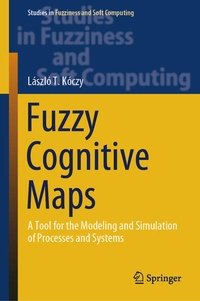
Fuzzy Cognitive Maps
Description

This book is considered as a monograph but also as a potential textbook for graduate students, focusing on the application of FCMs for modelling and analysing the behaviour of multicomponent systems. In the last two decades, no monograph or textbook has been published on the topic Fuzzy Cognitive Maps (FCM), so this new book is definitely filling a gap in the literature of computational intelligence.
The book is built up didactically, the novel results in the field being presented in the way of starting with two real-life case studies, one in the area of waste management, while the other one in modelling bank management systems. In both cases, the book starts with explaining the applied problem and then presenting how the model construction is done and what problems emerge when attempts are made for applying directly earlier results on FCM modelling. In the first case study, the problem of the oversimplification leads to inadequacy of the model, and then it is shown how new,much finer models can be built up based on expert domain knowledge. Then, the new problem of losing transparency and interpretability emerges, and as a solution, a new algorithm family is proposed that reduces FCMs to fewer components, while preserving the essential characteristics of the original model.
The second case study raises the problems of stability and sensitivity of FCMs, especially, considering that expert knowledge is often uncertain and subjective. The new results summarised in the book target the questions of how to ascertain whether an FCM is converging to one or several fixed point attractors, whether there is a bifurcation when parameters are changing, etc.
Both problems deal with the ultimate question whether the system modelled is stable and sustainable.
More details
Other editions
Additional editions
Content
Introduction to Fuzzy Cognitive Maps.- Systemic Relationships Between Regional Sustainability and Waste Management.- Identification of the Main Factors (Concepts) of Waste Management for Building the Initial FCM Model.- Rethinking the Set of Concepts - Applying Expert Analysis by the Workshop Method.- Model Reduction Methods.- Text Mining Based on the Literature of Waste Management as the Source of a Reconstructed Time Series.- Behavioral Analysis of Fuzzy Cognitive Maps.- Fuzzy Cognitive Maps: Mathematical Challenges.- Dynamics of Classical Fuzzy Cognitive Maps.- Dynamics of Fuzzy Cognitive Maps with Uncertain Weights.
