

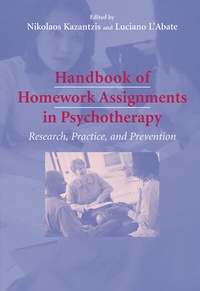
Handbook of Homework Assignments in Psychotherapy
Description

Reviews / Votes
From the reviews:
"Handbook of Homework Assignments in Psychotherapy presents multiple approaches to the integration of homework into therapy, including perspectives from nine theoretical orientations plus psychotherapy integration, as well as research and practical case examples. This inclusiveness is to be commended, as it lends to the overall strength and contributions of the work. . solid reference work with a broad perspective on homework that will likely become an essential component in the personal libraries of clinicians from all levels of experience as well as those of researchers." (Michele A. Schottenbauer, PsycCritiques, Vol. 52 (40), 2007)
"The Handbook of Homework Assignments in Psychotherapy: Research, Practice, and Prevention . provides readers with an extensive overview of how clinicians of various orientations integrate homework assignments into their clinical work with various popultions. . All chapters are well-organized, succinct, and written by experts in their respective fields. This book is geared towards clinicians working with adult populations. . This would be an excellent book for beginning clinicians or graduate students who are seeking an overview of various treatment approaches and clinical disorders." (Jeanne M. Duax, Journal of Contemporary Psychotherapy, Vol. 37, 2007)
"The book operationally defines 'homework' in various kinds of therapy . . is aimed at practitioners and researchers with all ranges of experience. . Readers looking for an 'academic' perspective on homework, a comparison of different approaches to between-session work, and inspiration in working with different populations will find a great deal here. . It really does represent a 'first to market' work that will be foundational for others interested in the theory and practise of psychotherapy homework, and certainly makes a very unique contribution." (Peter Bieling, Canadian Psychology, Vol. 49 (2),2008)
More details
Other editions
Additional editions
Persons
Nikolaos Kazantzis, Ph.D., is faculty member at the School of Psychology, Massey University, Auckland, New Zealand. He has published widely on the topic of homework assignments in psychotherapy, including serving as a Guest Editor for special issues on this topic in the journals IN SESSION: Journal of Clinical Psychology (2002), Journal of Psychotherapy Integration (2006), and Cognitive and Behavioral Practice (2006). He has co-authored more than 40 articles and book chapters and has participated in national and international conferences related to his research interests. He is also a recipient of the Royal Society of New Zealand Science and Technology Award for Beginning Scientists, The Australian Association for Cognitive Behavior Therapy's (AACBT) Tracy Goodall Early Career Award, and Massey University's Research Medal - Early Career. Dr. Kazantzis is a licensed (registered) clinical psychologist and maintains a part-time practice in Auckland, New Zealand.
Luciano L'Abate, Ph.D., is Professor Emeritus of Psychology, Georgia State University, Georgia, Atlanta, USA where he was Director of the Family Psychology Training Program and the Family Study Center. He completed his Ph.D., at Duke University, with post-doctoral specialization at Michael Reese Hospital in Chicago. He worked in the Psychiatry Departments of Washington (St. Louis) and Emory (Atlanta) Universities Schools of Medicine before moving to Georgia State University, where he spent his entire academic career. He was in part-time private and consulting and clinical practice for 42 years. He has published (author, co-author, edited, and co-edited) 37 books, 3 are in press, as well as over 250 papers in scientific and professional journals.
Content
Malcolm H. Johnson
The primary purposes of acute pain and the reason it is noxious are to interrupt ongoing activity in order to warn the sufferer of tissue damage, to discourage movement that might exacerbate injury or prevent healing, and to teach the organism to avoid the pain-producing circumstances. Therefore, it is no wonder that when pain persists to become chronic, many sufferers tend to continue to reduce activities to avoid pain and to look to others for physical treatments such as medications or procedures to resolve the physical injury they assume still exists, rather than expecting their own efforts to provide resolution. Furthermore, chronic pain sufferers that do attempt to self-manage their pain tend to use passive strategies such as resting, taking medication and using hot/cold packs that are associated with higher levels of pain-related disability (Blyth, March, Nicholas, and Cousins, 2005).
In fact, the evidence increasingly shows that self-management approaches based on components of cognitive-behavior therapy, including those that are incorporated into multidisciplinary pain management programs, offer the best prospect of return to satisfactory functioning for the chronic pain sufferer (Morley, Eccleston, &,Williams., 1999), and that maintained or increased activity is often part of the rehabilitation process (Von Korff et al., 2005).
However, in spite of this evidence for treatment success in the short term, the treatment of chronic pain patients is plagued by relatively high relapse rates (Turk &, Rudy, 1991), with a major contribution to relapse being failure to generalize behaviors learned during treatment to the environment outside the treatment setting or to maintain behaviors following treatment. The potential for the effective use of homework to improve generalization and maintenance is clear in spite of the dearth of direct evidence for the ef.cacy of homework in chronic pain treatment. The few studies that have assessed the usefulness of homework for chronic pain treatment have mostly looked at single modes of treatment, such as relaxation training for treating chronic headache (e.g., Blanchard et al., 1991). For the most part the .ndings of these studies have been equivocal, although several have shown a trend for homework to make a useful contribution.
Although there is not much .rm evidence for the ef.cacy of homework for psychological treatment of chronic pain, formanyof the most signi.cant components such as relaxation and exercise/reactivation, home practice, following initial in-session instruction and coaching, is the treatment. Thus, for chronic pain treatment, whether one considers the encouragement to complete treatment activities outside the treatment setting as homework or the treatment itself, the encouragement and awareness of strategies to maximize the prospect of patients maintaining treatment activities is an essential part of effective treatment.
This chapter will .rst present two cases to highlight some of the issues presented by the chronic pain patient. Some of the components of chronic pain treatment and the homework that might be incorporated into them will then be reviewed. Finally, some of the barriers to homework in chronic pain and strategies to manage them will be discussed.
CASE ONE: JOSEPHINE
Josephine is a 43-year-old woman who has experienced pain for almost three years. She has been referred to a pain treatment center by her employer and the employer's compensation agency. The problem commenced shortly after she obtained a new job. She applied for this position as her husband was forced to close down the family bricklaying business following an injury. This left the family short of income and struggling to pay the mortgage.
