

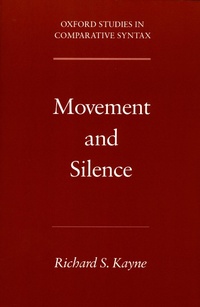
Movement and Silence
1st Edition
Published on 14. July 2005
393 pages
978-0-19-803983-9 (ISBN)
Description

This volume collects important recent articles by Richard Kayne, one of the top formal linguists in the world. Although the articles range widely in topic and theme, they hang together in that they illustrate the power of the comparative approach, and that they reinforce Kayne's view that syntax is generally more complex than it first appears. As with other volumes in this series, the audience for the volume will be formal linguists and syntacticians around the world.
More details
Other editions
Additional editions
Richard S. Kayne
Movement and Silence
Book
08/2005
Oxford University Press Inc
€36.70
Shipment within 15-20 days
Richard S. Kayne
Movement and Silence
Book
07/2005
Oxford University Press Inc
€110.50
Shipment within 15-20 days
Content
- Intro
- Contents
- 1. New Thoughts on Stylistic Inversion (in collaboration with Jean-Yves Pollock)
- 1.1. Proposal
- 1.2. The position of the postverbal subject
- 1.3. The position of the postverbal subject bis
- 1.4. The position of the postverbal subject ter
- 1.5. Leftward raising of the SI subject out of IP
- 1.6. Non-Wh-SI with indicatives
- 1.7. An ECM effect
- 1.8. Subjunctive SI
- 1.9. Subjunctives versus indicatives
- 1.10. Quirky subjects
- 1.11. Expletives
- 1.12. SI "triggers"
- 1.13. SI and post-subject complements
- 1.14. SI with more than one verb
- 1.15. SI and direct objects
- 1.16. Strong focalization SI
- 1.17. Successive cyclicity
- 1.18. Conclusion
- 2. On the Left Edge in UG: A Reply to McCloskey
- 2.1. Uniform movement
- 2.2. Irish
- 2.3. Too and Heavy-NP Shift
- 2.4. Leftward movement past if
- 2.5. Conclusion
- 3. Review of Paola Benincà, La variazione sintattica
- 3.1. Dialect syntax
- 3.2. Subject clitics and null subjects
- 3.3. Diachronic syntax
- 4. Here and There
- 4.1. Demonstrative there
- 4.2. Locatives
- 4.2.1. THIS/THAT and PLACE
- 4.2.2. The adposition requirement
- 4.3. Non-locative there
- 4.4. French and Italian
- 4.5. Number
- 5. Prepositions as Probes
- 5.1. Internal Merge and (some) prepositions
- 5.2. Causatives in French
- 5.2.1. "Dativization" of the subject of a transitive infinitive
- 5.2.2. This à looks like a preposition
- 5.2.3. This causative construction is not an instance of control
- 5.2.4. An ECM analysis
- 5.2.5. French and English
- 5.2.6. English double-object sentences
- 5.2.7. à as probe
- 5.2.8. Word order
- 5.2.9. Complementizers
- 5.2.10. Finite complementizers
- 5.2.11. Case
- 5.3. Conclusion
- 5.4. Appendix: Constituent Structure
- 6. Pronouns and Their Antecedents
- 6.1. Binding as movement
- 6.2. Clitic doubling
- 6.3. Antecedent and pronoun
- 6.4. Control
- 6.5. Merge and Move
- 6.6. Condition C
- 6.7. More on Condition C and on apparently antecedent-less pronouns
- 6.8. Strong crossover
- 6.9. Condition B
- 6.10. Why are there reflexives?
- 6.11. English-type reflexives
- 6.12. Zich-type reflexives
- 6.13. Backward pronominalization
- 6.14. Epithets again
- 6.15. Condition C reconstruction effects
- 6.16. Further Condition C reconstruction effects
- 6.17. Sideward movement
- 6.18. Circularity
- 6.19. Transitivity of coreference
- 6.20. Split antecedents and overlapping reference
- 6.21. Conclusion
- 7. On Some Prepositions That Look DP-Internal: English of and French de
- 7.1. Mostly English
- 7.1.1. Subextraction
- 7.1.2. P and K merged above VP
- 7.1.3. Of and Case theory
- 7.1.4. Case is limited to lexical items
- 7.1.5. English few and little
- unpronounced NUMBER and AMOUNT
- 7.1.6. Unpronounced MANY and MUCH
- 7.1.7. More on Case
- 7.1.8. Phi-feature agreement
- 7.1.9. A little and a lot
- 7.2. Mostly French
- 7.2.1. French de as parallel to English of
- 7.2.2. QP movement in French
- 7.2.3. QP movement as remnant movement
- 7.2.4. Past participle agreement
- 7.2.5. The blocking effect of prepositions
- 7.2.6. Combien
- 7.2.7. More on remnant movement of peu
- 7.3. Conclusion
- 8. A Note on the Syntax of Quantity in English
- 8.1. Few and NUMBER
- 8.2. The preposing of few within DP
- 8.3. AP movement within DP
- 8.4. Bare few
- 8.5. A few
- 8.6. Many
- 8.7. GOOD
- 8.8. Numerous
- 8.9. Polarity and modification
- 8.10. Scope in English and French
- 8.11. Many a
- 8.12. Quite a few
- 8.13. Polarity and few and little
- 8.14. Conclusion
- 8.15. Appendix: Principle of Decompositionality
- 9. Antisymmetry and Japanese
- 9.1. Antisymmetry
- 9.2. Japanese
- 9.2.1. The position of objects
- 9.2.2. Relative pronouns
- 9.2.3. Head finality
- 9.3. Additional cross-linguistic "gaps"
- 9.3.1. Serial verbs
- 9.3.2. Aux V versus V Aux
- 9.3.3. Adverbs and ("heavy") objects
- 9.3.4. OVX languages
- 9.3.5. Subordinating conjunctions
- 9.3.6. Negation and auxiliaries
- 9.3.7. DP
- 9.4. Some modifications
- 9.4.1. Word order in adjuncts and in complements
- 9.4.2. Adpositions and complementizers
- 9.4.3. (Remnant) VP-movement
- 9.4.4. Postpositions
- 9.4.5. Prepositional complementizers
- 9.4.6. Nonprepositional complementizers
- 9.4.7. Final complementizers
- 9.5. Conclusion
- 10. Silent Years, Silent Hours
- 10.1. NUMBER and COLOR
- 10.2. Age
- 10.3. French and Italian
- 10.4. Some further remarks on silent nouns and time
- 10.5. Conclusion
- 11. Some Remarks on Agreement and on Heavy-NP Shift
- 11.1. Agreement
- 11.2. Heavy-NP Shift
- 12. Some Notes on Comparative Syntax: With Special Reference to English and French
- 12.1. Generalities
- 12.1.1. Parameters
- 12.1.2. Microcomparative syntax and microparameters
- 12.2. How many parameters? How many languages?
- 12.2.1. How many functional elements?
- 12.2.2. How many parameters per functional element?
- 12.3. Some parameters having to do with nonpronunciation
- 12.3.1. Pronunciation versus nonpronunciation: the case of French -aine and English -AINE
- 12.3.2. Nonpronunciation and licensing: the case of something heavy
- 12.3.3. Determiners and unpronounced EVER
- 12.3.4. "Extraposition" differences
- 12.3.5. Quantity word differences and nonpronunciation
- 12.3.6. A licensing parameter possibly reinterpreted as a movement parameter
- 12.3.7. Missing Wh-words
- 12.4. Related parameters
- 12.4.1. The indefinite article
- 12.4.2. The categorial status of few and little versus peu
- 12.4.3. In what sense can a difference in category be a parameter?
- 12.5. Comparative syntax and Greenbergian typology
- 12.5.1. Syntactic data
- 12.5.2. Missing languages
- 12.5.3. English and Haitian
- 12.5.4. Adpositions
- 12.5.5. Movement as a side effect of doubling
- 12.5.6. Feature-driven movement or "closeness-driven" movement?
- 12.6. Conclusion
- Bibliography
- Index
- A
- B
- C
- D
- E
- F
- G
- H
- I
- J
- K
- L
- M
- N
- O
- P
- Q
- R
- S
- T
- U
- V
- W
- X
- Y
- Z
