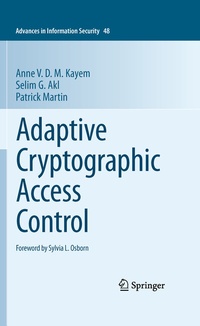
Adaptive Cryptographic Access Control
Description

Cryptographic access control (CAC) is an approach to securing data by encrypting it with a key, so that only the users in possession of the correct key are able to decrypt the data and/or perform further encryptions. Applications of cryptographic access control will benefit companies, governments and the military where structured access to information is essential.
The purpose of this book is to highlight the need for adaptability in cryptographic access control schemes that are geared for dynamic environments, such as the Internet. Adaptive Cryptographic Access Control presents the challenges of designing hierarchical cryptographic key management algorithms to implement Adaptive Access Control in dynamic environments and suggest solutions that will overcome these challenges.
Adaptive Cryptographic Access Control is a cutting-edge book focusing specifically on this topic in relation to security and cryptographic access control. Both the theoretical and practical aspects and approaches of cryptographic access control are introduced in this book. Case studies and examples are provided throughout this book.
Reviews / Votes
From the reviews:
"This monograph gives an overview of cryptographic access control with an emphasis on key management. The authors compare different techniques described in the literature. . The book does not only give a valuable overview of the current methods. The authors also give detailed practical analysis of the key management functions such as key assignment and replacement as well as re-keying in the different approaches." (Ulrich Tipp, Zentralblatt MATH, Vol. 1202, 2011)
"Data encryption--the main technique used to control access to data--is the subject of this book. . the intended audience comprises students, researchers, and teachers. . The authors proceed by presenting an algorithm and an experimental measurement of its performance. . The book has an extensive bibliography--151 entries--and a minimal index." (J. W. Snively, ACM Computing Reviews, February, 2012)
More details
Other editions
Additional editions