

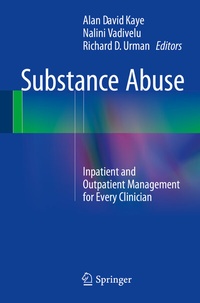
Substance Abuse
Description

This book is written for any clinician who encounters substance abuse in a patient and wonders what to do. Experts from a cross-section of specialties and health professions provide up-to-date, evidence-based guidance on how non-expert clinicians can recognize, understand, and approach the management of substance abuse in their patients. They detail the range of treatments available and whether and how they work. The central importance of using a carefully selected multimodal approach that is tailored to the individual patient is emphasized throughout and illustrated in case scenarios from actual clinical practice.
Reviews / Votes
"This is a comprehensive review of the management of patients with substance abuse problems geared for the nonexpert. It is a guide for everyday clinicians who are most likely to encounter these patients. . The audience is all healthcare providers who encounter individuals in their practice with substance abuse problems. It also can be an excellent resource for residents, medical students, nurses, and other healthcare providers." (Michael Easton, Doody's Book Reviews, May, 2015)
More details
Other editions
Additional editions
Persons
Alan David Kaye, MD, PhD, is Professor and Chair of the Department of Anesthesiology at LSU Health Sciences Center in New Orleans, LA, USA and Editor-in-Chief of the journal, Pain Physician .
Nalini Vadivelu, MBBS, MD, DNB is Associate Professor of Anesthesiology at Yale University School of Medicine, New Haven, CT, USA.
Richard D. Urman, MD, MBA is Assistant Professor of Anesthesiology, Perioperative and Pain Medicine at Harvard Medical School and staff anesthesiologist and director of procedural sedation management at the Brigham and Women's Hospital in Boston, MA, USA.
Content
Demographics.- Legal Issues.- The multidisciplinary approach to substance abuse management.- Why a multidisciplinary approach?.- The role of the physician.- The role of the psychologist.- The role of the nurse.- The role of the physical therapist and the occupational therapist.- The role of the pharmacist.- Screening and assessment for substance abuse.- Inpatient screening and assessment.- Outpatient screening and assessment.- Substances of Abuse.- Food.- Alcohol (genetics, prevention, complications, and treatment).- Tobacco.- Induction agents (propofol, nitrous oxide, and inhaled agents).- Prescription drugs.- Cocaine.- Amphetamines.- Herbs.- Opioids.- Treatment Modalities.- Pharmacotherapy in substance abuse and addiction.- Methadone.- Buprenorphine.- Opioid sparing drugs(ketamine, clonidine, gabapentin, and novel analgesics).- Non-pharmacological approaches (relaxation techniques, acupuncture, nerve stimulation, hypnosis, etc.).- Special Clinical Scenarios.- Post-operative pain management (including regional anesthesia).- Management of chronic pain.- Management of acute pain.- Unique Issues in Selected Populations.- Children and adolescents.- Older adults.- Healthcare professionals.
