

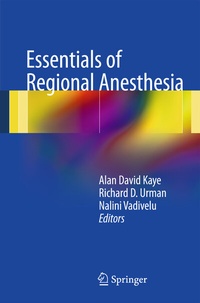
Essentials of Regional Anesthesia
Description

This is a compact, single-source guide to regional anesthesia. Chapters are authored by regional anesthesia fellowship directors and fellows to insure maximum practicality and up-to-date coverage.
Essentials of Regional Anesthesia covers all anatomical regions as well as the unique considerations in patients with chronic pain, obstetric patients, pediatric patients, and patients treated in the outpatient setting. A common chapter format makes it easy to find information quickly, and extensive illustrations enhance the text.
Stay current with Essentials of Regional Anesthesia, and stay ahead with these helpful features:
Ultrasound incorporated into each block
Extremely practical focus
More than 400 Q & As to test knowledge
Authored by regional anesthesia fellowship directors and fellows
Clinical pearls and guidance on complications
Concise, clinically oriented review of relevant basic science
Common chapter format for ease of use
Well illustrated with 350 figures, nearly 200 in color
Reviews / Votes
From the reviews:
"There are many books available on regional anesthesia, and the trend is either to focus on illustrations, forgoing any discussion, or on text descriptions, making them bulky and hard to read. This book maintains that perfect balance between text and illustrations. It is truly a master companion book on regional anesthesia." (Tariq M. Malik, Doody's Book Reviews, April, 2012)
More details
Other editions
Additional editions
Persons
Alan David Kaye, MD, PhD
Professor and Chairman
Department of Anesthesiology
Tulane University School of Medicine
Director of Pain Services
University Hospital and Ochsner Kenner Hospital
New Orleans, LA 70112 USA
Richard D. Urman, MD, MBA
Assistant Professor of Anesthesia, Harvard Medical School
Director, Hospital Procedural Sedation Management and Safety
Co-Director, Center for Perioperative Management and Medical Informatics
Brigham and Women's Hospital
Boston, MA 02115 USA
Nalini Vadivelu, MD
Associate Professor of Anesthesiology
Yale University School of Medicine
New Haven, CT 06510 USA
Content
Section I. General Principles of Regional Anesthesia Practice.- 1. General Considerations for Regional Anesthesia Practice.- 2. Monitoring for Regional Anesthesia.- 3. Regional Anesthesia in the Community Practice Setting.- Section II. Basic Science and Clinical Practice.- 4. The Anatomy of Pain.- 5. Practical Pharmacology in Regional Anesthesia .- 6. Anticoagulation and Regional Anesthesia Considerations.- Section III. Equipment for Regional Anesthesia.- 7. Equipment and Clinical Practice: Aids to Localization of Peripheral Nerves.- 8. Principles of Sonography.- 9. Ultrasound-Guided Peripheral Nerve Blockade.- 10. Sonopathology.- Section IV. Techniques for Regional Anesthesia.- 11. Neuraxial Blockade: Subarachnoid Anesthesia.- 12. Neuraxial Blockade: Epidural Anesthesia.- 13. Upper Extremity Nerve Blocks.- 14. Peripheral Nerve Blocks for the Lower Extremity.- 15. Regional Anesthesia Techniques for Foot Surgery.- 16. Regional Anesthesia of Thorax and Abdomen.- 17. Head and Neck: Scalp, Ophthalmic, and Cervical Blocks.- 18. Local Anesthesia of the Masticatory Region.- 19. Topical and Regional Anesthesia of the Airway.- 20. Selective Regional Anesthesia Options in Surgical Subspecialties.- 21. Regional Anesthesia for Chronic Disease States.- 22. Intravenous Regional Anesthesia.- 23. Regional Anesthesia and Trauma.- 24. Postoperative Pain Management.- 25. Sympathetic Blockade.- Section V. Special Populations.- 26. Regional Anesthesia for Chronic Pain.- 27. Regional Anesthetic Techniques for the Pediatric Patient.- 28. Obstetric Anesthesiology.- 29. Regional Anesthesia for Outpatient Surgery.- Section VI. Additional Topics.- 30. Outcome Studies and Infection Control in Regional Anesthesia.- 31. Regional Anesthesiology Education.
