

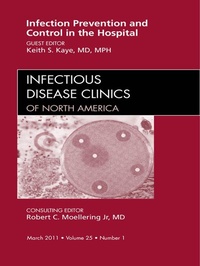
Infection Prevention and Control in the Hospital, An Issue of Infectious Disease Clinics
Published on 28. March 2011
312 pages
978-1-4557-0934-2 (ISBN)
Description

Over the past several decades, "infection control¿ has become a rapidly growing multidisciplinary field of incredible importance with regard to the safety of patients and healthcare workers, regulation and accreditation of healthcare facilities, and finances. The focus of this field has increasingly turned to prevention rather than control of hospital-acquired infections. This issue will bring the infectious disease specialist up to date on important topics such as hand hygiene, sterilization, methicillin-resistant Staphylococcus aureus, antibiotic stewardship, and specific infections of particular concern.
More details
Other editions
Additional editions
Keith S. Kaye
Infection Prevention and Control in the Hospital, An Issue of Infectious Disease Clinics: Volume 25-1
Volume 25-1
Book
03/2011
Saunders
€100.50
Shipment within 10-15 days
Content
- Front Cover
- Infection Prevention and Control in the Hospital
- Copyright Page
- Contributors
- Contents
- Preface
- Chapter 1. Building a Successful Infection Prevention Program: Key Components, Processes, and Economics
- THE EMERGENCE AND DEVELOPMENT OF REGULATION AND REQUIREMENTS OF INFECTION PREVENTION AND CONTROL
- INFECTION PREVENTION AND CONTROL PROGRAM
- KEY MEMBERS OF THE INFECTION PREVENTION TEAM AND/OR PROGRAM
- ECONOMICS AND BUSINESS PLAN
- REFERENCES
- Chapter 2. Hand Hygiene
- HUMAN SKIN AND SKIN FLORA
- EVOLUTION OF GUIDELINES
- ALCOHOL-BASED HAND RUBS
- STUDIES OF HAND HYGIENE EFFICACY
- SUMMARY
- REFERENCES
- Chapter 3. Sterilization, High-Level Disinfection, and Environmental Cleaning
- A RATIONAL APPROACH TO DISINFECTION AND STERILIZATION
- NEW TECHNOLOGIES FOR STERILIZATION AND HIGH-LEVEL DISINFECTION
- REPROCESSING SEMICRITICAL ITEMS
- ENVIRONMENTAL CLEANING
- SUMMARY
- REFERENCES
- Chapter 4. Central Line-Associated Bloodstream Infections: Prevention and Management
- DEFINITIONS
- PREVALENCE, INCIDENCE, AND IMPACT OF CLA-BSIS
- PATHOGENS
- PATHOGENESIS
- RISK FACTORS FOR CLA-BSI
- PREVENTION
- DIAGNOSIS
- CLA-BSI
- SURVEILLANCE OF CLA-BSI
- MANAGEMENT OF CLA-BSI
- SUMMARY
- REFERENCES
- Chapter 5. Urinary Tract Infections
- PATHOGENESIS
- EPIDEMIOLOGY
- DIAGNOSIS AND SURVEILLANCE
- PREVENTING CAUTIS
- REFERENCES
- Chapter 6. Prevention of Health Care-Acquired Pneumonia and Transmission of Mycobacterium tuberculosis in Health Care Settings
- HAP
- TB
- SUMMARY
- REFERENCES
- Chapter 7. Surgical Site Infections
- EPIDEMIOLOGY AND OUTCOMES
- DIAGNOSIS
- PATHOGENESIS OF INFECTION
- RISK FACTORS
- PREVENTION
- TREATMENT
- SUMMARY
- REFERENCES
- Chapter 8. Control of Methicillin-resistant Staphylococcus aureus
- EPIDEMIOLOGY
- CURRENT MRSA INFECTION CONTROL PRACTICES
- OUTCOMES OF MRSA INFECTION CONTROL PRACTICES
- APPROACHES TO AND CONTROVERSIES IN MRSA CONTROL
- SUMMARY
- REFERENCES
- Chapter 9. Common Approaches to the Control of Multidrug-resistant Organisms Other Than Methicillin-resistant Staphylococcus aureus (MRSA)
- RATIONALE FOR COMMONLY USED MDRO CONTROL STRATEGIES
- EVIDENCE OF EFFECTIVENESS FOR SPECIFIC MDRO CONTROL STRATEGIES
- CHALLENGES AND OPPORTUNITIES
- SUMMARY
- REFERENCES
- Chapter 10. Nosocomial Fungal Infections: Epidemiology, Infection Control, and Prevention
- IMPACT OF NOSOCOMIAL FUNGAL INFECTIONS
- COMMON NOSOCOMIAL INFECTIONS CAUSED BY YEASTS
- NOSOCOMIAL INFECTIONS CAUSED BY MOLDS
- STRATEGIES FOR PREVENTION OF NOSOCOMIAL CANDIDIASIS
- STRATEGIES FOR PREVENTION OF NOSOCOMIAL ASPERGILLOSIS AND MOLD INFECTIONS
- STRATEGIES FOR PREVENTION OF FUNGAL INFECTION IN HSCT RECIPIENTS
- SUMMARY
- REFERENCES
- Chapter 11. Health Care-Acquired Viral Respiratory Diseases
- RSV
- SEASONAL INFLUENZA
- PANDEMIC INFLUENZA
- OTHER VIRUSES
- SUMMARY
- REFERENCES
- Chapter 12. Antimicrobial Stewardship
- ANTIMICROBIAL STEWARDSHIP
- WHAT IS ANTIMICROBIAL STEWARDSHIP?
- THE GOALS OF ANTIMICROBIAL STEWARDSHIP
- ESSENTIAL PARTICIPANTS IN AN ANTIMICROBIAL STEWARDSHIP PROGRAM
- ANTIMICROBIAL STEWARDSHIP STRATEGIES
- BARRIERS TO IMPLEMENTATION AND MAINTENANCE OF STEWARDSHIP PROGRAMS
- MAKING A BUSINESS CASE FOR ANTIMICROBIAL STEWARDSHIP
- MEASURING THE EFFECT OF THE PROGRAM
- SUMMARY
- REFERENCES
- Chapter 13. Informatics and Epidemiology in Infection Control
- MEDICAL INFORMATICS FOR HEALTH CARE EPIDEMIOLOGY
- BASIC EPIDEMIOLOGY FOR INFECTION CONTROL
- SUMMARY
- REFERENCES
- Chapter 14. Infection Prevention in Alternative Health Care Settings
- INFECTION PREVENTION PROGRAMS IN SNFs
- INFECTION PREVENTION PROGRAM IN SNFs: FUNCTIONS, COMPONENTS, AND OVERSIGHT
- AMBULATORY CARE CENTERS
- SUMMARY
- REFERENCES
- Index
