

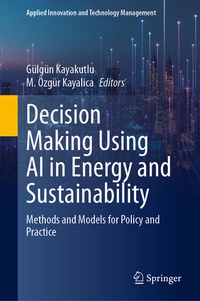
Decision Making Using AI in Energy and Sustainability
Description

Artificial intelligence (AI) has a huge impact on science and technology, including energy, where access to resources has been a source of geopolitical conflicts. AI can predict the demand and supply of renewable energy, optimize efficiency in energy systems, and improve the management of natural energy resources, among other things. This book explores the use of AI tools for improving the management of energy systems and providing sustainability with smart cities, smart facilities, smart buildings, smart transportation, and smart houses. Featuring research from International Federation for Information Processing's (IFIP) "AI in Energy and Sustainability" working group, this book provides new models and algorithms for AI applications in energy and sustainability fields. Any short-term, mid-term and long-term forecasting, optimization models, trend foresights and prescriptions based on scenarios are studied in the energy world and the smart systems for sustainability. The contents of this book are valuable for energy researchers, academics, scholars, practitioners and policy makers.
More details
Other editions
Additional editions
Persons
Gulgun Kayakutlu is Professor in the Department of Energy Planning and Management at the Energy Institute of Istanbul Technical University (Turkey). Before joining the University, she was the founder and General Manager of Sybase Turkey, where she managed several real-time transaction projects in the private sector and many B2B projects in the government sector. She wrote the book Intelligence in Energy (Elsevier, 2017) and co-edited Energy Management-Collective and Computational Intelligence with Theory and Applications (Springer, 2018). Dr. Kayakutlu has published more than fifty articles in SCI and SSCI reviewed journals on energy optimization and intelligence.
M. Özgür Kayalica is a Senior Lecturer in the Energy Institute and Director of the Technological and Economic Development Research Center (TEGAM) at Istanbul Technical University (Turkey). Dr. Kayalica's research focuses on the microeconomics of environmental economics, energy economics andtrade theory. Dr. Kayalica published books and numerous articles in SCI and SSCI indexed journals.
