

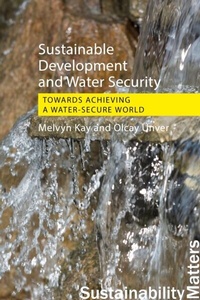
Sustainable Development and Water Security
Description

Water is an integral part of our daily lives, yet most of us have little idea about how much water we use to maintain our lifestyles and the extent to which our lifestyles pollute and degrade water resources. The increasing occurrence of floods, droughts and water pollution incidents are reminders of our vulnerability in relation to water. Estimates suggest that global water demand could outstrip supply by as much as 40 per cent by 2030 if we continue with the current "business as usual" approach to water management.
Melvyn Kay and Olcay Unver use Sustainable Development Goal (SDG) 6 as a framework to explore the concept of sustainable water resources management and how to improve water security. They provide a synthesis of water resources planning and management issues across all water-using sectors to dispel misunderstandings and myths and enable informed approaches to decision-making. In so doing, they offer an in-depth critical review of SDG6, including what it does and does not do. Case studies from around the world are used throughout the book to illustrate the key issues of water (in)security.
All prices
More details
Other editions
Additional editions
Persons
Melvyn Kay has over 40 years' international experience in water resources, particularly agricultural water management and irrigation. His early career with consulting engineers in the Middle East and Africa was followed by 25 years with Cranfield University (Silsoe College). He edited UN-Water's Sustainable Development Goal 6: Synthesis Report 2018 on Water and Sanitation and was chief editor of UN FAO's flagship report The State of the World's Land and Water Resources for Food and Agriculture 2021. He also authored Practical Hydraulics and Water Resources Engineering (3rd edition).
Olcay Ünver is Professor of Practice on the Environmental and Resource Management Program at Arizona State University and a member of Water Policy Group and Industry Fellow at Australian Rivers Institute. In his public service career spanning three decades, he led FAO's water programs and activities, UN-Water's World Water Assessment Programme, and UNESCO's Program Office on Global Water Assessment and served as Vice-Chair of UN-Water.
Content
1. Water, water...
1.1 Water security: balancing supply and demand
1.2 Different people, different views and priorities
1.3 Does water have value?
1.4 About Covid
1.5 This book...
2. Understanding water better and working together
2.1 The hydrologist's story
2.2 The water resource planner's story
2.3 The river engineer's story
2.4 The freshwater ecologist's story
2.5 The water engineer's story
2.6 The irrigation engineer's story
2.7 The farmer's story
2.8 The energy engineer's story
2.9 Working together
2.10 Need for a common language
3. An anatomy of SDG 6
3.1 Data are vital
3.2 The value of indicators
3.3 Water, sanitation and health targets
3.4 Target 6.3: Water quality and wastewater
3.5 Target 6.4: WUE and scarcity
3.6 Target 6.5: Integrated water resources management
3.7 Target 6.6: Freshwater ecosystems
3.8 Targets 6.a and 6.b: Means of implementation
4. Responding to the challenges
4.1 Governance
4.2 Integrated water resources management
4.3 Eliminating inequalities
4.4 Embracing innovative technologies and management
4.5 Increasing spending
4.6 Increasing capacity
4.7 More data needed
4.8 Science into policy and practice
5. Thinking beyond SDG 6: links with other SDGs
5.1 Water and society
5.2 Water and the economy
5.3 Water and the environment
6. Our final word
