

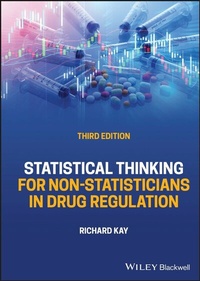
Statistical Thinking for Non-Statisticians in Drug Regulation
Description

Statistical methods in the pharmaceutical industry are accepted as a key element in the design and analysis of clinical studies. Increasingly, the medical and scientific community are aligning with the regulatory authorities and recognizing that correct statistical methodology is essential as the basis for valid conclusions. In order for those correct and robust methods to be successfully employed there needs to be effective communication across disciplines at all stages of the planning, conducting, analyzing and reporting of clinical studies associated with the development and evaluation of new drugs and devices.
Statistical Thinking for Non-Statisticians in Drug Regulation provides a comprehensive in-depth guide to statistical methodology for pharmaceutical industry professionals, including physicians, investigators, medical science liaisons, clinical research scientists, medical writers, regulatory personnel, statistical programmers, senior data managers and those working in pharmacovigilance. The author's years of experience and up-to-date familiarity with pharmaceutical regulations and statistical practice within the wider clinical community make this an essential guide for the those working in and with the industry.
The third edition of Statistical Thinking for Non-Statisticians in Drug Regulation includes:
* A detailed new chapter on Estimands in line with the 2019 Addendum to ICH E9
* Major new sections on topics including Combining Hierarchical Testing and Alpha Adjustment, Biosimilars, Restricted Mean Survival Time, Composite Endpoints and Cumulative Incidence Functions, Adjusting for Cross-Over in Oncology, Inverse Propensity Score Weighting, and Network Meta-Analysis
* Updated coverage of many existing topics to reflect new and revised guidance from regulatory authorities and author experience
Statistical Thinking for Non-Statisticians in Drug Regulation is a valuable guide for pharmaceutical and medical device industry professionals, as well as statisticians joining the pharmaceutical industry and students and teachers of drug development.
More details
Other editions
Additional editions
Person
Richard Kay, PhD is a Visiting Professor at the School of Pharmacy and Pharmaceutical Medicine, Cardiff University, UK, and a longtime statistical consultant for the pharmaceutical industry. He provides consultancy and training services for pharmaceutical companies and research institutions.
Content
Preface to the second edition, xv
Preface to the first edition, xvii
Abbreviations, xxi
1 Basic ideas in clinical trial design, 1
1.1 Historical perspective, 1
1.2 Control groups, 2
1.3 Placebos and blinding, 3
1.4 Randomisation, 3
1.4.1 Unrestricted randomisation, 4
1.4.2 Block randomisation, 4
1.4.3 Unequal randomisation, 5
1.4.4 Stratified randomisation, 6
1.4.5 Central randomisation, 7
1.4.6 Dynamic allocation and minimisation, 8
1.4.7 Cluster randomisation, 9
1.5 Bias and precision, 9
1.6 Between- and within-patient designs, 11
1.7 Crossover trials, 12
1.8 Signal, noise and evidence, 13
1.8.1 Signal, 13
1.8.2 Noise, 13
1.8.3 Signal-to-noise ratio, 14
1.9 Confirmatory and exploratory trials, 15
1.10 Superiority, equivalence and non-inferiority trials, 16
1.11 Data and endpoint types, 17
1.12 Choice of endpoint, 18
1.12.1 Primary variables, 18
1.12.2 Secondary variables, 19
1.12.3 Surrogate variables, 20
1.12.4 Global assessment variables, 21
1.12.5 Composite variables, 21
1.12.6 Categorisation, 21
2 Sampling and inferential statistics, 23
2.1 Sample and population, 23
2.2 Sample statistics and population parameters, 24
2.2.1 Sample and population distribution, 24
2.2.2 Median and mean, 25
2.2.3 Standard deviation, 25
2.2.4 Notation, 26
2.2.5 Box plots, 27
2.3 The normal distribution, 28
2.4 Sampling and the standard error of the mean, 31
2.5 Standard errors more generally, 34
2.5.1 The standard error for the difference between two means, 34
2.5.2 Standard errors for proportions, 37
2.5.3 The general setting, 37
3 Confidence intervals and p-values, 38
3.1 Confidence intervals for a single mean, 38
3.1.1 The 95 per cent Confidence interval, 38
3.1.2 Changing the confidence coefficient, 40
3.1.3 Changing the multiplying constant, 40
3.1.4 The role of the standard error, 41
3.2 Confidence interval for other parameters, 42
3.2.1 Difference between two means, 42
3.2.2 Confidence interval for proportions, 43
3.2.3 General case, 44
3.2.4 Bootstrap Confidence interval, 45
3.3 Hypothesis testing, 45
3.3.1 Interpreting the p-value, 46
3.3.2 Calculating the p-value, 47
3.3.3 A common process, 50
3.3.4 The language of statistical significance, 53
3.3.5 One-sided and two-sided tests, 54
4 Tests for simple treatment comparisons, 56
4.1 The unpaired t-test, 56
4.2 The paired t-test, 57
4.3 Interpreting the t-tests, 60
4.4 The chi-square test for binary data, 61
4.4.1 Pearson chi-square, 61
4.4.2 The link to a ratio of the signal to the standard error, 64
4.5 Measures of treatment benefit, 64
4.5.1 Odds ratio, 65
4.5.2 Relative risk, 65
4.5.3 Relative risk reduction, 66
4.5.4 Number needed to treat, 66
4.5.5 Confidence intervals, 67
4.5.6 Interpretation, 68
4.6 Fisher's exact test, 69
4.7 Tests for categorical and ordinal data, 71
4.7.1 Categorical data, 71
4.7.2 Ordered categorical (ordinal) data, 73
4.7.3 Measures of treatment benefit, 74
4.8 Extensions for multiple treatment groups, 75
4.8.1 Between-patient designs and continuous data, 75
4.8.2 Within-patient designs and continuous data, 76
4.8.3 Binary, categorical and ordinal data, 76
4.8.4 Dose-ranging studies, 77
4.8.5 Further discussion, 77
5 Adjusting the analysis, 78
5.1 Objectives for adjusted analysis, 78
5.2 Comparing treatments for continuous data, 78
5.3 Least squares means, 82
5.4 Evaluating the homogeneity of the treatment effect, 83
5.4.1 Treatment-by-factor interactions, 83
5.4.2 Quantitative and qualitative interactions, 85
5.5 Methods for binary, categorical and ordinal data, 86
5.6 Multi-centre trials, 87
5.6.1 Adjusting for centre, 87
5.6.2 Significant treatment-by-centre interactions, 87
5.6.3 Combining centres, 88
6 Regression and analysis of covariance, 89
6.1 Adjusting for baseline factors, 89
6.2 Simple linear regression, 89
6.3 Multiple regression, 91
6.4 Logistic regression, 94
6.5 Analysis of covariance for continuous data, 94
6.5.1 Main effect of treatment, 94
6.5.2 Treatment-by-covariate interactions, 96
6.5.3 A single model, 98
6.5.4 Connection with adjusted analyses, 98
6.5.5 Advantages of ANCOVA, 99
6.5.6 Least squares means, 100
6.6 Binary, categorical and ordinal data, 101
6.7 Regulatory aspects of the use of covariates, 103
6.8 Baseline testing, 105
7 Intention-to-treat and analysis sets, 107
7.1 The principle of intention-to-treat, 107
7.2 The practice of intention-to-treat, 110
7.2.1 Full analysis set, 110
7.2.2 Per-protocol set, 112
7.2.3 Sensitivity, 112
7.3 Missing data, 113
7.3.1 Introduction, 113
7.3.2 Complete cases analysis, 114
7.3.3 Last observation carried forward, 114
7.3.4 Success/failure classification, 114
7.3.5 Worst-case/best-case classification, 115
7.3.6 Sensitivity, 115
7.3.7 Avoidance of missing data, 116
7.3.8 Multiple imputation, 117
7.4 Intention-to-treat and time-to-event data, 118
7.5 General questions and considerations, 120
8 Power and sample size, 123
8.1 Type I and type II errors, 123
8.2 Power, 124
8.3 Calculating sample size, 127
8.4 Impact of changing the parameters, 130
8.4.1 Standard deviation, 130
8.4.2 Event rate in the control group, 130
8.4.3 Clinically relevant difference, 131
8.5 Regulatory aspects, 132
>80 per cent, 132
8.5.2 Powering on the per-protocol set, 132
8.5.3 Sample size adjustment, 133
8.6 Reporting the sample size calculation, 134
9 Statistical significance and clinical importance, 136
9.1 Link between p-values and Confidence intervals, 136
9.2 Confidence intervals for clinical importance, 137
9.3 Misinterpretation of the p-value, 139
9.3.1 Conclusions of similarity, 139
9.3.2 The problem with 0.05, 140
9.4 Single pivotal trial and 0.05, 140
10 Multiple testing, 142
10.1 Inflation of the type I error, 142
10.1.1 False positives, 142
10.1.2 A simulated trial, 142
10.2 How does multiplicity arise?, 143
10.3 Regulatory view, 144
10.4 Multiple primary endpoints, 145
10.4.1 Avoiding adjustment, 145
10.4.2 Significance needed on all endpoints, 145
10.4.3 Composite endpoints, 146
10.4.4 Variables ranked according to clinical importance: Hierarchical testing, 146
10.5 Methods for adjustment, 149
10.5.1 Bonferroni correction, 149
10.5.2 Hochberg correction, 150
10.5.3 Interim analyses, 151
10.6 Multiple comparisons, 152
10.7 Repeated evaluation over time, 153
10.8 Subgroup testing, 154
10.9 Other areas for multiplicity, 156
10.9.1 Using different statistical tests, 156
10.9.2 Different analysis sets, 156
10.9.3 Pre-planning, 157
11 Non-parametric and related methods, 158
11.1 Assumptions underlying the t-tests and their extensions, 158
11.2 Homogeneity of variance, 158
11.3 The assumption of normality, 159
11.4 Non-normality and transformations, 161
11.5 Non-parametric tests, 164
11.5.1 The Mann-Whitney U-test, 164
11.5.2 The Wilcoxon signed rank test, 166
11.5.3 General comments, 167
11.6 Advantages and disadvantages of non-parametric methods, 168
11.7 Outliers, 169
12 Equivalence and non-inferiority, 170
12.1 Demonstrating similarity, 170
12.2 Confidence intervals for equivalence, 172
12.3 Confidence intervals for non-inferiority, 173
12.4 A p-value approach, 174
12.5 Assay sensitivity, 176
12.6 Analysis sets, 178
12.7 The choice of ¿, 179
12.7.1 Bioequivalence, 179
12.7.2 Therapeutic equivalence, 180
12.7.3 Non-inferiority, 180
12.7.4 The 10 per cent rule for cure rates, 182
12.7.5 The synthesis method, 183
12.8 Biocreep and constancy, 184
12.9 Sample size calculations, 184
12.10 Switching between non-inferiority and superiority, 186
13 The analysis of survival data, 189
13.1 Time-to-event data and censoring, 189
13.2 Kaplan-Meier curves, 190
13.2.1 Plotting Kaplan-Meier curves, 190
13.2.2 Event rates and relative risk, 192
13.2.3 Median event times, 192
13.3 Treatment comparisons, 193
13.4 The hazard ratio, 196
13.4.1 The hazard rate, 196
13.4.2 Constant hazard ratio, 197
13.4.3 Non-constant hazard ratio, 197
13.4.4 Link to survival curves, 198
13.4.5 Calculating Kaplan-Meier curves, 199
13.5 Adjusted analyses, 199
13.5.1 Stratified methods, 200
13.5.2 Proportional hazards regression, 200
13.5.3 Accelerated failure time model, 201
13.6 Independent censoring, 202
13.7 Sample size calculations, 203
14 Interim analysis and data monitoring committees, 205
14.1 Stopping rules for interim analysis, 205
14.2 Stopping for efficacy and futility, 206
14.2.1 Efficacy, 206
14.2.2 Futility and conditional power, 207
14.2.3 Some practical issues, 208
14.2.4 Analyses following completion of recruitment, 209
14.3 Monitoring safety, 210
14.4 Data monitoring committees, 211
14.4.1 Introduction and responsibilities, 211
14.4.2 Structure and process, 212
14.4.3 Meetings and recommendations, 214
15 Bayesian statistics, 215
15.1 Introduction, 215
15.2 Prior and posterior distributions, 215
15.2.1 Prior beliefs, 215
15.2.2 Prior to posterior, 217
15.2.3 Bayes theorem, 217
15.3 Bayesian inference, 219
15.3.1 Frequentist methods, 219
15.3.2 Posterior probabilities, 219
15.3.3 Credible intervals, 220
15.4 Case study, 221
15.5 History and regulatory acceptance, 222
15.6 Discussion, 224
16 Adaptive designs, 225
16.1 What are adaptive designs?, 225
16.1.1 Advantages and drawbacks, 225
16.1.2 Restricted adaptations, 226
16.1.3 Flexible adaptations, 227
16.2 Minimising bias, 228
16.2.1 Control of type I error, 228
16.2.2 Estimation, 229
16.2.3 Behavioural issues, 230
16.2.4 Exploratory trials, 232
16.3 Unblinded sample size re-estimation, 232
16.3.1 Product of p-values, 232
16.3.2 Weighting the two parts of the trial, 233
16.3.3 Rationale, 234
16.4 Seamless phase II/III studies, 234
16.4.1 Standard framework, 234
16.4.2 Aspects of the p-value calculation, 235
16.4.3 Logistical challenges, 236
16.5 Other types of adaptation, 236
16.5.1 Changing the primary endpoint, 236
16.5.2 Focusing on a sub-population, 237
16.5.3 Dropping the placebo arm in a non-inferiority trial, 237
16.6 Further regulatory considerations, 238
16.6.1 Impact on power, 238
16.6.2 Non-standard experimental settings, 239
17 Observational studies, 241
17.1 Introduction, 241
17.1.1 Non-randomised comparisons, 241
17.1.2 Study types, 241
17.1.3 Sources of bias, 243
17.1.4 An empirical investigation, 244
17.1.5 Selection bias in concurrently controlled studies: An empirical evaluation, 245
17.1.6 Selection bias in historically controlled studies: An empirical evaluation, 246
17.1.7 Some conclusions, 246
17.2 Guidance on design, conduct and analysis, 247
17.2.1 Regulatory guidance, 247
17.2.2 Strengthening the Reporting of Observational Studies in Epidemiology, 248
17.3 Evaluating and adjusting for selection bias, 249
17.3.1 Baseline balance, 249
17.3.2 Adjusting for imbalances using stratification and analysis of covariance, 250
17.3.3 Propensity scores, 250
17.3.4 Different methods for adjustment: An empirical evaluation, 253
17.3.5 Some conclusions, 256
17.4 Case-control studies, 257
17.4.1 Background, 257
17.4.2 Odds ratio and Relative risk, 259
18 Meta-analysis, 261
18.1 Definition, 261
18.2 Objectives, 263
18.3 Statistical methodology, 264
18.3.1 Methods for combination, 264
18.3.2 Confidence intervals, 265
18.3.3 Fixed and random effects, 265
18.3.4 Graphical methods, 266
18.3.5 Detecting heterogeneity, 266
18.3.6 Robustness, 269
18.3.7 Rare events, 269
18.3.8 Individual patient data, 269
18.4 Case study, 270
18.5 Ensuring scientific validity, 271
18.5.1 Planning, 271
18.5.2 Assessing the risk of bias, 273
18.5.3 Publication bias and funnel plots, 273
18.5.4 Preferred Reporting Items for Systematic Reviews and Meta-Analyses, 275
18.6 Further regulatory aspects, 275
19 Methods for the safety analysis and safety monitoring, 277
19.1 Introduction, 277
19.1.1 Methods for safety data, 277
19.1.2 The rule of three, 278
19.2 Routine evaluation in clinical studies, 279
19.2.1 Types of data, 280
19.2.2 Adverse events, 281
19.2.3 Laboratory data, 284
19.2.4 ECG data, 287
19.2.5 Vital signs, 288
19.2.6 Safety summary across trials, 288
19.2.7 Specific safety studies, 289
19.3 Data monitoring committees, 289
19.4 Assessing benefit-risk, 290
19.4.1 Current approaches, 290
19.4.2 Multi-criteria decision analysis, 291
19.4.3 Quality-Adjusted Time without Symptoms or Toxicity, 297
19.5 Pharmacovigilance, 299
19.5.1 Post-approval safety monitoring, 299
19.5.2 Proportional reporting ratios, 300
19.5.3 Bayesian shrinkage, 302
20 Diagnosis, 304
20.1 Introduction, 304
20.2 Measures of diagnostic performance, 304
20.2.1 Sensitivity and specificity, 304
20.2.2 Positive and negative predictive value, 305
20.2.3 False positive and false negative rates, 306
20.2.4 Prevalence, 306
20.2.5 Likelihood ratio, 307
20.2.6 Predictive accuracy, 307
20.2.7 Choosing the correct cut-point, 307
20.3 Receiver operating characteristic curves, 308
20.3.1 Receiver operating characteristic, 308
20.3.2 Comparing ROC curves, 309
20.4 Diagnostic performance using regression models, 310
20.5 Aspects of trial design for diagnostic agents, 312
20.6 Assessing agreement, 313
20.6.1 The kappa statistic, 313
20.6.2 Other applications for kappa, 314
21 The role of statistics and statisticians, 316
21.1 The importance of statistical thinking at the design stage, 316
21.2 Regulatory guidelines, 317
21.3 The statistics process, 321
21.3.1 The statistical methods section of the protocol, 321
21.3.2 The statistical analysis plan, 322
21.3.3 The data validation plan, 322
21.3.4 The blind review, 322
21.3.5 Statistical analysis, 323
21.3.6 Reporting the analysis, 323
21.3.7 Pre-planning, 324
21.3.8 Sensitivity and robustness, 326
21.4 The regulatory submission, 327
21.5 Publications and presentations, 328
References, 331
Index, 339
Preface to the first edition
This book is primarily concerned with clinical trials planned and conducted within the pharmaceutical industry. Much of the methodology presented is in fact applicable on a broader basis and can be used in observational studies and in clinical trials outside of the pharmaceutical sector; nonetheless, the primary context is clinical trials and pharmaceuticals. The development is aimed at non-statisticians and will be suitable for physicians, investigators, clinical research scientists, medical writers, regulatory personnel, statistical programmers, senior data managers and those working in quality assurance. Statisticians moving from other areas of application outside of pharmaceuticals may also find the book useful in that it places the methods that they are familiar with, in context in their new environment. There is substantial coverage of regulatory aspects of drug registration that impact on statistical issues. Those of us working within the pharmaceutical industry recognise the importance of being familiar with the rules and regulations that govern our activities, and statistics is a key aspect of this.
The aim of the book is not to turn non-statisticians into statisticians. I do not want you to go away from this book and 'do' statistics. It is the job of the statistician to provide statistical input to the development plan, to individual protocols, to write the statistical analysis plan, to analyse the data and to work with medical writing in producing the clinical report, and also to support the company in its interactions with regulators on statistical issues.
The aims of the book are really threefold. Firstly, to aid communication between statisticians and non-statisticians; secondly, to help in the critical review of reports and publications; and finally, to enable the more effective use of statistical arguments within the regulatory process. We will take each of these points in turn.
In many situations, the interaction between a statistician and a non-statistician is not a particularly successful one. The statistician uses terms such as power, odds ratio, p-value, full analysis set, hazard ratio, non-inferiority, type II error, geometric mean, last observation carried forward and so on, of which the non-statistician has a vague understanding, but maybe not a good enough understanding to be able to get an awful lot out of such interactions. Of course, it is always the job of a statistician to educate and every opportunity should be taken for imparting knowledge about statistics, but in a specific context, there may not be time for that. Hopefully this book will explain, in ways that are understandable, just what these terms mean and provide some insight into their interpretation and the context in which they are used. There is also a lot of confusion between what on the surface appear to be the same or similar things: significance level and p-value, equivalence and non-inferiority, odds ratio and relative risk, relative risk and hazard ratio (by the way this is a minefield!) and meta-analysis and pooling to name just a few. This book will clarify these important distinctions.
It is unfortunately the case that many publications, including some in leading journals, contain mistakes with regard to statistics. Things have improved over the years with the standardisation of the ways in which publications are put together and reviewed. For example, the CONSORT statement (see Section 16.5 [this is Section 21.5 in the 2nd edition]) has led to a distinct improvement in the quality of reporting. Nonetheless mistakes do slip through, in terms of poor design, incorrect analysis, incomplete reporting and inappropriate interpretation - hopefully not all at once! It is important therefore when reading an article that the non-statistical reader is able to make a judgement regarding the quality of the statistics and to notice any obvious flaws that may undermine the conclusions that have been drawn. Ideally, the non-statistician should involve their statistical colleagues in evaluating their concerns, but keeping a keen eye on statistical arguments within the publication may help to alert the non-statistician to a potential problem. The same applies to presentations at conferences, posters, advertising materials and so on.
Finally, the basis of many concerns raised by regulators, when they are reviewing a proposed development plan or assessing an application for regulatory approval, is statistical. It is important that non-statisticians are able to work with their statistical colleagues in correcting mistakes, changing aspects of the design, responding to questions about the data to hopefully overcome those concerns.
In writing this book, I have made the assumption that the reader is familiar with the general aspects of the drug development process. I have assumed knowledge of the phase I to phase IV framework, of placebos, control groups, and double-dummy together with other fundamental elements of the nuts and bolts of clinical trials. I have assumed however no knowledge of statistics! This may or may not be the correct assumption in individual cases, but it is the common denominator that we must start from, and also it is actually not a bad thing to refresh on the basics. The book starts with some basic issues in trial design in Chapter 1, and I guess most people picking up this book will be familiar with many of the topics covered there. But don't be tempted to skip this chapter; there are still certain issues, raised in this first chapter, that will be new and important for understanding arguments put forward in subsequent chapters. Chapter 2 looks at sampling and inferential statistics. In this chapter, we look at the interplay between the population and the sample, basic thoughts on measuring average and variability and then explore the process of sampling leading to the concept of the standard error as a way of capturing precision/reliability of the sampling process. The construction and interpretation of confidence intervals are covered in Chapter 3 together with testing hypotheses and the (dreaded!) p-value. Common statistical tests for various data types are developed in Chapter 4 which also covers different ways of measuring treatment effect for binary data, such as the odds ratio and relative risk.
Many clinical trials that we conduct are multi-centre and Chapter 5 looks at how we extend our simple statistical comparisons to this more complex structure. These ideas lead naturally to the topics in Chapter 6 which include the concepts of adjusted analyses, and more generally, analysis of covariance which allows adjustment for many baseline factors, not just centre. Chapters 2-6 follow a logical development sequence in which the basic building blocks are initially put in place and then used to deal with more and more complex data structures. Chapter 7 moves a little away from this development path and covers the important topic of 'intention-to-treat' and aspects of conforming with that principle through the definition of different analysis sets and dealing with missing data. In Chapter 8, we cover the very important design topics of power and the sample size calculation which then leads naturally to a discussion about the distinction between statistical significance and clinical importance in Chapter 9.
The regulatory authorities, in my experience, tend to dig their heels in on certain issues and one such issue is multiplicity. This topic, which has many facets, is discussed in detail in Chapter 10. Non-parametric and related methods are covered in Chapter 11. In Chapter 12, we develop the concepts behind the establishment of equivalence and non-inferiority. This is an area where many mistakes are made in applications, and in many cases, these slip through into published articles. It is a source of great concern to many statisticians that there is widespread misunderstanding of how to deal with equivalence and non-inferiority. I hope that this chapter helps to develop a better understanding of the methods and the issues. If you have survived so far, then Chapter 13 covers the analysis of survival data. When an endpoint is time to some event, for example, death, the data are inevitably subject to what we call censoring and it is this aspect of so-called survival data that has led to the development of a completely separate set of statistical methods. Chapter 14 builds on the earlier discussion on multiplicity to cover one particular manifestation of that, the interim analysis. This chapter also looks at the management of these interim looks at the data through data monitoring committees. Meta-analysis and its role in clinical development is covered in Chapter 15, and the book finishes with a general Chapter 16 on the role of statistics and statisticians in terms of the various aspects of design and analysis and statistical thinking more generally.
It should be clear from the last few paragraphs that the book is organised in a logical way; it is a book for learning rather than a reference book for dipping into. The development in later chapters will build on the development in earlier chapters. I strongly recommend, therefore, that you start on page 1 and work through. I have tried to keep the discussion away from formal mathematics. There are formulas in the book but I have only included these where I think this will enhance understanding; there are no formulas for formulas...
