

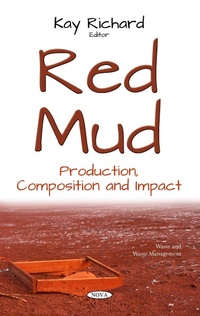
Red Mud: Production, Composition and Impact
Published on 26. November 2018
324 pages
978-1-5361-4384-3 (ISBN)
Description

Red mud is a waste material derived as residual from the Bayer process by the caustic digestion of crushed bauxite at elevated temperature. It is chemically characterized by the presence of Si, Al, Fe, Ca, Ti as well as an array of minor constituents such as Na, K, Cr, Ni, Mn, Cu, Zn and Pb. Red Mud: Production, Composition and Impact begins by giving a brief review of laboratories, in situ and remote sensing techniques applied to characterize the RM waste materials focusing on both standard and novel methods. Next, the authors deal with composite materials based on different kind of polymers and red mud, and attempts to summarize the literature about these kind of materials. A great deal of attention is also paid to the possible applications of these new alternatives to classical materials. The main characteristics of several red muds from own studies and the scientific literature are described, and relevant examples of chemical composition variability of red muds emphasize the variability in chemical and mineralogical composition of red muds. This compilation systematically presents the updated scientific literature data regarding the applications of red mud waste in environmental protection. The authors present aspects related to red mud composition and the types of treatments applied to red mud to enhance its adsorption or catalytic performances. The performance of red mud-adsorbents in the removal of inorganic anions, heavy metals and organic compounds from wastewaters, and gaseous effluents is also discussed. The final chapter reviews the existing technological solutions to valorize the red mud in order to develop other engineering activities. The aim is to provide information on the enormous bauxite and alumina industry in Guinea and to appeal for a global approach to tackle the management of red mud; to assist in economic and technical planning of the issue by scientists, industry-leaders, high level policy makers.
More details
Other editions
Additional editions
Book
11/2018
Nova Science Publishers Inc
€362.47
Shipment within 15-20 days
Content
- Intro
- Contents
- Preface
- Chapter 1
- Red Mud: A Brief Review on Conventional and Unconventional Techniques Used to Characterize This Waste Material
- Abstract
- Introduction
- Red Mud: Generation, Disposal and Use
- Techniques Used for Red Mud Characterization
- Conventional Techniques
- Un-Conventional Techniques: Imaging Spectroscopy and Remote Sensing
- Imaging Spectroscopy and Sentinel 2 Data to Characterize and Map Red Mud and Red Dust
- Conclusion
- References
- Chapter 2
- Red Mud Polymer Composites
- Abstract
- Introduction
- Historical Concepts
- Innovative Composites Based on RM and Different Kinds of Polymers
- Composites Based on RM and Thermoplastic Polymers (Thermoplastics)
- Composites Based on RM and PE
- Composites Based on RM and PP
- Composites Based on RM and ABS
- Composites Based on RM and PET
- Composites Based on RM and PVC
- Composites Based on RM and PS
- Composites Based on RM and Thermosetting Polymers (Thermosets)
- Composites Based on RM and Epoxy Resins
- Composites Based on RM and Polyester Resins
- Other Polymer Composites Containing RM
- Polyvinyl Alcohol Composites
- Poly(ethylene-co-vinyl acetate) Composites
- Polyaniline Composites
- Acrylic Hydrogels Composites
- Other Composites
- Acknowledgments
- References
- Biographical Sketches
- Chapter 3
- Influence of Bauxite Ore on Chemical and Mineralogical Composition Variability of Red Mud
- Abstract
- Conclusion
- Acknowledgments
- References
- Chapter 4
- Environmental Protection Applications of Red Mud
- Abstract
- 1. Introduction
- 2. Physico-Chemical and Mineralogical Properties of Red Mud Residues
- 3. Red Mud as Adsorbent in Wastewaters and Waste Gases Treatment
- 3.1. Removal of Inorganic Anions from Wastewaters
- 3.1.1. Phosphate Removal
- 3.1.2. Fluoride and Bromate Removal
- 3.1.3. Removal of Nitrate and Nitrite
- 3.1.4. Removal of Boron
- 3.1.5. Removal of Cyanides
- 3.2. Removal of Heavy Metals from Waste Waters
- 3.2.1. Adsorption of Bivalent Heavy Metals
- 3.2.2. Adsorption of Metalloid Oxoanions
- 3.2.3. Adsorption of Radioactive Metals (U, Th, Cs)
- 3.3. Removal of Organic Compounds from Waste Waters
- 3.3.1. Removal of Dyes Using RM-Derived Adsorbents
- 3.3.2. Removal of Other Persistent Organic Pollutants Using RM Derived Adsorbents
- 3.4. Removal of Acid Components from Gaseous Effluents
- 4. Red Mud as Catalyst for Pollutants Removal and Eco-Friendly Processes
- 4.1. RM-Derived Catalysts for the Degradation of Chlorinated Organic Compounds
- 4.2. RM as Catalyst in Biomass Processing
- 4.3. Red Mud as Oxidation Catalyst
- 4.4. RM as Catalyst for Eco-Friendly and Sustainable Organic Syntheses
- 4.5. Photocatalytic Processes Mediated by RM-Derived Catalysts
- 4.6. RM-Derived Catalysts for NOx Removal
- 5. Red Mud and Soil Amendment
- 5.1. Sources of Metal Pollution in Soil
- 5.2. Remediation Treatments Appliable to Contaminated Soils
- 5.3. The Utilization of RM as Permeable Reactive Barrier for Acid Mine Drainage
- Conclusion
- References
- Chapter 5
- Bauxite Potential of Guinea and the Management Prospects of the Red Mud as the Main Byproduct Resulting from Its Conversion into Alumina
- Abstract
- Introduction
- Materials and Methodological Approach
- Bauxite Deposits
- Origin and Definitions
- Resources and Reserves
- World Bauxite Potential Overview
- Bauxite Deposits of Guinea
- Badi-Konkouré (Fria)
- Boké
- Dabola
- Kindia-Friguiagbé
- Tougué-Dabola
- Red Mud and Bauxite Residue
- Chemical, Mineralogical and Physical Characteristics of Red Mud
- The Bauxite and Alumina Industry in Guinea
- Red Mud Production in ACG Fria
- Chemical and Mineral Composition of Fria Bauxite Deposits
- Physical Properties of Fria Bauxite Deposits
- Red Mud Disposal and Environment Hazards
- Red Mud Dust Impacts
- Effects on Health
- Impact on Water Resources
- Value Opportunities of the Red Mud
- Construction and Chemical Applications
- Civil and Building Construction
- Cement
- Aggregate
- Bricks and Blocks
- Geopolymers
- Catalysts or Adsorbents
- Ceramics, Coatings, Plastics and Pigments
- Metallurgical Applications
- Recovery of Major Metals
- Steel Making and Slag Additive
- Analysis for Development the Bauxite Industry in Guinea
- Findings
- Conclusion
- References
- Index
- Blank Page
