

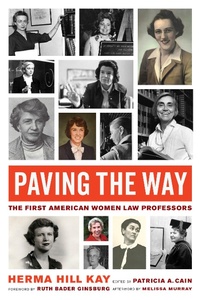
Paving the Way
The First American Women Law Professors
1st Edition
Published on 13. April 2021
384 pages
978-0-520-97646-7 (ISBN)
Description

The first wave of trailblazing female law professors and the stage they set for American democracy.
When it comes to breaking down barriers for women in the workplace, Ruth Bader Ginsburg's name speaks volumes for itself-but, as she clarifies in the foreword to this long-awaited book, there are too many trailblazing names we do not know. Herma Hill Kay, former Dean of UC Berkeley School of Law and Ginsburg's closest professional colleague, wrote Paving the Way to tell the stories of the first fourteen female law professors at ABA- and AALS-accredited law schools in the United States. Kay, who became the fifteenth such professor, labored over the stories of these women in order to provide an essential history of their path for the more than 2,000 women working as law professors today and all of their feminist colleagues.
Because Herma Hill Kay, who died in 2017, was able to obtain so much first-hand information about the fourteen women who preceded her, Paving the Way is filled with details, quiet and loud, of each of their lives and careers from their own perspectives. Kay wraps each story in rich historical context, lest we forget the extraordinarily difficult times in which these women lived. Paving the Way is not just a collection of individual stories of remarkable women but also a well-crafted interweaving of law and society during a historical period when women's voices were often not heard and sometimes actively muted. The final chapter connects these first fourteen women to the "second wave" of women law professors who achieved tenure-track appointments in the 1960s and 1970s, carrying on the torch and analogous challenges. This is a decidedly feminist project, one that Justice Ruth Bader Ginsburg advocated for tirelessly and admired publicly in the years before her death.
When it comes to breaking down barriers for women in the workplace, Ruth Bader Ginsburg's name speaks volumes for itself-but, as she clarifies in the foreword to this long-awaited book, there are too many trailblazing names we do not know. Herma Hill Kay, former Dean of UC Berkeley School of Law and Ginsburg's closest professional colleague, wrote Paving the Way to tell the stories of the first fourteen female law professors at ABA- and AALS-accredited law schools in the United States. Kay, who became the fifteenth such professor, labored over the stories of these women in order to provide an essential history of their path for the more than 2,000 women working as law professors today and all of their feminist colleagues.
Because Herma Hill Kay, who died in 2017, was able to obtain so much first-hand information about the fourteen women who preceded her, Paving the Way is filled with details, quiet and loud, of each of their lives and careers from their own perspectives. Kay wraps each story in rich historical context, lest we forget the extraordinarily difficult times in which these women lived. Paving the Way is not just a collection of individual stories of remarkable women but also a well-crafted interweaving of law and society during a historical period when women's voices were often not heard and sometimes actively muted. The final chapter connects these first fourteen women to the "second wave" of women law professors who achieved tenure-track appointments in the 1960s and 1970s, carrying on the torch and analogous challenges. This is a decidedly feminist project, one that Justice Ruth Bader Ginsburg advocated for tirelessly and admired publicly in the years before her death.
More details
Other editions
Additional editions
Book
04/2021
1st Edition
University of California Press
€28.50
Shipment within 10-20 days
Person
Herma Hill Kay was Barbara Nachtrieb Armstrong Professor of Law and former Dean at UC Berkeley School of Law. Kay was president of the Association of American Law Schools in 1989 and secretary of the American Bar Association Section on Legal Education and Admissions to the Bar from 1999 to 2001. She received the 1992 Margaret Brent Award to Women Lawyers of Distinction, the 2003 Boalt Hall Alumni Association Faculty Lifetime Achievement Award, the 2015 AALS Triennial Award for Lifetime Service to Legal Education and Law, and the 2015 Association of American Law Schools' Ruth Bader Ginsburg Lifetime Achievement Award.
Patricia A. Cain is Professor of Law at Santa Clara University and Aliber Family Chair in Law Emerita at University of Iowa.
Patricia A. Cain is Professor of Law at Santa Clara University and Aliber Family Chair in Law Emerita at University of Iowa.
Content
Foreword
Justice Ruth Bader Ginsburg
Preface
Patricia A. Cain
Introduction
1. Leading the Way: Barbara Nachtrieb Armstrong
2. Armstrong's Pre-World War II Contemporaries: Harriet Spiller Daggett and Margaret Harris Amsler
3. The Czarina of Legal Education: Soia Mentschikoff
4. From the Library to the Faculty: Five Women Who Changed Careers: Miriam Theresa Rooney, Jeanette Ozanne Smith, Janet Mary Riley, Helen Elsie Steinbinder, and Maria Minnette Massey
5. The Mid-Fifties: Ellen Ash Peters and Dorothy Wright Nelson
6. The End of an Era: Joan Miday Krauskopf and Marygold Shire Melli
7. The Next Decades: Ruth Bader Ginsburg and Women Law Professors from the 1960s to the 1980s
Conclusion
Appendix: A Note on Clemence Myers Smith, the Sixth Woman Law Professor
Afterword
Melissa Murray
Notes
Justice Ruth Bader Ginsburg
Preface
Patricia A. Cain
Introduction
1. Leading the Way: Barbara Nachtrieb Armstrong
2. Armstrong's Pre-World War II Contemporaries: Harriet Spiller Daggett and Margaret Harris Amsler
3. The Czarina of Legal Education: Soia Mentschikoff
4. From the Library to the Faculty: Five Women Who Changed Careers: Miriam Theresa Rooney, Jeanette Ozanne Smith, Janet Mary Riley, Helen Elsie Steinbinder, and Maria Minnette Massey
5. The Mid-Fifties: Ellen Ash Peters and Dorothy Wright Nelson
6. The End of an Era: Joan Miday Krauskopf and Marygold Shire Melli
7. The Next Decades: Ruth Bader Ginsburg and Women Law Professors from the 1960s to the 1980s
Conclusion
Appendix: A Note on Clemence Myers Smith, the Sixth Woman Law Professor
Afterword
Melissa Murray
Notes
