

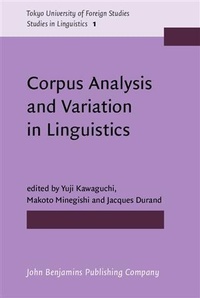
Corpus Analysis and Variation in Linguistics
1st Edition
Published on 26. March 2009
VI, 399 pages
978-90-272-8706-9 (ISBN)
Description

For sale in all countries except Japan. For customers in Japan: please contact Yushodo Co.
In this new edition of TUFS Studies in Linguistics, we aim to showcase the various linguistics research conducted at Tokyo University of Foreign Studies. In this first volume, we report on the international symposium hosted by the Global Center of Excellence Program "Corpus-based Linguistics and Language Education (CbLLE)" throughout 2008. Also in this collection, we consider the timeless linguistics issue of "variation" by utilizing the corpus analysis method. Whether socio-linguistic, stylistic or individual, variations manifest in a variety of ways throughout time and space and are closely related to issues surrounding linguistic theories. Additionally this volume includes other research upon diverse themes such as diachronic variation analysis, lexical variations, second language acquisition and bilingualism.
In this new edition of TUFS Studies in Linguistics, we aim to showcase the various linguistics research conducted at Tokyo University of Foreign Studies. In this first volume, we report on the international symposium hosted by the Global Center of Excellence Program "Corpus-based Linguistics and Language Education (CbLLE)" throughout 2008. Also in this collection, we consider the timeless linguistics issue of "variation" by utilizing the corpus analysis method. Whether socio-linguistic, stylistic or individual, variations manifest in a variety of ways throughout time and space and are closely related to issues surrounding linguistic theories. Additionally this volume includes other research upon diverse themes such as diachronic variation analysis, lexical variations, second language acquisition and bilingualism.
More details
Other editions
Additional editions
Yuji Kawaguchi | Makoto Minegishi | Jacques Durand
Corpus Analysis and Variation in Linguistics
Book
03/2009
John Benjamins Publishing Co
€100.70
Shipment within 10-15 days
Persons
Content
- Corpus Analysis and Variation in Linguistics
- Editorial page
- Title page
- LCC data
- Table of contents
- Message from the President
- Center for Corpus-based Linguistics and Language Education
- Introduction
- On the Scope of Linguistics: Data, Intuitions, Corpora
- Education and the Enforcement of Standard English
- Variability and Invariability in Learner Language: A Corpus-based Approach
- Lexical Variations in "Singapore English": Linguistic Description and Language Education
- Computer-mediated Language and Corpus Linguistics
- Making a List of Essential Phrasal Verbs Based on Large Corpora and Phrasal Verb Dictionaries
- Generation of Word Profiles for Large German Corpora
- Modeling Change : A Historical Sociolinguistics Perspective on French Negation
- Phonetic Input, Phonological Categories and Orthographic Representations: A Psycholinguistic Perspective on Why Language Education Needs Oral Corpora- The Case of French-Japanese Interphonology Development -
- Language Choice of Bilingual Federal Public Servants in Canada - With an Emphasis on their Perception of Passive Bilingualism -
- Lexical Variation of Urban Spanish
- Palatal Graphemes in a Medieval Spanish Biblical Text: A Corpus Analysis of «i, j, y» in Genesis, Biblia de Alba
- Argument Structure, Animacy, Syntax and Semantics of Passivization in Turkish : A Corpus-based Approach
- A Corpus-driven Analysis of -r Dropping in Spoken Turkish
- The Use of -ag- in Colloquial Swahili in Tanzania - Report of a Preliminary Survey Conducted in 2008* -
- A Study on the Pragmatic Functions of ialah and adalah in Malay
- Aspects of Style-shifting in Japanese
- Necessity of Corpora for Japanese Dialectology - From the Viewpoints of Dialect Contact and the Consciousness of Dialect Inexistence -
- Mitigation Strategies in Expressions of Disagreement Adopted by Intermediate Learners of Japanese
- Index of Proper Nouns
- Index of Subjects
- Contributors
