

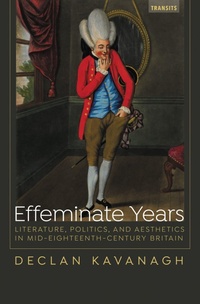
Effeminate Years
Literature, Politics, and Aesthetics in Mid-Eighteenth-Century Britain
1st Edition
Published on 23. June 2017
1 pages
978-1-61148-940-8 (ISBN)
Description

Effeminate Years: Literature, Politics, and Aesthetics in Mid-Eighteenth-Century Britain investigates the gendered, eroticized, and xenophobic ways in which the controversies in the 1760s surrounding the political figure John Wilkes (1725-97) legitimated some men as political subjects, while forcefully excluding others on the basis of their perceived effeminacy or foreignness. However, this book is not a literary analysis of the Wilkes affair in the 1760s, nor is it a linear account of Wilkes's political career. Instead, Effeminate Years examines the cultural crisis of effeminacy that made Wilkes's politicking so appealing. The central theoretical problem that this study addresses is the argument about what is and is not political: where does individual autonomy begin and end? Addressing this question, Kavanagh traces the shaping influence of the discourse of effeminacy in the literature that was generated by Wilkes's legal and sexual scandals, while, at the same time, he also reads Wilkes's spectacular drumming up of support as a timely exploitation of the broader cultural crisis of effeminacy during the mid century in Britain.
The book begins with the scandals and agitations surrounding Wilkes, and ends with readings of Edmund Burke's (1729-1797) earliest political writings, which envisage political community-a vision, that Kavanagh argues, is influenced by Wilkes and the effeminate years of the 1760s. Throughout, Kavanagh shows how interlocutors in the political and cultural debates of the mid-eighteenth-century period in Britain, such as Tobias Smollett (1721-1771) and Arthur Murphy (1727-1805), attempt to resolve the problem of effeminate excess. In part, the resolution for Wilkes and Charles Churchill (1731-1764) was to shunt effeminacy onto the sexually non-normative. On the other hand, Burke, in his aesthetic theorization of the beautiful privileges the socially constitutive affects of feeling effeminate. Through an analysis of poetry, fiction, social and economic pamphlets, aesthetic treatises, journalism and correspondences, placed within the latest queer historiography, Kavanagh demonstrates that the mid-century effeminacy crisis served to re-conceive male heterosexuality as the very mark of political legitimacy. Overall, Effeminate Years explores the development of modern ideas of masculinity and the political subject, which are still the basis of debate and argument in our own time.
The book begins with the scandals and agitations surrounding Wilkes, and ends with readings of Edmund Burke's (1729-1797) earliest political writings, which envisage political community-a vision, that Kavanagh argues, is influenced by Wilkes and the effeminate years of the 1760s. Throughout, Kavanagh shows how interlocutors in the political and cultural debates of the mid-eighteenth-century period in Britain, such as Tobias Smollett (1721-1771) and Arthur Murphy (1727-1805), attempt to resolve the problem of effeminate excess. In part, the resolution for Wilkes and Charles Churchill (1731-1764) was to shunt effeminacy onto the sexually non-normative. On the other hand, Burke, in his aesthetic theorization of the beautiful privileges the socially constitutive affects of feeling effeminate. Through an analysis of poetry, fiction, social and economic pamphlets, aesthetic treatises, journalism and correspondences, placed within the latest queer historiography, Kavanagh demonstrates that the mid-century effeminacy crisis served to re-conceive male heterosexuality as the very mark of political legitimacy. Overall, Effeminate Years explores the development of modern ideas of masculinity and the political subject, which are still the basis of debate and argument in our own time.
More details
Series
Edition
1. Auflage
Language
English
Place of publication
United States
Publishing group
Associated University Presses
Target group
Professional and scholarly
ISBN-13
978-1-61148-940-8 (9781611489408)
Copyright in bibliographic data and cover images is held by Nielsen Book Services Limited or by the publishers or by their respective licensors: all rights reserved.
Schweitzer Classification
Other editions
Additional editions
Declan Kavanagh
Effeminate Years
Literature, Politics, and Aesthetics in Mid-Eighteenth-Century Britain
Book
11/2019
Bucknell University Press,U.S.
€56.20
Shipment within 3-4 weeks
Person
Declan Kavanagh is lecturer in eighteenth-century studies and director of the Centre for Gender, Sexuality, and Writing at the University of Kent.
Content
Acknowledgments
Introduction: Effeminate Years
Chapter 1: "HERCULES, turn'd Beau": Charles Churchill's Satire
Chapter 2: Enlightenment Closets: Publishing Privacy
Chapter 3: Mobocracy: Public Opinion and the Free Press
Chapter 4: Bog Men: Celtic Landscapes during the Seven Years' War
Chapter 5: Effeminate Aesthetics and Backstairs Politics
Coda
Bibliography
About the Author
Introduction: Effeminate Years
Chapter 1: "HERCULES, turn'd Beau": Charles Churchill's Satire
Chapter 2: Enlightenment Closets: Publishing Privacy
Chapter 3: Mobocracy: Public Opinion and the Free Press
Chapter 4: Bog Men: Celtic Landscapes during the Seven Years' War
Chapter 5: Effeminate Aesthetics and Backstairs Politics
Coda
Bibliography
About the Author
