

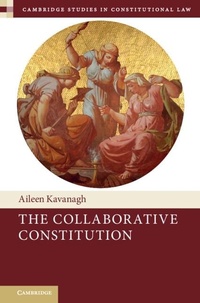
The Collaborative Constitution
Published on 11. October 2023
510 pages
978-1-108-58137-0 (ISBN)
Description

In this book, Aileen Kavanagh offers a fresh account of how we should protect rights in a democracy. Departing from leading theoretical accounts which present the courts and legislature as rivals for constitutional supremacy, Kavanagh argues that protecting rights is a collaborative enterprise between all three branches of government - the Executive, the legislature, and the courts. On a collaborative vision of constitutionalism, protecting rights is neither the solitary task of a Herculean super-judge, nor the dignified pronouncements of an enlightened legislature. Instead, it is a complex, dynamic, and collaborative endeavour, where each branch has a distinct but complementary role to play, whilst engaging with each other in a spirit of comity and mutual respect. Connecting constitutional theory with the practice of protecting rights in a democracy, this book offers an innovative understanding of the separation of powers, grounded in the values and virtues of constitutional collaboration.
Reviews / Votes
'In this enormously impressive work, Aileen Kavanagh argues that constitutions achieve their purposes best when the three branches collaborate in defining and enforcing constitutional rights, with each branch recognising the strengths and weaknesses of the others. She backs up her normative argument with detailed studies of the real world of lawmaking in the United Kingdom that show collaboration in action. The Collaborative Constitution is one of those rare filed-defining works that will stimulate discussion and further scholarship for years to come.' Mark Tushnet, Harvard Law School 'In her magisterial new book, Aileen Kavanagh provides an elegant and timely alternative to the courts versus legislature binary for protection of rights and the Madisonian conception of separation of powers as premised on institutional rivalry and conflict. Combining theory with UK and comparative experience, she makes a powerful case that, as both descriptive practice and normative ideal, constitutionalism is a collaborative enterprise among all branches of government that ultimately depends more on unwritten norms and culture than institutional design.' Stephen Gardbaum, UCLA School of Law 'This book offers a new vision of the constitutional separation of powers - one guided by the idea of shared responsibility for constitutional implementation, and notions of comity and mutual respect. Kavanagh points to the UK as a model of this approach in action, but all democracies, as they engage in the project of constitutional self-government, have much to learn from this model and Kavanagh's ideas.' Rosalind Dixon, UNSW 'The Collaborative Constitution is one of the most interesting contributions produced by the legal academia in recent years. It is a clear, easy to read and at the same time profound book, in which its author, Professor Aileen Kavanagh, investigates what is the best and most justified way to protect rights in a democracy. The book offers lucid answers to the dilemmas posed by the problem under examination. And it does so, at the same time, in a forceful and challenging way, which serves the author to clearly differentiate her views from many of the unfertile dichotomies that prevail in contemporary doctrine.' Roberto Gargarella, Balkinization 'The Collaborative Constitution is an elegant and deeply impressive contribution to constitutional law and theory. It is sure to join the handful of other seminal works in the separation of powers pantheon... Aileen Kavanagh's The Collaborative Constitution is a rich and wise book. It has an adult in the room quality by comparison with the quarrelling pro-legislature and pro-courts camps... the book provides a major and important corrective to both the Madisonian model of the separation of powers and the aspirations of institutional designers...' Stephen Gardbaum, King's Law Journal 'Aileen Kavanagh's important book, The Collaborative Constitution, offers a deep, insightful, and optimistic analysis of constitutional theory that aims to displace the conventional narrative that pits judicial supremacy and the institution of judicial review against a form of legislative supremacy that would take constitutions away from the courts.' Lawrence Solum, Balkinization 'Aileen Kavanagh has written a book that is beautiful in both words and in sentiment. She deftly paints a vision of the separation of powers that goes 'beyond the forms to norms' (p. 261) and privileges 'inter-institution comity [or] that respect which one great organ of the State owes to another'.' Erin Delaney, Balkinization 'In this 'deeply insightful, sophisticated, and original book', Kavanagh identifies 'a way of thinking about constitutionalism that is capable of capturing these realities whilst at the same time offering a normative ideal to which a system might aspire.' Tom Hickey, European Constitutional Law Review 'In this excellent book, Aileen Kavanagh argues that the protection of human rights and other constitutional values has to be a collaborative endeavour ... this is an important and original book. Aileen Kavanagh's command of the literature is evident from the bibliography which alone runs to 68 pages. The learning is lightly worn, for Kavanagh's thesis is advanced in lively and attractive prose. The Collaborative Constitution challenges a number of fashionable scholarly positions.' Jonathan Morgan, Cambridge Law Journal 'Aileen Kavanagh's The Collaborative Constitution offers an original and innovative answer to a longstanding question of constitutional theory: how should governments go about protecting the rights of their citizens?' Peter Stone, Irish Political StudiesMore details
Series
Language
English
Place of publication
Cambridge
United Kingdom
Illustrations
Worked examples or Exercises
File size
4,91 MB
ISBN-13
978-1-108-58137-0 (9781108581370)
Copyright in bibliographic data and cover images is held by Nielsen Book Services Limited or by the publishers or by their respective licensors: all rights reserved.
Schweitzer Classification
Other editions
Additional editions
Aileen Kavanagh
The Collaborative Constitution
Book
10/2023
Cambridge University Press
€150.50
Shipment within 15-20 days
Person
Content
Introduction: the Call for Collaboration; Part I. Institutions and Interactions: 1. Constitutionalism beyond manicheanism; 2. The promise and perils of dialogue; 3. The case for collaboration; Part II. Rights in Politics: 4. Governing with rights; 5. Legislating for rights; 6. Legislated rights: from domination to collaboration; Part III. Judge as Partner: 7. Judge as partner; 8. The HRA as partnership in progress; 9. Calibrated constitutional review; 10. Courting collaborative constitutionalism; Part IV. Legislatures in Response: 11. Underuse of the override; 12. Declarations, obligations, collaborations; Conclusion: the currency of collaboration.
