

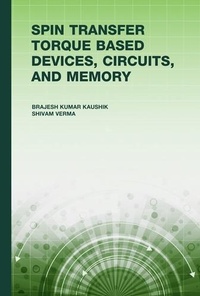
Spin Transfer Torque (STT) Based Devices, Circuits, and Memory
Published on 1. January 2016
310 pages
978-1-63081-436-6 (ISBN)
Description

This first-of-its-kind resource is completely dedicated to spin transfer torque (STT) based devices, circuits, and memory. A wide range of topics including, STT MRAMs, MTJ based logic circuits, simulation and modeling strategies, fabrication of MTJ CMOS circuits, non-volatile computing with STT MRAMs, all spin logic, and spin information processing are explored. State-of-the-art modeling and simulation strategies of spin transfer torque based devices and circuits in a lucid manner are covered. Professional engineers find practical guidance in the development of micro-magnetic models of spin-torque based devices in object-oriented micro-magnetic framework (OOMMF) and compact modeling of STT based magnetic tunnel junctions in Verilog-A. The performance parameters and design aspects of STT MRAMs and MTJ based hybrid spintronic CMOS circuits are covered and case studies are presented demonstrating STT-MRAM design and simulation with a detailed analysis of results. The fundamental physics of STT based devices are presented with an emphasis on new advancements from recent years. Advanced topics are also explored including, micromagnetic simulations, multi-level STT MRAMs, giant spin Hall Effect (GSHE) based MRAMs, non-volatile computing, all spin logic and all spin information processing.
More details
Other editions
Additional editions
Brajesh Kaushik | Shivam Verma
Spin Transfer Torque (STT) Based Devices, Circuits and Memory
Book
10/2016
Artech House Publishers
Unfortunately, price unknown
Available (delivery time upon request)
Content
- Intro
- Spin Transfer Torque Based Devices, Circuits, and Memory
- Contents
- Preface
- 1 Introduction to Magnetic Memories and STT
- 1.1 Electron Spin and FM Materials: Some Basic Concepts
- 1.1.1 Magnetic Moment of a Single Electron
- 1.1.2 Magnetization, Spin Polarization, and Spin Filtering
- 1.1.3 Electrical Spin Injection
- 1.2 Spin Valve and GMR Effect
- 1.3 Vector Spin Polarization
- 1.4 Theory of Magnetization Dynamics
- 1.4.1 Gyromagnetic Precession
- 1.4.2 Damping
- 1.4.3 Landau-Lifschitz-Gibert Equation
- 1.5 STT and LLGS Equation
- 1.5.1 Direction of STT
- 1.5.2 Magnitude of STT
- 1.5.3 STT in Magnetic Multilayers and Spin Torque Efficiency
- 1.5.4 Overview of Internal fields
- Summary
- References
- 2 MTJs
- 2.1 Thin Film Magnetism: In-Plane and Perpendicular Magnetic Anisotropy
- 2.2 MTJ Architecture and Operation
- 2.2.1 Precessional Switching (PS)
- 2.2.2 Thermally Assisted Switching (TAS){AU: previously the acronym TSA was "temperature-assisted switching." Pls make consistent or alter the use of the acronym as necessary.}
- 2.3 Recent Experimental Data and PMA MTJ Scaling
- 2.4 MTJ Conductance and TMR
- 2.5 Simulation Program with Integrated Circuit Emphasis (SPICE) Modeling of MTJs
- 2.6 Micromagnetic Modeling of MTJs
- 2.6.1 Implementation of the STT Term
- 2.6.2 Implementation of Energy Terms
- 2.6.3 Micromagnetic Simulation of Magnetization Dynamics
- 2.7 Novel Architectures and Electric Field-Assisted Switching
- 2.7.1 Giant Spin Hall Effect based MTJs
- 2.7.2 Electric Field-Assisted Switching
- 2.8 MTJ-Based Stateful Logic Gates
- 2.9 MTJs Exploiting TAS
- Summary
- References
- 3 STT MRAMs
- 3.1 Cell and Array Architectures
- 3.2 Operation of STT MRAMs
- 3.2.1 Read and Write Mechanism
- 3.2.2 I-V and R-V Characteristics of a STT MRAM Cell
- 3.2.3 Load line Analysis
- 3.3 STT MRAM Performance Parameters
- 3.4 STT MRAM Cell Layout
- 3.5 STT MRAM Design and Simulation
- 3.5.1 Simulation Methodology
- 3.5.2 STT MRAM Design: A Case Study
- 3.5.3 Analysis of Standard-Connected and Reverse-Connected Cells
- 3.5.4 Comparison in Terms of Power, Area, and Speed
- 3.6 Fabrication of STT MRAMs
- 3.6.1 BEOL MTJ Processing
- 3.6.2 MTJ Processing: Deposition, Annealing, and Etching
- 3.6.3 Challenges in MTJ Fabrication
- 3.7 Novel STT MRAM
- 3.7.1 2T-1R STT MRAM Cell
- 3.7.2 GSHE-Based STT MRAMs
- 3.7.3 Multilevel Cell Design
- 3.8 Comparison with Other Memory Technologies
- Summary
- References
- 4 Hybrid MTJ-CMOS Digital Circuits
- 4.1 Nonvolatile Combinational Circuits
- 4.2 Hybrid MTJ-CMOS-Based Reconfigurable Logic Gates
- 4.2.1 Hybrid CMOS/MTJ-Based Reconfigurable AND Operation
- 4.2.2 Hybrid CMOS/MTJ-Based Reconfigurable OR Operation
- 4.3 Hybrid MTJ-CMOS-Based FA
- 4.4 Nonvolatile Flip-Flop
- Summary
- References
- 5 Nonvolatile Computing with STT MRAMs
- 5.1 Nonvolatile and Normally OFF Computing Architectures
- 5.2 Hybrid Cache Memories
- 5.2.1 Nonvolatile DRAM-MRAM Cache
- 5.2.2 Nonvolatile SRAM-MRAM Cache
- 5.3 Low-Power Techniques for the STT MRAM Cache
- 5.3.1 EWT
- 5.3.2 WL Voltage Reduction
- 5.3.3 BL Clamping Technique
- 5.3.4 Asymmetric Access Devices
- 5.4 STT MRAM as a Main Memory
- Summary
- References
- 6 STT-Based All Spin Logic (ASL)
- 6.1 NLSV Devices
- 6.2 All Spin Logic (ASL)
- 6.3 Static and Clocked ASL
- 6.4 Modeling of NLSV and ASLD
- 6.4.1 Modeling the Spin Transport
- 6.4.2 Modeling of Magnetization Dynamics
- Summary
- References
- 7 Nonvolatile Computing with All Spin Information Processing
- 7.1 Implementation of Minimum Boolean Functions
- 7.1.1 Implementation of the NAND Operation
- 7.1.2 Implementation of NOR Operation
- 7.1.3 Implementation of AND and OR Operation
- 7.1.4 ASL Cascading
- 7.2 ASL-Based Latch and Flip-flop
- 7.2.1 ASL Latch
- 7.2.2 Flip-Flop
- 7.4 FAs
- 7.5 Nonvolatile Computing Architecture with ASL
- 7.6 Comparison and Challenges
- Summary
- References
- Appendix A SI-to-CGS Conversion of Basic Units Used in Magnetism
- Appendix B OOMMF .MIF Input file for Multilayer Micromagnetic Simulation of MTJ at 300K
- Appendix C HSPICE Net-list for STT MRAM Simulation: Case Study
- Appendix D HSPICE Net-list for Asymmetric STT MRAM Simulation
- Appendix E MATLAB Code for Simulation of Nonlocal Spin Valve Device
- Appendix F OOMMF Code for Micromagnetic Simulation of ASLD
- Appendix G MATLAB Code for Simulation of NAND and NOR ASL Gates
- About the Authors
- Index
