

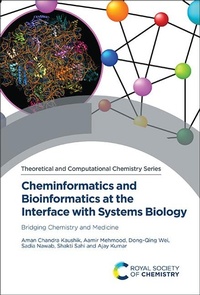
Cheminformatics and Bioinformatics at the Interface with Systems Biology
Bridging Chemistry and Medicine
1st Edition
Published on 8. September 2023
264 pages
978-1-83916-603-7 (ISBN)
Description

The cost of drug development is increasing, and investment returns are decreasing. The number of drugs approved by FDA is in decline in terms of the number of new molecular entities (NMEs). Amongst the reasons noted for this are the adverse side effects and reduced efficiency of many of the potential compounds. This is a problem both for the pharmaceutical industry and for those suffering from diseases for which there are no or few available treatments.
Advances in computational chemistry, computer science, structural biology and molecular biology have all contributed to improved drug design strategies and reduced the time taken for drug discovery. By interfacing cheminformatics and bioinformatics with systems biology we can create a powerful tool for understanding the mechanisms of patho-physiological systems and identifying lead molecules for various diseases. This integration of drug design approaches can also play a crucial role in the prediction and rationalization of drug effects and side effects, improving safety and efficacy and leading to better approval rates.
Addressing the lack of knowledge on the fundamental aspects of the various computational tools for drug discovery, this book is a compilation of recent bioinformatics and cheminformatics approaches, and their integration with systems biology. Written primarily for researchers and academics in chem- and bioinformatics, it may also be a useful resource for advanced-level students.
Advances in computational chemistry, computer science, structural biology and molecular biology have all contributed to improved drug design strategies and reduced the time taken for drug discovery. By interfacing cheminformatics and bioinformatics with systems biology we can create a powerful tool for understanding the mechanisms of patho-physiological systems and identifying lead molecules for various diseases. This integration of drug design approaches can also play a crucial role in the prediction and rationalization of drug effects and side effects, improving safety and efficacy and leading to better approval rates.
Addressing the lack of knowledge on the fundamental aspects of the various computational tools for drug discovery, this book is a compilation of recent bioinformatics and cheminformatics approaches, and their integration with systems biology. Written primarily for researchers and academics in chem- and bioinformatics, it may also be a useful resource for advanced-level students.
More details
Series
Language
English
Place of publication
Cambridge
United Kingdom
Target group
College/higher education
File size
9,49 MB
ISBN-13
978-1-83916-603-7 (9781839166037)
DOI
10.1039/9781839166037
Copyright in bibliographic data and cover images is held by Nielsen Book Services Limited or by the publishers or by their respective licensors: all rights reserved.
Schweitzer Classification
Other editions
Additional editions
Aman Chandra Kaushik | Aamir Mehmood | Dongqing Wei
Cheminformatics and Bioinformatics at the Interface with Systems Biology
Bridging Chemistry and Medicine
E-Book
09/2023
1st Edition
Royal Society of Chemistry
€216.99
Available for download
Aman Chandra Kaushik | Aamir Mehmood | Dongqing Wei
Cheminformatics and Bioinformatics at the Interface with Systems Biology
Bridging Chemistry and Medicine
Book
09/2023
Royal Society of Chemistry
€200.50
Shipment within 3-4 weeks
Persons
Dongqing Wei is a professor of Bioinformatics at Shanghai Jiaotong University and editor-in-chief of "Interdisciplinary Sciences- Computational Life Sciences". Over the past three decades he has made many grand breaking contributions to the development of molecular simulation techniques and their interdisciplinary applications to systems of ever-increasing complexity. He has published more than 350 papers, 9 monographs with 6000 SCI citations and a H factor of 50.
Aman Chandra Kaushik is a core computational biologist with a proclivity for biological databases and nature inspired algorithms. He holds Bachelors in Life Science (DDU University, India); Masters in Bioinformatics (CSJM University, India); PhD in Bioinformatics (Indo-Israel collaborative Project) and Post-doctorate in computational biology from Ben Gurion University, Israel. Currently, he is a Research assistant at Shanghai Jiao Tong University, China. He was a research fellow in Indian Council of Medical Research (ICMR) sponsored project.
Zhengtian Yu is Associate Director at Novartis Institutes for BioMedical Research (NIBR), Shanghai, China. Over the past three decades he has made many grand breaking contributions to the development of CADD techniques and their interdisciplinary applications to systems of ever-increasing complexity.
Shakti Sahi is a Professor at School of Biotechnology, Gautam Buddha University. She holds a PhD in Molecular Modelling and Drug Designfrom Department of Biophysics, All-India Institute of Medical Sciences. Prior to this, she completed a Masters in pharmacy from the Institute of Technology, Banaras Hindu University. Her research works focus on molecular modelling and drug design with special emphasis on G-protein-coupled receptor (GPCRs).
Ajay Kumar is a biologist with a proclivity for nanotechnology and materials science. He holds a Bachelors and Masters in mechanical Eng. (Gautam Buddha University, India) and a PhD from National Sun Yat-sen University, Taiwan. Currently, he is a Research scholar at National Sun Yat-sen University, Taiwan.
Aman Chandra Kaushik is a core computational biologist with a proclivity for biological databases and nature inspired algorithms. He holds Bachelors in Life Science (DDU University, India); Masters in Bioinformatics (CSJM University, India); PhD in Bioinformatics (Indo-Israel collaborative Project) and Post-doctorate in computational biology from Ben Gurion University, Israel. Currently, he is a Research assistant at Shanghai Jiao Tong University, China. He was a research fellow in Indian Council of Medical Research (ICMR) sponsored project.
Zhengtian Yu is Associate Director at Novartis Institutes for BioMedical Research (NIBR), Shanghai, China. Over the past three decades he has made many grand breaking contributions to the development of CADD techniques and their interdisciplinary applications to systems of ever-increasing complexity.
Shakti Sahi is a Professor at School of Biotechnology, Gautam Buddha University. She holds a PhD in Molecular Modelling and Drug Designfrom Department of Biophysics, All-India Institute of Medical Sciences. Prior to this, she completed a Masters in pharmacy from the Institute of Technology, Banaras Hindu University. Her research works focus on molecular modelling and drug design with special emphasis on G-protein-coupled receptor (GPCRs).
Ajay Kumar is a biologist with a proclivity for nanotechnology and materials science. He holds a Bachelors and Masters in mechanical Eng. (Gautam Buddha University, India) and a PhD from National Sun Yat-sen University, Taiwan. Currently, he is a Research scholar at National Sun Yat-sen University, Taiwan.
Content
System Biology and Drug Target Identification;Modulating Drug Target Gene Expression in Cancer;Drug Repositioning Using Genome-wide Screening and Systems Biology Approaches and Applications;New Directions in System Biology-based Target Identification and Cancer Genome Analysis;Molecular Investigation of Protein-Protein Interaction Candidates Related to Mammalian Brain;Biological Systems to Computational Systems Biology;Controlled Vocabularies and Semantics in Systems Biology;Single-molecule Imaging in Biosystems;Tracking the Emergence of Synthetic Biology;Synthetic Biology: Fostering the Cyber-biological Revolution;Computational Systems Chemical Biology;Systems Biology Methods to Assist in the Discovery of Efficacious Drug Combinations
