

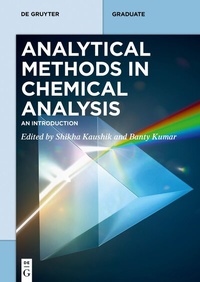
Analytical Methods in Chemical Analysis
Description

Analytical Chemistry is important and applied, experimental field of science that employs different instruments, and methods for the collection, separation, identification, and quantification of various organic, inorganic, and biological molecules. This interdisciplinary branch is based not only on chemistry but also on other disciplines such as biology, physics, pharmaceutical, and many areas of technology. The book is organized into six sections and provides information pertinent to the important techniques, and methods employed in analytical chemistry. It covers the basic concepts of qualitative and quantitative analysis, spectrochemical methods of analysis, along with thermal- and electroanalytical methods. Qualitative analysis identifies analytes, while quantitative analysis determines the concentration or numerical amount of the molecules under study. This book also exposes students to the different laws of spectroscopy, and various electronic transitions that occur in the different regions of the electromagnetic spectra. The main objective of this work is to develop an understanding and make learners familiar with the basic analytical methods employed in the chemical analysis of various compounds.
More details
Other editions
Additional editions
Persons
Dr. Shikha Kaushik is working as Assistant Professor (Chemistry) at Rajdhani College, University of Delhi, and teaching graduate students of various courses for more than 12 years. She did her post-graduation in Organic Chemistry and Ph.D. in Biophysical Chemistry from the University of Delhi. Her research interests include biophysical & biochemical aspects of nucleic acids, multistranded DNA structures, and DNA-drug interactions. She has been a recipient of the UGC Research Fellowship in Science for Meritorious Students (RFSMS). Dr. Kaushik has published a number of research articles in international journals like Biochemistry, JBSD, Biopolymers, Results in Chemistry (Elsevier), etc . She has also written two chapters in books published by Springer and also contributed as a content writer - "Electrophoresis & Isotopes in Biology" (Bioorganic & Biophysical Chemistry) for Epg Pathshala.
Dr. Banty Kumar is working as Associate Professor at Rajdhani College (DU) for the last 18 years in the Department of Chemistry. His area of specialization is Organic Chemistry. He has taught different classes such as B.Sc. (H) Chemistry, B.Sc. (Physical .Science), B.Sc. (Applied Physical Science). and published six research articles in different international peer reviewed journals with good impact factors. Recently, he has written a book on practical Organic Chemistry, which is at the last stage of publication.
Content
- Intro
- Preface
- Contents
- List of authors
- About the editors
- Abbreviations
- Section I: Analytical chemistry
- Chapter 1. Introduction to analytical chemistry
- Section II: Qualitative and quantitative aspects of analysis
- Chapter 2. Quantitative aspects of analysis
- Chapter 3. Data handling in qualitative and quantitative analysis
- Section III: Spectrochemical methods of analysis
- Chapter 4. UV-visible spectroscopy
- Chapter 5. Infrared spectroscopy
- Chapter 6. Flame atomic absorption and emission spectroscopy
- Section IV: Thermoanalytical Methods
- Chapter 7 Thermogravimetric (TG) and derivative thermogravimetric analysis (DTG)
- Chapter 8. Differential thermal analysis
- Section V: Electroanalytical Methods
- Chapter 9. pH Metry
- Chapter 10. Conductance
- Chapter 11 Electrochemistry
- Section VI: Separation methods and chromatography
- Chapter 12. Separation methods in analysis
- Chapter 13 Chromatographic methods
- Chapter 14. Chromatographic techniques
- Index
