

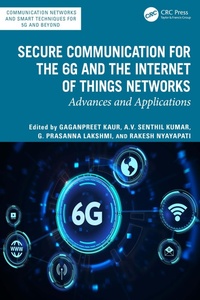
Secure Communication for the 6G and the Internet of Things Networks
Advances and Applications
1st Edition
Published on 9. December 2025
390 pages
978-1-040-58998-4 (ISBN)
Description

This book will serve as a comprehensive resource for readers interested in utilizing different technologies like fog computing, federated learning, cloud computing, and blockchain in 6G-enabled systems for addressing security concerns.
Key Features:
Discusses technologies such as fog computing, federated learning, and blockchain in 6G-enabled networks to address security threats.
Provides in-depth coverage of fundamental models, architectures, and security frameworks to help readers understand the complex landscape of 6G and the Internet of Things (IoT) security.
Covers diverse areas of security frameworks and software-defined fixes for security problems in 6G and the IoT networks.
Presents protocols for authentication and key exchange in 6G and the IoT networks.
Highlights the use of the IoT for enhanced biometric authentication in security.
This book is primarily written for senior undergraduates, graduate students, and academic researchers in the fields of electrical engineering, electrical and communications engineering, telecommunications, and computer science and engineering.
Key Features:
Discusses technologies such as fog computing, federated learning, and blockchain in 6G-enabled networks to address security threats.
Provides in-depth coverage of fundamental models, architectures, and security frameworks to help readers understand the complex landscape of 6G and the Internet of Things (IoT) security.
Covers diverse areas of security frameworks and software-defined fixes for security problems in 6G and the IoT networks.
Presents protocols for authentication and key exchange in 6G and the IoT networks.
Highlights the use of the IoT for enhanced biometric authentication in security.
This book is primarily written for senior undergraduates, graduate students, and academic researchers in the fields of electrical engineering, electrical and communications engineering, telecommunications, and computer science and engineering.
More details
Series
Edition
1. Auflage
Language
English
Place of publication
London
United Kingdom
Publishing group
Taylor & Francis Ltd
Target group
College/higher education
Professional and scholarly
Illustrations
35 Tables, black and white; 97 Line drawings, black and white; 2 Halftones, black and white; 99 Illustrations, black and white
File size
13,65 MB
ISBN-13
978-1-040-58998-4 (9781040589984)
Copyright in bibliographic data and cover images is held by Nielsen Book Services Limited or by the publishers or by their respective licensors: all rights reserved.
Schweitzer Classification
Other editions
Additional editions
Gaganpreet Kaur | A.V. Senthil Kumar | G. Prasanna Lakshmi
Secure Communication for the 6G and the Internet of Things Networks
Advances and Applications
Book
approx. 12/2025
1st Edition
CRC Press
€178.10
Not yet published
Persons
Gaganpreet Kaur is currently working as an associate professor, in the Department of Computer Science and Engineering, at Chitkara University, Punjab, India. She has teaching experience of more than eighteen years and has published more than a hundred research articles in various peer-reviewed, SCI, Scopus Journals, and International and National Conferences in the field of computer science. She has published more than 17 Indian patents. Her research interests include biometrics, image processing, forensic science, cloud computing, and healthcare.
A. V. Senthil Kumar is presently working as a Professor and Director, PG and Research Department of Computer Applications, at Hindusthan College of Arts & Science, Coimbatore, India. To his credit, he has industrial experience of five years and teaching experience of 27 years. He has published more than two hundred papers in International and National Journals, and nearly sixty papers in International Conferences. His areas of research interest include data mining and networks.
G. Prasanna Lakshmi is working as a Professor in the Department of Computer Science and Engineering and R&D Coordinator, at Sandip University, Nashik, India. She has 23 years of teaching experience and seven years of industrial experience. Her field of expertise includes data mining, pattern recognition techniques, artificial intelligence, machine learning, and deep learning. She has published research papers in journals and conferences of national and international reputation.
Rakesh Nyayapati, based in Weehawken, New Jersey, United States, is currently an Associate Director at UBS, bringing experience from previous roles at Cognizant and UBS. He holds a ITIL Intermediate - SO in Service Management @ APMG International. With a robust skill set that includes Process Excellence, Vendor Management, Transition Management, IT Service Management, Service Delivery, and more, he contributes valuable insights to the industry.
A. V. Senthil Kumar is presently working as a Professor and Director, PG and Research Department of Computer Applications, at Hindusthan College of Arts & Science, Coimbatore, India. To his credit, he has industrial experience of five years and teaching experience of 27 years. He has published more than two hundred papers in International and National Journals, and nearly sixty papers in International Conferences. His areas of research interest include data mining and networks.
G. Prasanna Lakshmi is working as a Professor in the Department of Computer Science and Engineering and R&D Coordinator, at Sandip University, Nashik, India. She has 23 years of teaching experience and seven years of industrial experience. Her field of expertise includes data mining, pattern recognition techniques, artificial intelligence, machine learning, and deep learning. She has published research papers in journals and conferences of national and international reputation.
Rakesh Nyayapati, based in Weehawken, New Jersey, United States, is currently an Associate Director at UBS, bringing experience from previous roles at Cognizant and UBS. He holds a ITIL Intermediate - SO in Service Management @ APMG International. With a robust skill set that includes Process Excellence, Vendor Management, Transition Management, IT Service Management, Service Delivery, and more, he contributes valuable insights to the industry.
Content
1. Introduction.
2. Secure and Safe Communication in 6G and the Internet of Things Networks.
3. Protocols for Authentication and Key Exchange in 6G and the Internet of Things Networks.
4. Formal Security Study of 6G and the Internet of Things Networks Security Protocols.
5. Creating Safe Communication Environments or Systems in 6G and the Internet of Things Networks.
6. Assessment and Control of Security Risks in 6G and the Internet of Things Networks.
7. Case Studies and Applications on 6G and the Internet of Things Networks Usability.
8. Security and Reliability of 6G and the Internet of Things Networks.
9. Blockchain and 6G-enabled Internet of Things Networks.
10. 6G and the Internet of Things Networks High-quality Services.
11. Security Concerns on the Internet of Things and 6G Networks.
12. 6G and Sustainable Development Goals.
13. Securing the Internet of Things with Sustainable Development Goals.
14. Using Fog Computing in Securing 6G-enabled the Internet of Things.
15. Using Cloud Computing in securing 6G-enabled the Internet of Things.
16. Using Federated Learning for securing the Internet of Things and 6G.
17. Cyber Threat Hunting in 6G-enabled Internet of Things Devices.
18. Securing 6G-Enabled Internet of Things Devices: Smart Attack Detection System.
19. Securing 6G and the Internet of Things for the Metaverse.
20. Implementing the Internet of Things Solutions in Healthcare.
21. Utilizing the Internet of Things for Enhanced Biometric Authentication in Security.
2. Secure and Safe Communication in 6G and the Internet of Things Networks.
3. Protocols for Authentication and Key Exchange in 6G and the Internet of Things Networks.
4. Formal Security Study of 6G and the Internet of Things Networks Security Protocols.
5. Creating Safe Communication Environments or Systems in 6G and the Internet of Things Networks.
6. Assessment and Control of Security Risks in 6G and the Internet of Things Networks.
7. Case Studies and Applications on 6G and the Internet of Things Networks Usability.
8. Security and Reliability of 6G and the Internet of Things Networks.
9. Blockchain and 6G-enabled Internet of Things Networks.
10. 6G and the Internet of Things Networks High-quality Services.
11. Security Concerns on the Internet of Things and 6G Networks.
12. 6G and Sustainable Development Goals.
13. Securing the Internet of Things with Sustainable Development Goals.
14. Using Fog Computing in Securing 6G-enabled the Internet of Things.
15. Using Cloud Computing in securing 6G-enabled the Internet of Things.
16. Using Federated Learning for securing the Internet of Things and 6G.
17. Cyber Threat Hunting in 6G-enabled Internet of Things Devices.
18. Securing 6G-Enabled Internet of Things Devices: Smart Attack Detection System.
19. Securing 6G and the Internet of Things for the Metaverse.
20. Implementing the Internet of Things Solutions in Healthcare.
21. Utilizing the Internet of Things for Enhanced Biometric Authentication in Security.
