

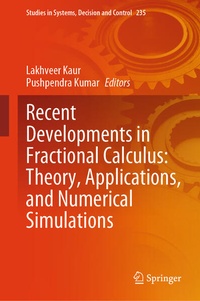
Recent Developments in Fractional Calculus: Theory, Applications, and Numerical Simulations
Description

This book discusses recent developments in fractional calculus and fractional differential equations in a very elaborative manner and is of interest to research scholars, academicians and scientists who want to enhance the knowledge in the context of new insights and mathematical ideas in fractional calculus and its emerging applications in various fields. It focuses on strengthening the existing results along with identifying the practical challenges encountered. The purpose of this collection is to provide comprehension of articles that reflect recent mathematical results as well as some results in applied sciences untouched by the tools and techniques of fractional calculus along with their modelling and computation having applications in diverse arenas.
More details
Other editions
Additional editions
Persons
Dr Lakhveer Kaur is an associate professor at Department of Mathematics, Jaypee Institute of Information Technology, India with H Index 24. She has been awarded with Institute of Physics (IOP) Trusted Reviewer Status in 2023. Most significantly, she has been listed in well reputed "World Top 2% Scientists-2023" announced by Elsevier and Stanford University, United States, from last four years in row 2024, 2023, 2022, 2021. Also, she has been awarded with Most Cited Article Award by IOP (Institute of Physics), using citations recorded in Web of Science in 2021. She is handling a research project based on Mathematical Modelling, funded by National Board for Higher Mathematics (NBHM) DAE, Govt. of India as Principal Investigator.
Dr Pushpendra Kumar is a dedicated researcher and academic specializing in fractional calculus, mathematical modeling, numerical analysis, and neural networks. Currently a postdoctoral researcher at Jeonbuk National University, South Korea, his work primarily focuses on fractional-order control systems and their diverse applications. He also served as a visiting professor at Istanbul Okan University and a research professor at the University of Johannesburg, reflecting his global academic footprint. Dr. Kumar earned his Ph.D. from the National Institute of Technology Puducherry, India, with a thesis on Caputo-type fractional differential equations. Recognized among the "World's Top 2% Scientists" by Elsevier and Stanford University in 2023 and 2024, Dr. Kumar has also been a recipient of the prestigious IMU Breakout Graduate Fellowship.
Content
1. Recent Advances in The Development of Analytical Solutions of Fractional Bateman Equations.- 2. Fractional-order non-linear nabla difference equation via Hilfer-type operator.- 3. On Fractional Integral Inequalities of Hermite-Hadamard type.- 4. Results on Existence and Controllability of Caputo Fractional Neutral Integro-Differential Equations.- 5. Thermoelastic impacts in a one dimensional problem using space-fractionally ordered andmemory-dependent derivatives.
