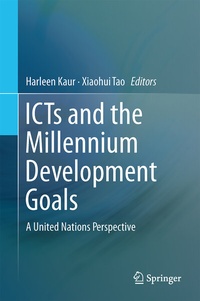
ICTs and the Millennium Development Goals
Description

This book attempts to create awareness about the UN-MDGs and how various ICT can be harnessed to appeal to different demographics. Current empirical evidence suggests that MDG awareness is relatively low particularly in developed countries, and that the levels of MDG awareness vary considerable across socioeconomic variables or demographics from United Nations perspective. It also examines how ICT can be used to bring about technical and social innovations strengthen livelihoods, support economic development, water and climate resilience and improve the education and health sectors and enhance development opportunities. Several studies are highlighted that reinforce the view that government support and private sector expertise and funding are important factors in ICT-based e-government solutions in developing countries.
The book also builds on the thesis that a strong connection between competencies in mathematics, science, and information communication/technology is required to build logical concepts and critical thinking skills. It also examines the opportunities and barriers of promoting students' learning skills, including communication, cooperation, collaboration and connection using the Wiki tool under the blackboard platform. Finally, the book also highlights the challenges involved in application of ICT in education. This is significant for educators in order to surmount these obstacles and consequently successfully incorporate ICT into the educational system.
The chapters present the relevant literature on ICTs and the perceived barriers to ICT integration in basic education. They also focus on the implications of incorporating ICT in the basic educational system. The challenges confronting the integration of ICT in education are equally identified with a view to ensuring a more efficient application of ICT in attaining education for all.
Reviews / Votes
From the book reviews:
"The contributors have presented the relevant literature on ICTs and the perceived barriers to ICT integration in basic education. . It is recommended for direct reference by officials of UN agencies and other multilateral and bilateral funding bodies. It will also interest researchers, students, and faculty in the associated subject domains." (C. S. Arora, Computing Reviews, February, 2015)
More details
Other editions
Additional editions