

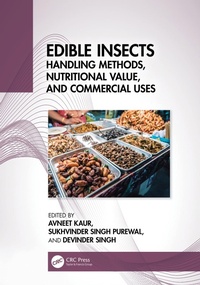
Edible Insects
Handling Methods, Nutritional Value, and Commercial Uses
1st Edition
Published on 4. March 2026
320 pages
978-1-040-54765-6 (ISBN)
Description

Exploring recent advances in the use of insects as a viable, sustainable, and nutritious food source, this book emphasizes effective handling techniques, the nutritional profile of different insects, and their potential commercial applications in the food sector. It covers insect farming, harvesting, and processing technologies, providing guidance on how to ensure safe food production, enhance taste, and maintain nutritional quality. The book also provides relevant information related to the bioavailability of nutrients in insects and assesses their potential to replace conventional protein sources like meat. It also discusses the commercial potential of a variety of insect-based food products. The combination of technical information and commercial assessments of edible insects makes this book suitable for industry professionals seeking to survey the market opportunities for edible insects as food, animal feed, and in health supplements.
More details
Edition
1. Auflage
Language
English
Place of publication
London
United Kingdom
Publishing group
Taylor & Francis Ltd
Target group
Professional and scholarly
Illustrations
29 Tables, black and white; 3 Line drawings, color; 16 Halftones, color; 1 Halftones, black and white; 19 Illustrations, color; 1 Illustrations, black and white
File size
8,31 MB
ISBN-13
978-1-040-54765-6 (9781040547656)
Copyright in bibliographic data and cover images is held by Nielsen Book Services Limited or by the publishers or by their respective licensors: all rights reserved.
Schweitzer Classification
Other editions
Additional editions
Avneet Kaur | Sukhvinder Singh Purewal | Devinder Singh
Edible Insects
Handling Methods, Nutritional Value, and Commercial Uses
Book
approx. 03/2026
1st Edition
CRC Press
€298.80
Not yet published
Persons
Avneet Kaur, Ph.D. is currently working as Assistant Professor, Department of Chemistry, Chandigarh University, Mohali, Punjab, India. During her Ph.D. tenure she has published 5 research papers in journals of high repute. Her research interest in Ph.D. was primarily focused on two different areas. Firstly, the thermophysical and theoretical investigation of binary mixtures of Choline based Ionic Liquids with Hydrogen Bond Donor solvents i.e. water, straight chain alcohols and alkane diols which has the efficacy to be used at industrial level. Second is the fabrication of choline based ionic liquid assisted nano structures for electrochemical sensing of pollutants which ultimately projects them as smart design for various engineering and industrial processes. Having authored more than 30 research papers/book chapters with publishers of International repute, Dr. Kaur has demonstrated her expertise by publishing an edited book Nanotechnology in the Food Industry: Applications, Recent Trends, and Future Perspectives with CRC Press, Taylor & Francis Group. Over the past two years, Dr. Kaur has been actively engaged in the field of food chemistry. In 2023, she was honored with the Best Poster Award at a national conference in recognition of her research excellence. She is a life member of the Indian Science Congress Association (ISCA) and is currently serving as a Guest Editor for a special issue on Pigmented Cereals in the Journal of Food Measurement and Characterization, a prestigious Springer Journal.
Dr. Sukhvinder Singh Purewal, Ph.D., is currently serving as an Assistant Professor at the University Centre for Research and Development (UCRD), Chandigarh University, Mohali, Punjab, India. He was awarded a Major Research Project (2018-2022) by the SEED Division, Department of Science and Technology (DST), New Delhi. His research interests include solid-state fermentation, extraction of bioactive compounds from natural sources, antioxidant research, and fruit processing. He has authored over 50 research papers in peer-reviewed international journals and has received multiple best poster awards at both national and international conferences. He is an active member of several professional organizations such as the Association of Microbiologists of India (AMI), Mycological Society of India (MSI), Association of Food Scientists and Technologists (India) (AFSTI), and the Indian Science Congress Association (ISCA). In 2023, he was recognized with the prestigious "Young Scientist Award" by AMI for his notable contributions to Food Microbiology. In 2023, Dr. Purewal was honored with the prestigious "Young Scientist Award" by the renowned Association of Microbiologists of India (AMI) in recognition of his outstanding contributions to the field of Food Microbiology. Furthermore, Dr. Sukhvinder Singh Purewal has demonstrated his expertise by publishing an authored book, Millets: Properties, Processing, and Health Benefits, along with eight edited books with CRC Press Taylor & Francis Group and Springer such as: 1) Maize Nutritional Composition, Processing, and Industrial Uses 2) Chickpea and Cowpea: Nutritional Profile, Processing, Health Prospects, and Commercial Uses 3) Nanotechnology in the Food Industry: Applications, Recent Trends, and Future Perspectives 4) Colored Cereals: Properties, Processing, Health Benefits, and Industrial Uses 5) Compendium of Clove: Navigating Agriculture, Chemistry, Processing, and Health Benefits 6) Liquorice Properties, Processing, and Health Benefits 7) Recent Advances in Citrus Fruits 8) Rye: Processing, Nutritional Profile and Commercial Uses. Dr. Purewal also serves as an Associate Editor for the highly reputed Journal of Food Measurement and Characterization of Springer. In 2025, his outstanding contributions to antioxidant research have earned him a place among the top 0.5% of researchers worldwide in this field, as reported by ScholarGPS.
Prof. Dr. Devinder Singh is a distinguished entomologist and academic administrator with about four decades of experience in Higher Education, Research, and Institutional leadership. Currently serving as the Pro Vice- Chancellor of Chandigarh University, Gharuan, Mohali, Punjab, he had held several key academic and administrative positions including Registrar, Dean of Faculty, Director, Planning and Monitoring, Head of Department, and Coordinator of the Intellectual Property Rights (IPR) Cell at Punjabi University, Patiala. Dr. Singh obtained his Ph.D. in Zoology with a specialization in Entomology from Punjabi University, Patiala, followed by a Postdoctoral Fellowship at the University of Illinois at Chicago, USA, in Life Sciences. He has authored/co-authored over 210 peer-reviewed publications. His research impact is reflected by an H-index of 18 and over 1550 citations. His work includes diverse areas including forensic entomology, molecular taxonomy, and environmental toxicology. He has contributed significantly to the academic community as a peer reviewer for several international journals and served on editorial boards. His publication record includes high-impact articles on forensically important insect species, environmental pollution assessment, and bioremediation. Prof. Devinder Singh has successfully completed several important research projects in the field of entomology, focusing on the study of insects, their classification, and their role in the environment. From 1991 to 1996, he worked on the detailed classification of the Tenthredinidae family (a group of sawflies) in India, supported under USPL-480 scheme by ICAR. Between 1998 and 2001, he studied the insect applications in forensic science, with funding from DST, New Delhi. From 1999 to 2003, he explored the diversity of Hymenoptera insects in the Shivalik hills of Punjab, supported by the Department of Environment and PSCST. He also led research on small moths under the All India Coordinated Taxonomy Project (MoEF, 2000-2008). In another project (DST, 2007-2010), he studied the taxonomy and chromosomes of true bugs (Heteroptera). From 2012 to 2017, he directed a major DBT-funded program (?5 Crores) to build a DNA-based insect identification system and to study the effects of insecticides on insect genes. From 2013 to 2018, under a UGC-supported program, he searched the diversity of insects in the Indian Himalayan region. His work has greatly helped in understanding the types and roles of insects in different ecosystems. His international academic exposure and administrative experience continue to influence research, teaching, and policy-making in Indian higher education.
Dr. Sukhvinder Singh Purewal, Ph.D., is currently serving as an Assistant Professor at the University Centre for Research and Development (UCRD), Chandigarh University, Mohali, Punjab, India. He was awarded a Major Research Project (2018-2022) by the SEED Division, Department of Science and Technology (DST), New Delhi. His research interests include solid-state fermentation, extraction of bioactive compounds from natural sources, antioxidant research, and fruit processing. He has authored over 50 research papers in peer-reviewed international journals and has received multiple best poster awards at both national and international conferences. He is an active member of several professional organizations such as the Association of Microbiologists of India (AMI), Mycological Society of India (MSI), Association of Food Scientists and Technologists (India) (AFSTI), and the Indian Science Congress Association (ISCA). In 2023, he was recognized with the prestigious "Young Scientist Award" by AMI for his notable contributions to Food Microbiology. In 2023, Dr. Purewal was honored with the prestigious "Young Scientist Award" by the renowned Association of Microbiologists of India (AMI) in recognition of his outstanding contributions to the field of Food Microbiology. Furthermore, Dr. Sukhvinder Singh Purewal has demonstrated his expertise by publishing an authored book, Millets: Properties, Processing, and Health Benefits, along with eight edited books with CRC Press Taylor & Francis Group and Springer such as: 1) Maize Nutritional Composition, Processing, and Industrial Uses 2) Chickpea and Cowpea: Nutritional Profile, Processing, Health Prospects, and Commercial Uses 3) Nanotechnology in the Food Industry: Applications, Recent Trends, and Future Perspectives 4) Colored Cereals: Properties, Processing, Health Benefits, and Industrial Uses 5) Compendium of Clove: Navigating Agriculture, Chemistry, Processing, and Health Benefits 6) Liquorice Properties, Processing, and Health Benefits 7) Recent Advances in Citrus Fruits 8) Rye: Processing, Nutritional Profile and Commercial Uses. Dr. Purewal also serves as an Associate Editor for the highly reputed Journal of Food Measurement and Characterization of Springer. In 2025, his outstanding contributions to antioxidant research have earned him a place among the top 0.5% of researchers worldwide in this field, as reported by ScholarGPS.
Prof. Dr. Devinder Singh is a distinguished entomologist and academic administrator with about four decades of experience in Higher Education, Research, and Institutional leadership. Currently serving as the Pro Vice- Chancellor of Chandigarh University, Gharuan, Mohali, Punjab, he had held several key academic and administrative positions including Registrar, Dean of Faculty, Director, Planning and Monitoring, Head of Department, and Coordinator of the Intellectual Property Rights (IPR) Cell at Punjabi University, Patiala. Dr. Singh obtained his Ph.D. in Zoology with a specialization in Entomology from Punjabi University, Patiala, followed by a Postdoctoral Fellowship at the University of Illinois at Chicago, USA, in Life Sciences. He has authored/co-authored over 210 peer-reviewed publications. His research impact is reflected by an H-index of 18 and over 1550 citations. His work includes diverse areas including forensic entomology, molecular taxonomy, and environmental toxicology. He has contributed significantly to the academic community as a peer reviewer for several international journals and served on editorial boards. His publication record includes high-impact articles on forensically important insect species, environmental pollution assessment, and bioremediation. Prof. Devinder Singh has successfully completed several important research projects in the field of entomology, focusing on the study of insects, their classification, and their role in the environment. From 1991 to 1996, he worked on the detailed classification of the Tenthredinidae family (a group of sawflies) in India, supported under USPL-480 scheme by ICAR. Between 1998 and 2001, he studied the insect applications in forensic science, with funding from DST, New Delhi. From 1999 to 2003, he explored the diversity of Hymenoptera insects in the Shivalik hills of Punjab, supported by the Department of Environment and PSCST. He also led research on small moths under the All India Coordinated Taxonomy Project (MoEF, 2000-2008). In another project (DST, 2007-2010), he studied the taxonomy and chromosomes of true bugs (Heteroptera). From 2012 to 2017, he directed a major DBT-funded program (?5 Crores) to build a DNA-based insect identification system and to study the effects of insecticides on insect genes. From 2013 to 2018, under a UGC-supported program, he searched the diversity of insects in the Indian Himalayan region. His work has greatly helped in understanding the types and roles of insects in different ecosystems. His international academic exposure and administrative experience continue to influence research, teaching, and policy-making in Indian higher education.
Content
1. Edible Insects: A Brief Introduction. 2. Edible Insects in Novel Food Product 3. Edible Insects in Food Product Development, Incorporation into Food Products 4. Edible Insects in Food Product Development 5. Insects in Extruded Products 6. Insect Proteins: Biochemical Characteristics, Development of Protein Isolates, and their Nutritional and Functional Quality in Food Prototypes 7. Insect Protein-Based Films 8. Lipids from Insects: Extraction, Identification and Characterization 9. Insects Residues: A Source of Chitin and Chitosan 10. Current Scenario and Future Prospects of Insects-Based Food Products
