

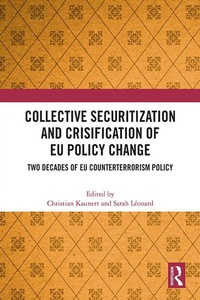
Collective Securitization and Crisification of EU Policy Change
Two Decades of EU Counterterrorism Policy
1st Edition
Published on 22. August 2022
288 pages
978-1-000-64934-5 (ISBN)
Description

This book represents the first attempt to evaluate the first two decades of the EU counterterrorism policy. It aims to assess the collective securitization process in EU counterterrorism, evaluating this as a process between a construction of security threats and the development of supranational governance through crisification.
Compared to the lack of shared perception of the terrorist threat and the virtual absence of counterterrorism cooperation amongst European states in the 1970s and 1980s, the existence of EU-wide debates, legislative instruments and practical cooperation nowadays is particularly remarkable. The chapters in this volume explore this change and seek to explain it by drawing upon the concept of 'collective securitization'. The book posits that EU counterterrorism needs to be analysed as a process driven by collective securitization as part of an ongoing process of crisification that leads to increased supranational governance.
The book is both extremely relevant and timely for readers outside the area of research for several reasons. First of all, EU counterterrorism is often argued to be at the forefront of the EU's response to new security threats. The 'EU acquis' on the Area of Freedom, Security and Justice (AFSJ) has grown significantly over the last years. Consequently, it is crucial and very timely to examine EU counterterrorism - exactly 20 years after the first significant measures were adopted in the wake of 9/11.
The chapters in this book were originally published in the journal Global Affairs.
Compared to the lack of shared perception of the terrorist threat and the virtual absence of counterterrorism cooperation amongst European states in the 1970s and 1980s, the existence of EU-wide debates, legislative instruments and practical cooperation nowadays is particularly remarkable. The chapters in this volume explore this change and seek to explain it by drawing upon the concept of 'collective securitization'. The book posits that EU counterterrorism needs to be analysed as a process driven by collective securitization as part of an ongoing process of crisification that leads to increased supranational governance.
The book is both extremely relevant and timely for readers outside the area of research for several reasons. First of all, EU counterterrorism is often argued to be at the forefront of the EU's response to new security threats. The 'EU acquis' on the Area of Freedom, Security and Justice (AFSJ) has grown significantly over the last years. Consequently, it is crucial and very timely to examine EU counterterrorism - exactly 20 years after the first significant measures were adopted in the wake of 9/11.
The chapters in this book were originally published in the journal Global Affairs.
More details
Edition
1. Auflage
Language
English
Place of publication
London
United Kingdom
Publishing group
Taylor & Francis Ltd
Target group
College/higher education
ISBN-13
978-1-000-64934-5 (9781000649345)
Copyright in bibliographic data and cover images is held by Nielsen Book Services Limited or by the publishers or by their respective licensors: all rights reserved.
Schweitzer Classification
Other editions
Additional editions
Christian Kaunert | Sarah Leonard
Collective Securitization and Crisification of EU Policy Change
Two Decades of EU Counterterrorism Policy
Book
05/2024
1st Edition
Routledge
€63.60
Shipment within 10-20 days
Christian Kaunert | Sarah Leonard
Collective Securitization and Crisification of EU Policy Change
Two Decades of EU Counterterrorism Policy
Book
08/2022
1st Edition
Routledge
€205.90
Shipment within 10-20 days
Persons
Christian Kaunert is Professor of International Security at Dublin City University, Ireland. He is also Professor of Policing and Security, as well as Director of the International Centre for Policing and Security at the University of South Wales. In addition, he is Jean Monnet Chair, Director of the Jean Monnet Centre of Excellence and Director of the Jean Monnet Network on EU Counter-Terrorism (www.eucter.net).
Sarah Leonard is Professor of International Security at the University of the West of England, Bristol, UK. Prior to taking up her post at UWE Bristol, Sarah was Lecturer in International Security at the University of Salford, Marie Curie Research Fellow at Sciences Po Paris, Senior Lecturer in Politics at the University of Dundee and Associate Professor in International Affairs at Vesalius College, Vrije Universiteit Brussel (Belgium).?
Sarah Leonard is Professor of International Security at the University of the West of England, Bristol, UK. Prior to taking up her post at UWE Bristol, Sarah was Lecturer in International Security at the University of Salford, Marie Curie Research Fellow at Sciences Po Paris, Senior Lecturer in Politics at the University of Dundee and Associate Professor in International Affairs at Vesalius College, Vrije Universiteit Brussel (Belgium).?
Content
Introduction - Two Decades of EU Counter-Terrorism: Between Collective Securitization and Crisification 1. EU counter-terrorism 20 years after 9/11: "common threat" and "common response"? 2. EU measures to combat terrorist financing since 9/11: efficient, but not very effective 3. Still the absent friend? The European Union's global counter-terrorism role after twenty years 4. The collective securitization of aviation in the European Union through association with terrorism 5. Electoral cost of the European Union promoted norms: Erdogan's counter-terrorism impasse 6. The new EU Counter-Terrorism Agenda: preemptive security through the anticipation of terrorist events 7. EU counterterrorism, collective securitization, and the internal-external security nexus 8. The evolution of information-sharing in EU counter-terrorism post-2015: a paradigm shift? 9. The key elements of the LIBE Committee's compromise proposal on e-evidence: a critical overview through a fundamental rights lens 10. Emerging challenges for combating the financing of terrorism in the European Union: financing of violent right-wing extremism and misuse of new technologies 11. Securitization across borders - commonalities and contradictions in European and Arab counterterrorism discourses 12. Islamic extremism and the war for hearts and minds 13. Legitimacy and EU security and defence policy: the chimera of a simulacrum 14. European security and defence in the shadow of Brexit 15. Diversified in unity: the agenda for the geopolitical European Commission 16. A dangerous middle-ground: terrorists, counter-terrorists, and gray-zone conflict
