

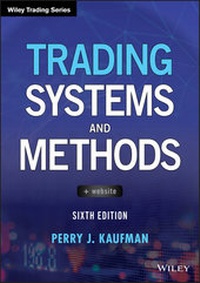
Trading Systems and Methods
6th Edition
Published on 5. November 2019
1168 pages
978-1-119-60538-6 (ISBN)
Description

The new edition of the definitive reference to trading systems--expanded and thoroughly updated.
Professional and individual traders haverelied on Trading Systems and Methods for over three decades. Acclaimed trading systems expert Perry Kaufman provides complete, authoritative information on proven indicators, programs, systems, and algorithms. Now in its sixth edition, this respected book continues to provide readers with the knowledge required to develop or select the trading programs best suited for their needs. In-depth discussions of basic mathematical and statistical concepts instruct readers on how much data to use, how to create an index, how to determine probabilities, and how best to test your ideas. These technical tools and indicators help readers identify trends, momentum, and patterns, while an analytical framework enables comparisons of systematic methods and techniques.
This updated, fully-revised edition offers new examples using stocks, ETFs and futures, and provides expanded coverage of arbitrage, high frequency trading, and sophisticated risk management models. More programs and strategies have been added, such as Artificial Intelligence techniques and Game Theory approaches to trading. Offering a complete array of practical, user-ready tools, this invaluable resource:
* Offers comprehensive revisions and additional mathematical and statistical tools, trading systems, and examples of current market situations
* Explains basic mathematical and statistical concepts with accompanying code
* Includes new Excel spreadsheets with genetic algorithms, TradeStation code, MetaStock code, and more
* Provides access to a companion website packed with supplemental materials
Trading Systems and Methods is an indispensable reference on trading systems, as well as system design and methods for professional and individual active traders, money managers, trading systems developers.
Professional and individual traders haverelied on Trading Systems and Methods for over three decades. Acclaimed trading systems expert Perry Kaufman provides complete, authoritative information on proven indicators, programs, systems, and algorithms. Now in its sixth edition, this respected book continues to provide readers with the knowledge required to develop or select the trading programs best suited for their needs. In-depth discussions of basic mathematical and statistical concepts instruct readers on how much data to use, how to create an index, how to determine probabilities, and how best to test your ideas. These technical tools and indicators help readers identify trends, momentum, and patterns, while an analytical framework enables comparisons of systematic methods and techniques.
This updated, fully-revised edition offers new examples using stocks, ETFs and futures, and provides expanded coverage of arbitrage, high frequency trading, and sophisticated risk management models. More programs and strategies have been added, such as Artificial Intelligence techniques and Game Theory approaches to trading. Offering a complete array of practical, user-ready tools, this invaluable resource:
* Offers comprehensive revisions and additional mathematical and statistical tools, trading systems, and examples of current market situations
* Explains basic mathematical and statistical concepts with accompanying code
* Includes new Excel spreadsheets with genetic algorithms, TradeStation code, MetaStock code, and more
* Provides access to a companion website packed with supplemental materials
Trading Systems and Methods is an indispensable reference on trading systems, as well as system design and methods for professional and individual active traders, money managers, trading systems developers.
More details
Other editions
Additional editions
Perry J. Kaufman
Trading Systems and Methods
Book
12/2019
6th Edition
Wiley
€123.50
Shipment within 15-20 days
Content
- Cover
- Title Page
- Copyright
- Contents
- Preface
- The Move Toward More Algorithmic Approach
- Competition
- Accepting Risk
- The Long Bull Market
- What's New in the Sixth Edition
- Companion Website
- With Appreciation
- Chapter 1 Introduction
- The Expanding Role of Technical Analysis
- Convergence of Trading Styles in Stocks and Futures
- A Line in the Sand between Fundamental and Technical Analysis
- Professional and Amateur
- The Tools
- Random Walk
- Deciding on a Trading Style
- Measuring Noise
- Other Measurements of Noise
- Impact on Trading
- Maturing Markets and Globalization
- Background Material
- System Development Guidelines
- Objectives of This Book
- Profile of a Trading System
- Changing Markets and System Longevity
- The Choice of Data
- Diversification
- Trade Selection
- Testing
- Risk Control
- Transaction Costs
- Performance Monitoring and Feedback
- A Word about the Notation Used in This Book
- A Final Comment
- Chapter 2 Basic Concepts and Calculations
- Helpful Software
- A Brief Word About Data
- Simple Measures of Error
- Sample Error
- Standard Error
- On Average
- The Law of Averages
- How We Use Averages
- Geometric Mean
- Quadratic Mean
- Harmonic Mean
- The Relationship Between the Means
- Price Distribution
- Frequency Distributions
- Median and Mode
- Summary of the Principal Averages
- Moments of the Distribution: Mean, Variance, Skewness, and Kurtosis
- Variance (2nd Moment) and Standard Deviation
- Skewness (3rd Moment)
- Kurtosis (4th Moment)
- Moments and Other Statistics Using Excel
- Stock Market Returns
- Choosing Between Frequency Distribution and Standard Deviation
- Measuring Similarity
- t-Statistic and Degrees of Freedom
- Autocorrelation
- Standardizing Risk and Return
- Calculating Returns
- Annualizing Returns
- Risk and Volatility
- Beta
- Downside Risk
- The Index
- Constructing an Index
- Calculating the Net Asset Value: Indexing Returns
- Leveraged Long or Short Index Funds
- Cross-Market and Weighted Index
- The Construction of the Major Index Markets
- An Overview of Probability
- Laws of Probability
- Joint and Marginal Probability
- Contingent Probability
- Markov Chains
- Bayes' Theorem
- Supply and Demand
- Demand
- Supply
- Equilibrium
- Building a Econometric Model
- A Fundamental Model
- Changing Factors
- Economic Reports
- Chapter 3 Charting
- Finding Consistent Patterns
- What Causes Chart Patterns?
- What Causes the Major Price Moves and Trends?
- The Bar Chart and Its Interpretation by Charles Dow
- The Dow Theory
- The Basic Tenets of the Dow Theory
- 3. The Principle of Confirmation
- 4. Volume Goes with the Trend
- 5. Only Closing Prices Are Used
- 6. The Trend Persists
- Chart Formations
- The Trend in Retrospect
- Trendlines
- Redrawing Trendlines
- Support and Resistance Lines
- Trading Rules for Trendlines
- Trading Rules for Horizontal Support and Resistance Levels
- Creating a Channel with Trendlines
- One-Day Patterns
- Gaps
- Trading Rules for Gaps
- Spikes
- Island Reversals
- Reversal Days and Key Reversal Days
- Wide-Ranging Days, Inside Days, and Outside Days
- Continuation Patterns
- Symmetric, Descending, and Ascending Triangles
- Formation of a Descending Triangle
- Flags
- Pennants
- Wedges
- Basic Concepts in Chart Trading
- Major and Minor Formations
- Market Noise
- Accumulation and Distribution: Bottoms and Tops
- V-Tops and V-Bottoms
- Double and Triple Tops and Bottoms
- Extended Rectangle Bottom
- Rounded Tops and Bottoms
- Wedge Top and Bottom Patterns
- Head-and-Shoulders Formation
- Episodic Patterns
- Price Objectives for Bar Charting
- Common Elements of Profit Objectives
- Profit Targets for Consolidation Areas and Channels
- Targeting Profits after Tops and Bottoms
- Implied Strategies in Candlestick Charts
- Quantifying Candle Formations
- Morning Star and Evening Star
- Qstick
- Pivot Points and Candle Charts
- The Best of the Candles
- Practical Use of the Bar Chart
- Trends Are Easier to See in Retrospect
- Long-Term Trends Are More Reliable Than Short-Term Trends
- Confirming Signals
- Pattern Failures
- Testing Your Skill
- Evolution in Price Patterns
- Chapter 4 Charting Systems
- Dunnigan and the Thrust Method
- The Thrust Method
- One-Way Formula
- Updated Trend and One-Way Formula
- The Square Root Theory
- Nofri's Congestion-Phase System
- Implementing the Congestion-Phase System
- Outside Days and Inside Days
- Outside Days
- Inside Days
- Compression
- Pivot Points
- Action and Reaction
- Fibonacci Ratios
- Tubbs' Law of Proportion
- Trident
- An Overview of Percentage Retracements
- Programming the Channel Breakout
- Trading the Channel
- Moving Channels
- Commodity Channel Index
- Wyckoff's Combined Techniques
- Complex Patterns
- DeMark's SequentialT
- Thinking about Complex Patterns
- Computer Recognition of Chart Patterns
- Head-and-Shoulders Top:
- Broadening Top:
- Triangular Top:
- Rectangular Top:
- Double Top:
- Results of the Study
- Bulkowski's Chart Pattern Rankings
- Chapter 5 Event-Driven Trends
- Swing Trading
- Constructing a Classic Swing Chart
- Percentage Swings
- Rules for Swing Trading
- The Swing Philosophy
- The Livermore System
- Programming the Swing High and Low Points
- Keltner's Minor Trend Rule
- Pivot Points
- Wilder's Swing Index
- Point-and-Figure Charting
- Plotting Prices Using the Point-and-Figure Method
- Point-and-Figure Chart Formations
- Point-and-Figure Trendlines
- Finding the Point-and-Figure Box Size
- The Box Size Dilemma
- Point-and-Figure Trading Techniques
- Selecting Trades
- Price Objectives
- Recent Applications of Point-and-Figure
- Renko Bricks
- The N-Day Breakout
- Donchian's 4-Week Rule
- Testing the N-Day Rule
- The N-Day Breakout Applied to Stocks
- The Turtles
- Chapter 6 Regression Analysis
- Components of a Time Series
- Characteristics of the Price Data
- Selection of the Calculation Period
- Linear Regression
- Explaining, Not Predicting
- Calculating the Best Straight-Line Fit
- Excel Regression
- Corn Explained by Soybeans
- Gold Bullion and Barrick Gold Corporation
- Linear Correlation
- Use of Returns or Price Differences for Correlations
- Confidence Bands
- Spearman's Correlation
- Autocorrelation
- Nonlinear Approximations for Two Variables
- ABX-Gold Results
- Second-Order Least Squares Solution
- Transforming Nonlinear to Linear
- Logarithmic Solution
- Interrelationships
- Multivariate Approximations
- Generalized Multivariate Solution
- Selecting Data for an S&P Model
- Least-Squares Sinusoidal
- ARIMA
- Creating a Stationary Price Series
- Forecast Results
- ARIMA Trading Strategies
- Kalman Filters
- Basic Trading Signals Using a Linear Regression Model
- Adding Confidence Bands
- Using the Linear Regression Slope and Correlations
- Forecast Oscillator
- Measuring Market Strength
- Chapter 7 Time-Based Trend Calculations
- Forecasting and Following
- Least-Squares Model
- Error Analysis
- Defining Our Expectations
- Price Change Over Time
- The Moving Average
- User-Friendly Software
- What Can You Average?
- Types of Moving Averages
- Triangular Weighting
- Pivot-Point Weighting
- Standard Deviation Moving Average
- The Moving Median
- Geometric Moving Average
- Accumulative Average
- Drop-Off Effect
- Exponential Smoothing
- The Common Form of Exponential Smoothing
- Double Smoothing
- Double Smoothing of Price Changes
- Adding Back the Smoothing Error
- Regularization
- Hull Moving Average
- Plotting Lags and Leads
- Chapter 8 Trend Systems
- Why Trend Systems Work
- How Often Do Markets Trend?
- The Fat Tail
- Distribution of Profits and Losses
- Time Intervals, Market Characteristics, and Trends
- Basic Buy and Sell Signals
- Using the Trendline for Signals
- Anticipating the Trend Signal
- Profile of a Simple Moving Average System
- Timing the Order
- Bands and Channels
- Bands Formed by Highs and Lows
- Keltner Channels
- Percentage Bands
- Volatility Bands
- An Adaptive Band for Mean Reversion
- Bollinger Bands
- Rules for Using Bands
- The "Squeeze"
- Bollinger on Bollinger Bands
- Combining Bollinger with Other Indicators
- The Compromise between Reliability and Smaller Profits
- Choosing the Calculation Period for the Trend
- A Few Classic Single-Trend Systems
- A Simple Momentum System
- A Step-Weighted Moving Average
- The Volatility System
- The 10-Day Moving Average Rule
- TRIX, Triple Exponential Smoothing
- Comparison of Single-Trend Systems
- Trading Rules
- Spreadsheet Calculations
- Results for Futures
- Results for Stocks
- Observations
- Looking for Patterns
- Programs for Six Systems
- Techniques Using Two Trendlines
- Donchian's 5- and 20-Day Moving Average System
- Donchian's 20- and 40-Day Breakout
- The Golden Cross and the Death Cross
- ROC Method
- Staying Ahead of the Crowd
- Replication
- Three Trends
- Each Trend Must Have a Purpose
- Adding a Third Trend
- Modified 3-Crossover Model
- 4-9-18 Crossover Model
- Ichimoku Clouds
- Trading Rules for the Ichimoku Cloud
- Comprehensive Studies
- Selecting the Trend Speed to Fit the Problem
- Moving Average Sequences: Signal Progression
- Early Exits From a Trend
- Projecting Moving Average Crossovers
- Early Identification of a Trend Change
- Chapter 9 Momentum and Oscillators
- Price and Price Change
- Momentum
- Pattern of Change
- Characteristics of Momentum
- Momentum of Returns
- Momentum as the Difference between Price and Trend
- Momentum as a Trend Indicator
- Timing an Entry
- Identifying and Fading Price Extremes
- Fading an Entry or Exiting a Trade
- Changing Volatility
- Risk Protection
- Exiting Countertrend Trades
- High-Momentum Trading
- Moving Average Convergence/Divergence (MACD)
- Adding Volume to Momentum
- Scaling by a Percentage or Volatility
- Money Flow
- Herrick Payoff Index
- Comments on the Use of Volume
- Divergence Index
- Visualizing Momentum
- Oscillators
- Relative Strength Index
- Stochastics
- Left and Right Crossovers
- Creating a Stochastic from the RSI
- Williams' Oscillators
- Relative Vigor Index
- Awesome Oscillator
- Raschke's First Cross
- Modifying the Rules
- An Oscillator to Distinguish Between Trending and Sideways Markets
- Double-Smoothed Momentum
- True Strength Index
- Double-Smoothed Stochastics
- TRIX
- Changing the Divisor
- Velocity and Acceleration
- Slope, Velocity, and Acceleration
- Rules for Differentiation
- Finding the Velocity and Acceleration of Different Techniques
- Using Velocity and Acceleration to Identify a Sideways Market
- Quick Calculation of Velocity and Acceleration
- Hybrid Momentum Techniques
- Combining a Trend and an Oscillator
- Cambridge Hook
- Momentum Divergence
- An Amazon.com Example Using Momentum Peaks
- Trading Rules for Divergence
- Programming Divergence
- Slope Divergence
- Some Final Comments on Momentum
- Chapter 10 Seasonality and Calendar Patterns
- Seasonality Never Disappears
- The Seasonal Pattern
- Popular Methods for Calculating Seasonality
- An Important Note about the Data
- Basic Calculations
- Seasonality in Stocks
- Adding Volatility
- Classic Methods for Finding Seasonality
- Using Computer Programs to Find Seasonality
- An Example of Detrending Using Amazon
- Method of Yearly Averages
- The Method of Link Relatives
- The Moving Average Method
- X-11 and X-12 ARIMA Methods For another detailed description, see www.otexts.org/fpp/6/4 (On-Line Tests) and in Ladiray and Quenneville (2001). Free software that implements the method is available from the U.S. Census Bureau (https://www.census.gov/), along with various language interfaces.
- Winter's Method
- Weather Sensitivity
- Measuring Weather Sensitivity
- Identifying Seasonal Trades
- Commodity Seasonality Using ETFs
- Bullish and Bearish Years
- Seasonal and Nonseasonal Years
- Seasonal Studies and Key Dates
- Seasonality and the Stock Market
- The Major Equity Index Markets
- The Holiday Effect for Stocks
- The Month-End Effect
- The Hirsch Strategy
- The January Effect
- The Risk of October
- Common Sense and Seasonality
- Being Too Specific about Targets
- Chapter 11 Cycle Analysis
- Cycle Basics
- Five Principles
- Observing the Cycle
- Basic Cycle Identification
- The Business Cycle
- War and Politics
- The Kondratieff Wave
- Presidential Election Cycle
- Uncovering the Cycle
- Terminology
- Trigonometric Price Analysis
- A Corn Example
- 2-Frequency Trigonometric Regression
- Fourier Analysis: Complex Trigonometric Regression
- Using Excel's Fourier Analysis
- Maximum Entropy
- Using the Phase Angle
- Finding the Cycle Using the Hilbert Transform
- The Fisher Transform
- Inverse Fisher Transform
- Ehlers' Universal Oscillator
- Short Cycle Indicator
- Phasing
- Chapter 12 Volume, Open Interest, and Breadth
- Futures Volume and Open Interest
- Tick Volume
- Extended Hours and 24-Hour Trading
- Liquidity
- Variations from the Normal Patterns
- The W Intraday Pattern
- Variance in Volume
- Volume Spikes
- Drop in Volume
- Standard Interpretation
- Volume and Open Interest
- Exceptions
- Richard Arms' Equivolume
- Herrick Payoff Index
- Volume Is a Predictor of Volatility
- Volume Indicators
- Average Volume
- Normalizing the Volume
- Volume Momentum and Percentage Change
- Force Index
- Volume Oscillator
- On-Balance Volume
- Volume Accumulator
- Accumulation Distribution
- Intraday Intensity
- Price and Volume Trend, the Positive Volume Index, and the Negative Volume Index
- Aspray's Demand Oscillator
- Tick Volume Indicator
- Volume-Weighted MACD
- Variably Weighted Moving Average Using Volume
- Substituting Open Interest for Volume Using Futures
- VWAP and TWAP
- Breadth Indicators
- Separating Advancing from Declining Volume
- Sibbett's Demand Index
- McClellan Oscillator
- Bolton-Tremblay
- Schultz
- Upside/Downside Ratio
- Arms Index (TRIN)
- Thrust Oscillator
- New Highs and Lows
- Baskets of New Highs and Lows
- Is One Volume or Breadth Indicator Better Than Another?
- Breadth as a Countertrend Indicator
- More Trading Methods Using Volume and Breadth
- Identifying a Volume Spike
- A Pseudo-Volume Strategy
- Confirming the Trend with a Moving Average of Volume
- Advance-Decline System
- Breadth as a Countertrend Indicator
- An Integrated Probability Model
- Intraday Volume Patterns
- Time Stamps
- Intraday Patterns
- Relative Changes in Volume
- Filtering Low Volume
- Removing Low-Volume Periods
- Removing Volume Associated with Small Price Moves
- Market Facilitation Index
- Chapter 13 Spreads and Arbitrage
- Dynamics of Futures Intramarket Spreads
- Carrying Charges
- Inverted Term Structure
- Precious Metals
- Financial Markets
- Spreads in Stocks
- Globalization
- Spread and Arbitrage Relationships
- Risk Reduction in Spreads
- Arbitrage
- Pricing of Futures Contracts
- Forward Rates
- Forward Interest Rate Parity
- Triangular Arbitrage of Exchange Rates
- Program Trading
- Convertible Arbitrage
- Merger Arb
- Single Stock Futures and the Underlying Stock
- More ETF Arbitrage
- Intermarket Index Spreads
- Pairs Trading
- More Statistical Arbitrage
- Stock and Futures Relationships
- Bonds and Utilities
- Product Spreads
- Old Crop-New Crop Spreads
- Butterfly Spreads
- The Yield Curve
- Implied Interest Rates
- The Carry Trade
- Implementing the Carry Trade
- Opportunity and Concentration
- Implied Versus Historic Volatility
- Tradeable and Not Tradeable
- Implied Volatility and Historic Volatility
- The Arbitrage Opportunity
- Changing Spread Relationships
- Gold/Silver and Platinum/Gold Ratios
- Intermarket Spreads
- An S&P-Bond (Timing) Arbitrage
- Spreads Can Be High Risk
- Using Spreads to Create New Markets
- Trending or Mean Reverting?
- Trend Following Using Bull and Bear Spreads
- Changing Volatility in Spreads
- Historical Perspective
- Timing the Relative-Value Trade
- Rating Services
- Dogging the Dow
- Other Spread Issues
- Chapter 14 Behavioral Techniques
- Measuring the News
- Ranking and Measuring
- Trading on the News
- Market Selectivity
- Media Indicators
- Event Trading
- Price Shocks
- Market Reactions to Reports
- Measuring an Event
- Trading the Response to the Event
- Results of Event Studies
- Raschke Trades the News
- Trading the Reaction to Scheduled Reports in Treasuries, Energy, and the S&P
- Commitment of Traders Report
- The Briese Index
- Opinion and Contrary Opinion
- Contrary Opinion
- Commitment of Traders Sentiment Index
- Put-Call Ratios
- Other Market Sentiment Indicators
- Dogs of the Dow and the Small Dogs
- Watching the Big Block Transactions
- Fibonacci and Human Behavior
- Application of Fibonacci Ratios
- Elliott's Wave Principle
- Waves
- Elliott's Sideways Markets
- Fitting the Market to the Patterns
- Elliott's Use of the Fibonacci Series
- Trading Elliott
- The Supercycle
- Automating Elliott's Wave Analysis
- A Comment on Elliott Wave Theory
- Price Target Constructions Using the Fibonacci Ratio
- Alternate Arc Measurement
- Fischer's Golden Section Compass System
- Time-Goal Days
- Price Goals
- Filtering Highs and Lows
- W. D. Gann: Time and Space
- Time and Price
- Geometric Angles
- The Hexagon Chart
- Gann Software
- Financial Astrology
- The Jupiter-Saturn Cycle
- Major Physical Events
- The Moon: Buy Full, Sell New
- Calculation of a New Moon, Full Moon, Solar and Lunar Eclipse
- Example: Solar Eclipse of May 21, 1993
- Chapter 15 Short-Term Patterns
- Projecting Daily Highs and Lows
- Pivot Points
- DeMark's Projected Ranges
- Comparing the Two Ranges
- Time of Day
- The Participants Change but the Patterns Remain
- Tubbs' Intraday Patterns
- Merrill's Intraday Patterns
- Updating Intraday Time Patterns, 2017
- Intraday Highs and Lows
- Opening Gaps
- Gaps in Futures Markets
- Gaps in Stocks
- Generalizing the Gap Openings for Stocks
- Weekday, Weekend, and Reversal Patterns
- Weekday Patterns
- Weekday Patterns with a Trend Filter
- Weekend Patterns
- A Comment on Testing and Holidays
- Day of the Month
- Reversal Patterns
- The Taylor Trading Technique
- Computer-Based Pattern Recognition
- Repeated Patterns and Sample Size
- Artificial Intelligence Methods
- Replicating the Brain
- Chapter 16 Day Trading
- Impact of Transaction Costs
- Costs and Volatility
- Slippage and Liquidity
- Slippage Differs with the Strategy and the Orders
- Estimating Slippage Costs
- Markets with Trading Limits
- Key Elements of Day Trading
- Migration of Trading Techniques
- Basic System Decisions
- Using the Trend
- Choosing the Intraday Bar Size
- Trading in the Wrong Time Zone
- Time-of-Day Patterns
- Intraday Volatility
- Trading Key Levels
- Trading Using Price Patterns
- Variations on Support and Resistance
- Intraday Breakout Systems
- Opening Range Breakout Using Time
- Opening Range Breakout Using Volatility
- The Volatility Breakout Based on the Open
- Volatility Breakouts Based on the Previous Close
- A Program to Test Intraday Volatility Breakout
- Deciding What Parameters to Use for an Intraday Breakout
- Choosing Mean Reversion
- Mark Fisher's Opening Range Breakout
- Filtering the Opening Range Breakout
- Afternoon Breakouts and Midday Reversals
- Special Set-Up Patterns for Stocks
- Day Trades Following a Wide-Ranging Bar
- Reversal Bar Set-Up
- Short-Term Gap Patterns
- High-Frequency Trading
- HFT Basics
- Intraday Volume Patterns
- Intraday Price Shocks
- Chapter 17 Adaptive Techniques
- Adaptive Trend Calculations
- Chande's Variable Index Dynamic Average (VIDYA)
- Correlation Coefficient, r2
- Ehlers' Adaptive Moving Averages
- Comparison of Adaptive Methods
- Adaptive Variations
- Making Momentum Calculations Adaptive
- McGinley Dynamics
- The Parabolic Time/Price System
- The Master Trading Formula
- Other Adaptive Momentum Calculations
- Trend-Adjusted Oscillator
- Dynamic Momentum Index
- Combining an Adaptive Trend and an Oscillator
- Adaptive Intraday Breakout System
- An Adaptive Process
- Chapter 18 Price Distribution Systems
- Accuracy is in the Data
- Standard Deviation Bands
- Avoiding the Bulge
- Kase's DevStop
- Use of Price Distributions and Patterns to Anticipate Moves
- Analysis of Zones
- Zones for Forecasting Range and Controlling Risk
- Zones Based on Daily Price Levels
- The Importance of the Shape of the Distribution
- Changing Distributions
- Short-Term Distributions
- Identifying Potential Price Moves
- Using Skewness to Identify a Trend
- Trading Using Kurtosis and Skew
- A Purchaser's Inventory Model
- Setting the Range
- Maximum and Minimum Inventory Levels
- Timing the Purchases
- A Producer's Selling Model
- Identifying Selling Opportunities
- Steidlmayer's Market Profile
- Classifying the Patterns
- Construction of Market Profile
- Time/Price Opportunities
- Typical Patterns
- What Are the Buyers and Sellers Doing?
- Quantifying the Value Area
- Trending Markets
- Some Points to Remember about Market Profile
- Other Trading Platforms
- A Fast Version of Market Profile
- Chapter 19 Multiple Time Frames
- Tuning Two Time Frames to Work Together
- Displaying Two or Three Time Frames
- Elder's Triple Screen Trading System
- Screen 1: The Major Move (Lowest Frequency Data)
- Screen 2: The Intermediate Move (Middle Frequency Data)
- Screen 3: Timing (High-Frequency Data)
- Stop-Loss
- Robert Krausz's Multiple Time Frames
- Laws of Multiple Time Frames3
- More on Selecting the Three Time Frames
- Martin Pring's KST System
- Creating a Composite Indicator
- Chapter 20 Advanced Techniques
- Measuring Volatility
- Comparing Annualized Volatility and Average True Range
- Ratio Measurements
- Relative Volatility
- Implied Volatility, VIX
- The Price-Volatility Relationship
- Using Volatility to Forecast the Lowest Price
- Other Price-Volatility Relationships
- Using Volatility for Trading
- Intraday Volatility and Volume
- Predicting Volatility with Trading Ranges
- Thomas Bierovic: On-Balance True Range
- VIX Trading Systems
- Volatility System
- Using Volatility for Profit Targets and Stop-Loss Orders
- Low Volatility, High Returns
- Trade Selection
- Programs to Test Volatility Filters
- Liquidity
- Trends and Price Noise
- When Is It a Trend Change and Not Noise?
- Trends and Interest Rate Carry
- Fuzzy Logic
- Fuzzy Reasoning
- Common Approach to Fuzzy Solutions
- Turning "Fuzzy" into Trading Decisions
- A Candlestick Example
- Expert Systems
- Forward Chaining
- A Technical Expert System
- A Fuzzy Expert System
- Game Theory
- Terminology
- Matrix Representation
- A Frustrating Solution
- A Trading Example
- Fractals, Chaos, and Entropy
- Fractals
- Chaotic Patterns and Market Behavior
- Entropy: Predicting by Similar Situations
- Genetic Algorithms
- Representation of a Genetic Algorithm
- Initial Chromosome Pool
- Fitness
- Propagation
- Mating
- Mutation
- Converging on a Solution
- Putting It into Practice: Simulated Performance
- Multiple Seeding
- Success Stories
- Genetic Algorithm Software
- Neural Networks
- Terminology of Neural Networks
- Artificial Neural Networks
- Selecting and Preprocessing the Inputs
- Selecting the Success Criteria
- The Training Process
- A Training Example
- Success Criteria
- Reducing the Number of Layers and Neurons
- Modeling Human Behavior
- A Final Comment about Neural Networks
- Machine Learning and Artificial Intelligence
- Basic AI Techniques
- AI Perspective
- Replication of Hedge Funds
- Chapter 21 System Testing
- Expectations
- Setting Your Objective and Measuring Success
- Selecting the Test Data
- Using Adjusted Data Series
- Synthetic Data
- Data That Is No Longer Useful
- Economic Data
- Testing Integrity
- In-Sample and Out-of-Sample Data
- Alternating Test Periods
- Out-of-Sample Testing
- Identifying the Parameters
- Ordering the Test Parameters
- Range of Parameter Settings
- Distribution of Values to Be Tested
- Types of Test Variables
- Searching for the Best Result
- Mathematical Optimization
- Step-Forward Testing
- Too Large To Test Everything
- Genetic Algorithms
- Monte Carlo Sampling
- Visualizing and Interpreting Test Results
- Showing Returns Through Time
- Different Patterns
- Seeing Continuity in 2-Parameter Tests
- More Than Three Dimensions
- Averaging the Results
- 2-Parameter Averaging
- Trading More Than One Parameter Set
- The Impact of Costs
- Refining the Strategy Rules
- Arriving At Valid Test Results
- Common Sense versus Statistics
- Searching for Robustness
- Performance Criteria
- Reading between the Lines
- The Significance of Significant
- Systems That Work in Only One Market
- Comparing the Results of Two Trend Systems
- Which System Is Better?
- Retesting To Stay Current
- Profiting from the Worst Results
- Taking It Further
- Testing Across a Wide Range of Markets
- Classic Tests by Maxwell, Davis and Thiel, and Hochheimer
- Comparing the Results of Futures Markets
- Crossover Strategy
- Final Comments
- Price Shocks
- Misinterpreting the Past
- Impact of Price Shocks on Performance
- Anatomy of an Optimization
- Summarizing Robustness
- A Final Comment on Testing
- Chapter 22 Adding Reality
- Some Computer Basics
- Off-the-Shelf
- Acquiring Data
- Start with Standard Techniques
- Programming a New Idea
- The Abuse of Power
- Vertical or Integrated Solutions
- Transparent or Complex Solutions
- Final Steps Before Launch
- Paper Trading
- It Should Work, but It Doesn't
- Extreme Events
- Money Moves the Markets
- Fooling Yourself with Hindsight
- Analyzing the Price Shocks
- Identifying Price Shocks
- Crisis Management
- Gambling Techniques: The Theory of Runs
- The Theory of Runs
- Martingales and Anti-Martingales
- Anti-Martingales
- The Theory of Runs Applied to Trading
- Fractional Martingales
- Selective Trading
- System Trade-Offs
- Trend-Following Systems
- Mean-Reverting Systems
- Comparing Trend and Mean-Reversion Systems
- Combining Features
- Silver and Amazon: Too Good to be True
- Similarity of Systematic Trading Signals
- That Was Then.
- Holding the Same Position
- High Correlation at the Best and Worst Times
- Chapter 23 Risk Control
- Mistaking Luck for Skill
- Risk Aversion
- Risk Preference
- The Efficient Frontier
- Common sense Management of Risk
- Liquidity
- Measuring Return and Risk
- Risk Characteristics of a Trading Model
- The Sharpe Ratio and Variations
- Average Maximum Retracement
- Largest Loss and the Calmar Ratio
- Sortino Ratio
- Ulcer Index
- Time to Recovery
- Decaying Performance
- Can the Risk Be Greater Than the Numbers Show?
- Potential Risk
- It's Not the Markets, It's the Money
- Position Sizing
- Sizing Futures
- Sizing Stocks
- Using VIX Instead of Historic Volatility
- Individual Trade Risk
- Initial Position Risk
- Stop-Losses
- Profit-Taking
- Kaufman on Stops and Profit-Taking
- Stops
- Profit-Taking
- Managing Risk without Stops
- Entering a Position
- Averaging into a Position
- Waiting for a Better Price
- Using Momentum for a Better Entry Price
- Leverage
- Trading on Margin
- Margin Rules and Volatility
- Reserves and Targeted Risk Levels
- Leverage Based on Exposure
- Compounding a Position
- Adding on Profits
- Averaging Down
- Selecting the Best Markets
- Commodity Selection Index
- Directional Movement
- Trading Rules Combining PDM, MDM, and ADX
- Ranking Trends Using Prices
- Kaufman's Strategy Selection Indicator
- Probability of Success and Ruin
- Wins Not Equal to Losses
- Managing Equity Risk
- Trading on Equity Trends
- Ideal Leverage Using Optimal f
- John Ehlers' Method
- Ralph Vince Method
- Observations of Optimal f
- Comparing Expected and Actual Results
- Accuracy
- Binomial Probability and the Likelihood of a Loss
- ?2: Chi-Square Test
- Is the Model Broken?
- Chapter 24 Diversification and Portfolio Allocation
- Diversification
- 1. Selecting Individual Assets from Unrelated Groups
- 2. Multiple Strategies
- 3. Balanced Risk
- Changing Correlations
- Types of Portfolio Models
- Equal-Dollar Weighting
- Equal-Risk Weighting
- Alpha-Driven Weighting
- Decision-Tree Models
- Optimization
- Too Much Diversification
- Improving ETF Sector Returns with Equal Weighting
- Classic Portfolio Allocation Calculations
- Spreadsheet Approach
- Finding Optimal Portfolio Allocation Using Excel's Solver
- Solver Settings
- Solver Results
- Kaufman's Genetic Algorithm Solution to Portfolio Allocation (GASP)
- Modern Portfolio Theory
- A Special Case for Active Trading
- The Objective Function and Target Risk Level
- The Optimal Portfolio
- Portfolio Constraints
- Constraining Diversification
- The Genetic Algorithm Solution
- Initializing the Pool
- Evaluation of Each String in the Pool
- Test for Completion
- Propagation
- Propagation of the Best Results
- Mating Parents to Create Offspring
- Mutating: Introducing New Genes into the Pool
- Continue with the Evaluation Step
- Optimal Subsets
- Is It the Best Portfolio?
- An Example of a GASP Solution
- Test Interval for Portfolio Allocation
- Volatility Stabilization
- Switching Costs
- Capping Exposure
- Business Risk
- About the Companion Website
- Index
- EULA
