

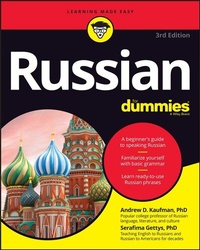
Russian For Dummies
Description

With over 260 million speakers around the world, Russian remains one of the most popular and marketable languages you can learn. And for those who have no idea where to begin, Russian For Dummies is the perfect first step!
In this easy-to-understand resource for Russian language beginners, you'll discover basic grammar and common expressions you might use while shopping, dining out, traveling, or conducting business. You'll also find simplified and generalized conjugation rules and a streamlined approach to grammar based on how you actually understand the language, rather than technical rules and details.
This book offers:
* Supplemental online resources so you can hear how native Russian speakers use the words you're trying to learn
* Guidance on identifying Cyrillic letters from the alphabet used by Russian speakers and writers
* Tons of useful exercise and practice opportunities you can take advantage of to sharpen your skills
Perfect for any newcomer to the Russian language trying to pick up their first few phrases, Russian For Dummies is a fantastic first foray into conversational Russian that will have you ordering meals, going shopping, and navigating other day-to-day situations with ease. ! (That means good luck!)
More details
Other editions
Additional editions
Persons
Serafima Gettys, PhD, is Director of the Foreign Language Program at Lewis University, where she also teaches Russian.
Content
Introduction
Speaking more than one language is like living more than one life, one of the ancient philosophers said. And it's true - traveling in a foreign country such as Russia suddenly becomes a lot more exciting when you can engage in elegant small talk with a hotel receptionist, compliment your tour guide's dress, or actually read the menu and order the food that you really want. Being able to ask for things instead of pointing at them and getting directions from the locals instead of staring at a map are some of the little things that make you feel at home.
You don't even need to cross the ocean to immerse yourself in Russian culture; you can find little Russian neighborhoods (or even pretty big ones!) in many American cities. Whether your colleagues, your neighbors, or your friends speak Russian, the best way to win their hearts is to speak their language to them.
Now, Russian For Dummies, 3rd Edition, won't make you a fluent reader of the original works of Dostoevsky (most Russians themselves need some preparation for that). Neither is it a textbook or grammar reference book. It will, however, equip you with phrases necessary to function in many life situations, from shopping to visiting the theater. And little gems of cultural wisdom offered throughout the book help you not only translate the language, but also understand Russians so much better. So, buckle up, and good luck on your journey! Or, as the Russians like to say, ?e?ae??a???a??! (zhi-lah-eem vahm ooh-dah-chee!) (We wish you good luck!).
About This Book
The best thing about Russian For Dummies, 3rd Edition, is that you don't have to read all the way through it to get the information you need. Again, this is not a Russian textbook where each new chapter or unit is built upon what you've learned before. What this means is you you can open the table of contents, find the section that interests you at the moment, and start talking! You don't have to read the previous chapters to understand any sections of this book. And if you decide that you want more information about something, a convenient system of cross-references takes you to just the right place.
Another thing you don't need to do is memorize long vocabulary lists or grammar rules. We give you ready-made phrases; you just need to read them to start using them right away to impress your Russian friends!
Conventions Used in This Book
Here are some conventions that allow you to navigate through this book with maximum ease:
- We present Russian in Russian, or what is also known as the Cyrillic alphabet. You can see the Cyrillic alphabet in Chapter 2. Russian terms are easily found in the text because they're set in boldface.
-
Each Russian word or sentence is followed by its pronunciation shown in English letters, and its English translation, respectively, in parentheses. In each pronunciation, the stressed syllable is in italics (Russian stresses are unpredictable and the words need to be remembered with their stresses); translations are also in italics.
Here's a little example to give you an idea of what we mean: The phrase for "I love you" in Russian is
??e???????(ya tee-bya lyooh-blyooh) (I love you). -
Verb conjugations (lists that show you the forms of a verb) are given in tables in this order:
- The I form
- The you (informal singular) form
- The he/she/it form
- The we form
- The you (formal singular or plural) form
- The they form
Pronunciations follow in the second column.
The meaning of a phrase doesn't always equal the sum of the individual words the phrase consists of. In this case, we talk about a literal meaning (the meaning of the individual words) and an idiomatic meaning (the actual meaning of the phrase in conversation). If the literal translation of a phrase differs from its idiomatic meaning, we give you both the idiomatic and the literal meanings in parentheses. For instance: ?a??e?a? (kahk dee-lah?) (How are you? Literally: How is business?).
In each chapter, look for the following elements:
- Talkin' the Talk: These real-life dialogues illustrate how native speakers use words and phrases in a particular section of the book. These informal dialogues are the actual conversations you may hear in similar situations. You can also play an audio version of these dialogues to help you grasp them even faster!
- Words to Know: This element follows every Talkin' the Talk and provides pronunciation and transcription of key words and expressions you encounter in the dialogue.
- Fun & Games: Find this section at the end of each chapter. These fun activities allow you to use the new words and phrases you encounter in each chapter to answer questions and solve puzzles.
What You're Not to Read
We like to think that you'll read every word in this book, but we also know that you're eager to start speaking Russian. So feel free to skip the sidebars (the gray-shaded boxes sprinkled throughout the book); they contain interesting information but aren't essential to your study of Russian.
Foolish Assumptions
When we started writing this book, we tried to imagine what our future reader was going to be like. In the end, we came up with a list of foolish assumptions about who we think wants to read this book. Do you recognize yourself in these descriptions?
- You know no Russian - or if you took Russian in high school, you don't remember a word of it.
- You're not looking for a book that will make you fluent in Russian; you just want to know some words, phrases, and sentence constructions so that you can communicate basic information in Russian.
- You don't want to have to memorize long lists of vocabulary words or a bunch of boring grammar rules.
- You want to have fun and learn a little bit of Russian at the same time.
How This Book Is Organized
Russian For Dummies, 3rd Edition, consists of four parts and a few appendixes. Each part of the book offers something different.
Part 1: Getting Started
In this part, you find the essentials of the Russian language. Chapter 1 gives you an overview of what you discover in this book. Chapter 2 introduces the Russian alphabet, Chapter 3 gives you a crash course on Russian grammar (but in very general terms, to give you a sense of the principles of Russian grammar, not mastery of it), and Chapter 4 gets you started with some basic Russian expressions. Chapter 5 is the right place to turn to if you want to talk about numbers, times, and measurements in Russian. And finally, Chapter 6 encourages you to start speaking Russian in the comfort of your home.
Part 2: Russian in Action
Part 2 prepares you for most social situations that you need to handle in Russian. Chapter 7 shows you how to make small talk; Chapter 8 is all about asking for directions in a strange city. Chapters 9 and 10 prepare you to talk about food and shopping. Chapter 11 equips you with words and phrases you can use while going out on the town. Chapter 12 takes you on a tour of your office and equips you with the necessary phrases to make phone calls and use a computer. In Chapter 13, you find out how to talk about fun things, such as sports, reading, and other hobbies.
Part 3: Russian on the Go
This part covers all the aspects of traveling, such as planning your trip (Chapter 14), settling your financial matters (Chapter 15), discussing transportation (Chapter 16), and arranging for a place to stay (Chapter 17). Chapter 18 prepares you for handling emergencies.
Part 4: The Part of Tens
The Part of Tens is an unusual part of this book; it gives you lists of fun things to know, such as ten ways to pick up Russian quickly and ten things never to say in Russian. This part is also the place to find ten favorite Russian expressions and to pick up ten phrases that make you sound authentically Russian.
Appendixes
Russian For Dummies, 3rd Edition, also includes three appendixes, which bring together some useful information. In Appendix A, you find two mini-dictionaries (both Russian-to-English and English-to-Russian) for quick reference. Appendix B contains verb tables that show you how to conjugate regular and irregular verbs. Appendix C offers the answer keys to the Fun & Games sections of each chapter.
Icons Used in This Book
For your convenience, we marked some information in this book with special icons. Check out this guide to the icons, and the next time you see one of them, you'll know what to expect!
From famous Russian writers to a polite way to...
