

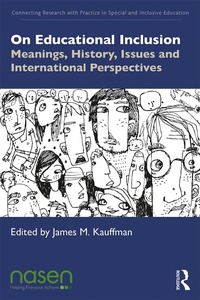
On Educational Inclusion
Meanings, History, Issues and International Perspectives
1st Edition
Published on 18. February 2020
300 pages
978-1-000-03840-8 (ISBN)
Description

Combining examination of policy with primary research and analysis of up-to-date literature, On Inclusive Education explores the various interpretations of inclusion, its history in education, and a range of its applications internationally.
With an international complement of authors, this book features detailed yet accessible chapters on a range of topics, including inclusion in law; academically gifted students; students with severe, sensory, and multiple impairments; and case studies from Germany, Portugal, the Netherlands, and the Russian Federation. The book also examines the impact of the Convention on the Rights of Persons with Disabilities-and Article 24 in particular-and the likely legacies and future implications of recent inclusion movements.
For postgraduate students and academics researching in the field of inclusive education, and also for school administrators and policy makers, On Inclusive Education is an essential resource.
With an international complement of authors, this book features detailed yet accessible chapters on a range of topics, including inclusion in law; academically gifted students; students with severe, sensory, and multiple impairments; and case studies from Germany, Portugal, the Netherlands, and the Russian Federation. The book also examines the impact of the Convention on the Rights of Persons with Disabilities-and Article 24 in particular-and the likely legacies and future implications of recent inclusion movements.
For postgraduate students and academics researching in the field of inclusive education, and also for school administrators and policy makers, On Inclusive Education is an essential resource.
Reviews / Votes
Inclusion aims to integrate students with special needs into general education. Inclusion should be analyzed with precision and competence, and interventions should be based on data derived from empirical research. Special education involves many forms and levels of difference, and does not allow simplistic, ideological answers. Without recognizing its limits in specific situations, inclusion can create more problems for schools, families, and children themselves than it solves. Nuanced and context-linked decisions are needed. This book will be useful for teachers, parents, educators, and psychologists who want first to achieve an effective answer to the special needs of children, then inclusion in general education when appropriate. - Santo F. Di Nuovo, Professor of Psychology, University of Catania, Italy, and President of the Italian Association of PsychologyThis is a timely, unique, and important book that focuses on relevant theory, research, and practical realities of the trend towards inclusion of all children with special needs and disabilities in mainstream schools. It pulls together perspectives of many experts in the field of special education in order to examine the potential benefits and negative consequences of such inclusion. It makes the case for not only maintaining special education but strengthening it through understanding the complex nature of this work, ensuring a strong base of scientific evidence, and carefully evaluating outcomes. - Garry Hornby, Emeritus Professor of Education, Plymouth University, UK
The complex issue of educational inclusion of students with disabilities has been at the forefront of special education research, commentary, practice, and policy for more than three decades. In this volume, we finally have a comprehensive view of the thorniest of issues surrounding inclusion and how our leaders in the field capture its complexities with clarity, command of the facts, and concern for how to ensure that special, individualized education is obtainable for students with disabilities. If you are concerned about the future of special education, you must read this volume. Get ready to think more clearly about educational inclusion. - Melody Tankersley, Interim Senior Vice President and Provost, Kent State University, USA
More details
Series
Edition
1. Auflage
Language
English
Place of publication
London
United Kingdom
Publishing group
Taylor & Francis Ltd
Target group
Professional and scholarly
College/higher education
Illustrations
17 Tables, black and white; 4 Line drawings, black and white; 4 Illustrations, black and white
ISBN-13
978-1-000-03840-8 (9781000038408)
Copyright in bibliographic data and cover images is held by Nielsen Book Services Limited or by the publishers or by their respective licensors: all rights reserved.
Schweitzer Classification
Other editions
Additional editions
Book
03/2020
1st Edition
Routledge
€60.60
Shipment within 15-20 days
Book
03/2020
1st Edition
Routledge
€192.04
Shipment within 15-20 days
Person
James M. Kauffman is Professor Emeritus of Education at the University of Virginia, USA. His many publications include articles and book chapters related to inclusion of students with disabilities in general education. He has been a teacher in both special and general education.
Content
Author Biographies
Series Editor Foreword
Philip Garner
Foreword
Edwin W. Martin, Jr.
Preface
James M. Kauffman
Chapter 1 Definitions and Other Issues
Kames M. Kauffman and Jeanmarie Badar
Chapter 2 Inclusion as Idea and its Justification in Law
Jean B. Crockett
Chapter 3 The Inclusion of Students with High-Incidence Disabilities in General Education Environments
Brian R. Barber and Andrew L Wiley
Chapter 4 A Science of Instruction and Its Implications for Students with Disabilities
Justin T. Cooper, Terrance M. Scott and Todd Whitney
Chapter 5 Tiered Systems and Inclusion: Potential Benefits, Clarifications, and Considerations
Kathleen Lynne Lane, Mark Matthew Buckman, Wendy Peia Oakes and Holly Menzies
Chapter 6 Disproportionality and Inclusion
Adrienne D. Woods, Yangyang Wang and Paul L. Morgan
Chapter 7 An Examination of Highly-Cited Research on Inclusion
Bryan G. Cook and Lysandra Cook
Chapter 8 Inclusion and Students with Severe, Sensory, and Multiple Impairments
Jason C. Travers, Heather J. Forbes, Jenee Vickers Johnson and Kevin Ayres
Chapter 9 Inclusion of Academically Advanced (Gifted) Students
Carolyn M. Callahan, Jonathan A. Plucker, Stuart Gluck and Carlos Rodriguez
Chapter 10 Inclusion, Governments, and Nongovernmental Organizations
Mitchell L. Yell and David F. Bateman
Chapter 11 The Impact of Article 24 of the CRPD on Special and Inclusive Education in Germany, Portugal, the Russian Federation and the Netherlands
Dimitris Anastasiou, Marion Felder, Luis Augusto De Miranda Correia, Alexey Shemanov, Inge Zweers and Bernd Ahrbeck
Chapter 12 Likely Legacies of the Inclusion Movement
James M. Kauffman, Daniel P. Hallaha, Timothy J. Landrum and Carl R. Smith
Index
Series Editor Foreword
Philip Garner
Foreword
Edwin W. Martin, Jr.
Preface
James M. Kauffman
Chapter 1 Definitions and Other Issues
Kames M. Kauffman and Jeanmarie Badar
Chapter 2 Inclusion as Idea and its Justification in Law
Jean B. Crockett
Chapter 3 The Inclusion of Students with High-Incidence Disabilities in General Education Environments
Brian R. Barber and Andrew L Wiley
Chapter 4 A Science of Instruction and Its Implications for Students with Disabilities
Justin T. Cooper, Terrance M. Scott and Todd Whitney
Chapter 5 Tiered Systems and Inclusion: Potential Benefits, Clarifications, and Considerations
Kathleen Lynne Lane, Mark Matthew Buckman, Wendy Peia Oakes and Holly Menzies
Chapter 6 Disproportionality and Inclusion
Adrienne D. Woods, Yangyang Wang and Paul L. Morgan
Chapter 7 An Examination of Highly-Cited Research on Inclusion
Bryan G. Cook and Lysandra Cook
Chapter 8 Inclusion and Students with Severe, Sensory, and Multiple Impairments
Jason C. Travers, Heather J. Forbes, Jenee Vickers Johnson and Kevin Ayres
Chapter 9 Inclusion of Academically Advanced (Gifted) Students
Carolyn M. Callahan, Jonathan A. Plucker, Stuart Gluck and Carlos Rodriguez
Chapter 10 Inclusion, Governments, and Nongovernmental Organizations
Mitchell L. Yell and David F. Bateman
Chapter 11 The Impact of Article 24 of the CRPD on Special and Inclusive Education in Germany, Portugal, the Russian Federation and the Netherlands
Dimitris Anastasiou, Marion Felder, Luis Augusto De Miranda Correia, Alexey Shemanov, Inge Zweers and Bernd Ahrbeck
Chapter 12 Likely Legacies of the Inclusion Movement
James M. Kauffman, Daniel P. Hallaha, Timothy J. Landrum and Carl R. Smith
Index
