

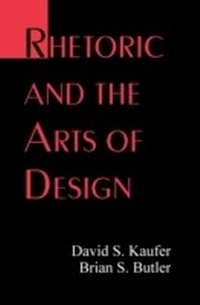
Rhetoric and the Arts of Design
1st Edition
Published on 26. November 2013
344 pages
978-1-136-68643-6 (ISBN)
Description

The design arts -- from the design of buildings and machines to software and interfaces -- are associated with types of knowledge and performance thought to be structured, modular, and systematic. Such arts have become increasingly prestigious in our technocratic society. Since Aristotle, the art of rhetoric was conceived as a loosely structured "practical" art thought to be limited in the extent to which it could mimic more precise subject matters. The art of rhetoric has been controversial since classical times, but its status has sunk even lower since the industrial revolution -- a point when civic cultures began to cede authority and control to the cultures of specialized experts. Many sympathizers of rhetoric have resisted its decline by calling for a civic art of public discourse to stand in opposition to a technocratic specialized discourse that has come, increasingly, to disenfranchise the ordinary citizen.
This is the first book to question the rhetoric/technical knowledge split from a more fundamental perspective. To get some perspective on what is at stake in rhetoric's traditional classification as a "practical" art, the authors:
* explore the distinction between practical and design arts;
* enumerate the various criteria cited in the literature for qualifying a cluster of knowledge and performative skills to count as an art of design;
* show how the knowledge and performative skills associated with the art of rhetoric meet the major requirements of design knowledge;
* propose a general architecture of rhetorical design, one descriptive both of civic address and specialized academic argument;
* turn to the Lincoln/Douglas debates to embody and provide some empirical support and illustration for their architecture;
* demonstrate how Lincoln and Douglas can be thought of as expert designers whose rhetoric is highly structured and modular; and
* explain how the rhetoric of both rhetorical agents can be represented in the layers and modules that one needs to display plans for buildings, software, or other design artifacts.
These layers and modules are not just post hoc annotations of the debates; they also illuminate new and systematic ways for viewing the debates -- and by implication, other specimens of rhetoric -- in terms of strategies of artistic production. Kaufer and Butler conclude their presentation by citing some of the research and educational implications that follow from housing rhetoric within the family of design arts.
This is the first book to question the rhetoric/technical knowledge split from a more fundamental perspective. To get some perspective on what is at stake in rhetoric's traditional classification as a "practical" art, the authors:
* explore the distinction between practical and design arts;
* enumerate the various criteria cited in the literature for qualifying a cluster of knowledge and performative skills to count as an art of design;
* show how the knowledge and performative skills associated with the art of rhetoric meet the major requirements of design knowledge;
* propose a general architecture of rhetorical design, one descriptive both of civic address and specialized academic argument;
* turn to the Lincoln/Douglas debates to embody and provide some empirical support and illustration for their architecture;
* demonstrate how Lincoln and Douglas can be thought of as expert designers whose rhetoric is highly structured and modular; and
* explain how the rhetoric of both rhetorical agents can be represented in the layers and modules that one needs to display plans for buildings, software, or other design artifacts.
These layers and modules are not just post hoc annotations of the debates; they also illuminate new and systematic ways for viewing the debates -- and by implication, other specimens of rhetoric -- in terms of strategies of artistic production. Kaufer and Butler conclude their presentation by citing some of the research and educational implications that follow from housing rhetoric within the family of design arts.
Reviews / Votes
"...the book as a whole is an important step forward."-Quarterly Journal of Speech
"...an excellent analysis....the authors have created a model that is impressive in ints detail and applicability, especially to those teaching composition and argument."
-Discourse and Society
"In this unusual and insightful book, they employ the idiom of cognitive science to achieve several goals. Given the scope of their project, they succeed remarkably well."
-Jahrbuch Rhetoric
Advance praise... "Kaufer and Butler offer a bold new path for rhetorical studies, dusting off and dressing up the 'harlot of the arts' in the most contemporary garb -- movements of architecture and design. This book will be a welcome provocation to classicists and modernists alike -- well argued, more than a little quirky, and always lively. I think it is not only essential reading for students and scholars in the arts; it is also great fun."
-Thomas B. Farrell
Northwestern University
"The central thesis of this remarkable book is that rhetoric should be regarded as belonging to the family of design arts. The thesis is defended through a careful, well-informed argument and brilliantly illustrated by reference to the Lincoln-Douglas debates. A masterful synthesis of traditional and contemporary rhetorical lore and of theoretical and practical interests. Rhetoric and the Arts of Design constructively formulates basic issues in rhetorical scholarship and opens new avenues for research."
-Michael Leff
Northwestern University
"In an unusual combination, Kaufer and Butler draw together orderly theory in the tradition of cognitive psychology and insights on both contemporary and historical public discourse. They show the power of rhetoric to affect our lives and pose what they call the fundamental question of rhetoric...How do we 'Design Things' with Words?"
-Dorothy Winsor
GMI Engineering & Management Institute
"...they address with great clarity and creativity the problems that bedevil any humanistic theory of rhetoric, and provide constructive solutions which will be instructive for anyone working in rhetorical theory or criticism."
-William Keith
Oregon State University
More details
Language
English
Place of publication
London
United Kingdom
Publishing group
Taylor & Francis Ltd
Target group
Professional and scholarly
File size
10,81 MB
ISBN-13
978-1-136-68643-6 (9781136686436)
Copyright in bibliographic data and cover images is held by Nielsen Book Services Limited or by the publishers or by their respective licensors: all rights reserved.
Schweitzer Classification
Other editions
Additional editions
David S. Kaufer | Brian S. Butler
Rhetoric and the Arts of Design
Book
02/1996
1st Edition
Routledge
€207.10
Article not available at the moment
David S. Kaufer | Brian S. Butler
Rhetoric and the Arts of Design
Book
02/1996
1st Edition
Routledge
€73.10
Shipment within 10-20 days
Persons
David S. Kaufer, Brian S. Butler
Content
Contents: Preface. Introduction. Rhetoric and Design: The Ancient Art Meets the Modern Science. Overlooking Rhetoric as Design. The Environments of Rhetoric and Design. An Architecture of Rhetorical Design. Goals. Structure. Plans. Tactics. Events. Putting it Together and Leaving it Undone: Threads and Loose Ends.
