

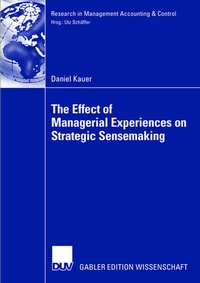
The Effect of Managerial Experiences on Strategic Sensemaking
1st Edition
Published on 29. February 2008
XVII, 257 pages
978-3-8349-9632-9 (ISBN)
Description

In order to survive in increasing environmental turbulence and uncertainty in the business context, organizations have to reconsider and revise their strategies frequently. But not all of them manage to detect and interpret environmental changes and, if necessary, react adequately.
Based on 50 interviews with top managers, Daniel Kauer studies the effects of managerial experiences on the strategic sensemaking of top management teams. He shows that it is very important to distinguish between the depth and breadth of managerial experience, as these discrete dimensions have different effects on strategic sensemaking on the individual as well as on the organizational level. While diversity represents a team's potential to be successful in strategic sensemaking, the team must realize this potential through effective interaction. Therefore, the author also analyzes decisive interaction factors and describes how teams can best leverage their members' experience.
Based on 50 interviews with top managers, Daniel Kauer studies the effects of managerial experiences on the strategic sensemaking of top management teams. He shows that it is very important to distinguish between the depth and breadth of managerial experience, as these discrete dimensions have different effects on strategic sensemaking on the individual as well as on the organizational level. While diversity represents a team's potential to be successful in strategic sensemaking, the team must realize this potential through effective interaction. Therefore, the author also analyzes decisive interaction factors and describes how teams can best leverage their members' experience.
More details
Series
Language
English
Place of publication
Wiesbaden
Germany
Publishing group
Betriebswirtschaftlicher Verlag Gabler
Target group
Professional and scholarly
Illustrations
XVII, 257 p.
File size
3,39 MB
ISBN-13
978-3-8349-9632-9 (9783834996329)
DOI
10.1007/978-3-8349-9632-9
Schweitzer Classification
Other editions
Additional editions
Daniel Kauer
The Effect of Managerial Experiences on Strategic Sensemaking
An Empirical Study of Top Management Teams. Zugl. Diss. European Business School Oetsrich Winkel 2006 - 210 x 148 mm
Book
01/2008
1st Edition
Springer Gabler
€53.49
Shipment within 10-15 days
Persons
Dr. Daniel Kauer promovierte bei Prof. Dr. Utz Schäffer am Lehrstuhl für Controlling der European Business School, Oestrich-Winkel. Er ist als Unternehmensberater tätig.
Content
Cognitive Theory - The Theoretical Foundation of Strategic Sensemaking.- Strategic Sensemaking Theory.- Research Design.- Results: Experience as an Influencing Factor of Strategic Sensemaking.- Implications and Outlook.
A Introduction (p. 1)
"Foolish he who trusts in the future, he who laughs Friday will cry Sunday". Jean Racine (1639-1699)
1. Research Topic and Objectives
Increasing levels of environmental turbulence and uncertainty in the business context have been documented for several decades and by a variety of scholars. To survive in such turbulent environments, where competitive advantages can be nullified rapidly, organizations must frequently reconsider and revise their strategies and therefore have to thoroughly understand their competitive environment. But not all organizations manage to detect, interpret and - if necessary - react to environmental changes: In two studies, for example, published in 2002 and 2005, WIGGINS AND RUEFLI show that while many companies can manage short-term bursts of high performance, only a few can sustain this in the longer run:
The authors sort a sample of 6,772 companies over 23 years into superior, middle and inferior performers in their industries. Only , percent of these companies remain in the superior stratum for 10 years or more. WIGGINS AND RUEFLI conclude that the short-term performers are successful executers that have lost their way when the environment shifted. The companies have neither interpreted upcoming challenges correctly, nor have drawn the right conclusions and disregarded the fact that all sources of competitive advantage are temporary.
To answer the question why some organizations successfully cope with environmental changes while others fail, various researchers suggest a crucial role of top managers, because they "[.] are charged with formulating, directing, coordinating, and managing the organizations response to rapid environmental change". Before being able to formulate the organizations response however, top managers need to detect that there is an environmental change, which has the potential to jeopardize the strategic position and performance of the organization. Such environmental changes are often referred to as "strategic issues".
Many researchers have noted the importance of managing strategic issues and have pointed to the relevance of information about strategic issues in order to enable effective organizational actions. As early as 1967, AGUILAR for example stressed that "[.] the need for top management to foresee and understand changes in the environment has become increasingly important [.]".
But he also recognized that "[.] top managements understanding of the [.] process was found to be generally inadequate, and there was little evidence of any coordinated, overall consideration of the problems involved". , ANSOFF pointed out that strategy concepts should be able to answer the question of how to configure the resources of a firm to effectively respond to unanticipated surprises. DAVENI supported this claim noting that in order "[.] to be effective in times of change, strategy must look to an industrys future".
However, a growing number of researchers, especially from the "cognitive theory school" stresses, that this "look to an industrys future" is not objective. It is "[.] socially created rather than concrete [. and] the environment is the joint product of the actions of purposeful actors and accompanying efforts to make sense out of these actions". , Building on the assumption of "purposeful actors" affecting the management of strategic issues, STARBUCK AND MILLIKEN argue that "[.] the stimuli that one executive receives may be precisely the same stimuli that another executive filters out.
"Foolish he who trusts in the future, he who laughs Friday will cry Sunday". Jean Racine (1639-1699)
1. Research Topic and Objectives
Increasing levels of environmental turbulence and uncertainty in the business context have been documented for several decades and by a variety of scholars. To survive in such turbulent environments, where competitive advantages can be nullified rapidly, organizations must frequently reconsider and revise their strategies and therefore have to thoroughly understand their competitive environment. But not all organizations manage to detect, interpret and - if necessary - react to environmental changes: In two studies, for example, published in 2002 and 2005, WIGGINS AND RUEFLI show that while many companies can manage short-term bursts of high performance, only a few can sustain this in the longer run:
The authors sort a sample of 6,772 companies over 23 years into superior, middle and inferior performers in their industries. Only , percent of these companies remain in the superior stratum for 10 years or more. WIGGINS AND RUEFLI conclude that the short-term performers are successful executers that have lost their way when the environment shifted. The companies have neither interpreted upcoming challenges correctly, nor have drawn the right conclusions and disregarded the fact that all sources of competitive advantage are temporary.
To answer the question why some organizations successfully cope with environmental changes while others fail, various researchers suggest a crucial role of top managers, because they "[.] are charged with formulating, directing, coordinating, and managing the organizations response to rapid environmental change". Before being able to formulate the organizations response however, top managers need to detect that there is an environmental change, which has the potential to jeopardize the strategic position and performance of the organization. Such environmental changes are often referred to as "strategic issues".
Many researchers have noted the importance of managing strategic issues and have pointed to the relevance of information about strategic issues in order to enable effective organizational actions. As early as 1967, AGUILAR for example stressed that "[.] the need for top management to foresee and understand changes in the environment has become increasingly important [.]".
But he also recognized that "[.] top managements understanding of the [.] process was found to be generally inadequate, and there was little evidence of any coordinated, overall consideration of the problems involved". , ANSOFF pointed out that strategy concepts should be able to answer the question of how to configure the resources of a firm to effectively respond to unanticipated surprises. DAVENI supported this claim noting that in order "[.] to be effective in times of change, strategy must look to an industrys future".
However, a growing number of researchers, especially from the "cognitive theory school" stresses, that this "look to an industrys future" is not objective. It is "[.] socially created rather than concrete [. and] the environment is the joint product of the actions of purposeful actors and accompanying efforts to make sense out of these actions". , Building on the assumption of "purposeful actors" affecting the management of strategic issues, STARBUCK AND MILLIKEN argue that "[.] the stimuli that one executive receives may be precisely the same stimuli that another executive filters out.
