

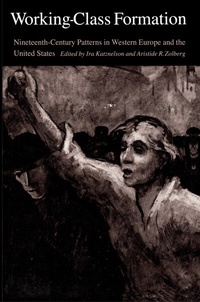
Working-Class Formation
Ninteenth-Century Patterns in Western Europe and the United States
1st Edition
Published on 5. April 2022
482 pages
978-0-691-22822-8 (ISBN)
Description

Applying an original theoretical framework, an international group of historians and social scientists here explores how class, rather than other social bonds, became central to the ideologies, dispositions, and actions of working people, and how this process was translated into diverse institutional legacies and political outcomes. Focusing principally on France. Germany, and the United States, the contributors examine the historically contingent connections between class, as objectively structured and experienced, and collective perceptions and responses as they develop in work, community, and politics.
Following Ira Katznelson's introduction of the analytical concepts, William H. Sewell, Jr., Michelle Perrot, and Alain Cottereau discuss France; Amy Bridges and Martin Shefter, the United States; and Jargen Kocka and Mary Nolan, Germany. The conclusion by Aristide R. Zolberg comments on working-class formation up to World War I, including developments in Great Britain, and challenges conventional wisdom about class and politics in the industrializing West.
Following Ira Katznelson's introduction of the analytical concepts, William H. Sewell, Jr., Michelle Perrot, and Alain Cottereau discuss France; Amy Bridges and Martin Shefter, the United States; and Jargen Kocka and Mary Nolan, Germany. The conclusion by Aristide R. Zolberg comments on working-class formation up to World War I, including developments in Great Britain, and challenges conventional wisdom about class and politics in the industrializing West.
More details
Other editions
Additional editions
Ira Katznelson | Aristide R. Zolberg
Working-Class Formation
Ninteenth-Century Patterns in Western Europe and the United States
Book
12/1986
Princeton University Press
€62.50
Article not available at the moment
Ira Katznelson | Aristide R. Zolberg
Working-Class Formation
Ninteenth-Century Patterns in Western Europe and the United States
Book
12/1986
Princeton University Press
€71.80
Article exhausted; check different version
Persons
Ira Katznelson is Ruggles Professor of Political Science and History at Columbia University. Aristide R. Zolberg is Walter A. Eberstadt Professor of Political Science at the Graduate Faculty of New School University in New York City and director of its International Center for Migration, Ethnicity, and Citizenship.
Content
- Cover Page
- Half-title Page
- Title Page
- Copyright Page
- Contents
- Preface
- Introduction
- 1. Working-Class Formation: Constructing Cases and Comparisons
- Part One. France
- 2. Artisans, Factory Workers, and the Formation of the French Working Class, 1789-1848
- 3. On the Formation of the French Working Class
- 4. The Distinctiveness of Working-Class Cultures in France, 1848-1900
- Part Two. The United States
- 5. Becoming American: The Working Classes in the United States before the Civil War
- 6. Trade Unions and Political Machines: The Organization and Disorganization of the American Working Class in the Late Nineteenth Century
- Part Three. Germany
- 7. Problems of Working-Class Formation in Germany: The Early Years, 1800-1875
- 8. Economic Crisis, State Policy, and Working-Class Formation in Germany, 1870-1900
- Conclusion
- 9. How Many Exceptionalisms? Aristide
- List of Contributors
- Index
