

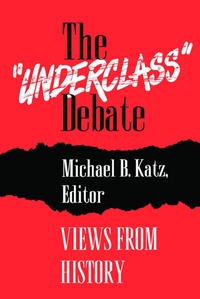
The "Underclass" Debate
Views from History
1st Edition
Published on 19. November 2018
520 pages
978-0-691-18854-6 (ISBN)
Description

Do ominous reports of an emerging "underclass" reveal an unprecedented crisis in American society? Or are social commentators simply rediscovering the tragedy of recurring urban poverty, as they seem to do every few decades? Although social scientists and members of the public make frequent assumptions about these questions, they have little information about the crucial differences between past and present. By providing a badly needed historical context, these essays reframe today's "underclass" debate. Realizing that labels of "social pathology" echo fruitless distinctions between the "deserving" and "undeserving" poor, the contributors focus not on individual and family behavior but on a complex set of processes that have been at work over a long period, degrading the inner cities and, inevitably, the nation as a whole.
How do individuals among the urban poor manage to survive? How have they created a dissident "infrapolitics?" How have social relations within the urban ghettos changed? What has been the effect of industrial restructuring on poverty? Besides exploring these questions, the contributors discuss the influence of African traditions on the family patterns of African Americans, the origins of institutions that serve the urban poor, the reasons for the crisis in urban education, the achievements and limits of the War on Poverty, and the role of income transfers, earnings, and the contributions of family members in overcoming poverty. The message of the essays is clear: Americans will flourish or fail together.
How do individuals among the urban poor manage to survive? How have they created a dissident "infrapolitics?" How have social relations within the urban ghettos changed? What has been the effect of industrial restructuring on poverty? Besides exploring these questions, the contributors discuss the influence of African traditions on the family patterns of African Americans, the origins of institutions that serve the urban poor, the reasons for the crisis in urban education, the achievements and limits of the War on Poverty, and the role of income transfers, earnings, and the contributions of family members in overcoming poverty. The message of the essays is clear: Americans will flourish or fail together.
More details
Other editions
Additional editions

Book
01/1993
Princeton University Press
€92.85
Article exhausted; check different version
Book
12/1992
Princeton University Press
€66.80
Article not available at the moment
Person
Michael B. Katz is Stanley I. Sheerr Professor of History at the University of Pennsylvania. He is the author or editor of ten books on the history of education, social policy, and poverty, including Poverty and Policy in American History (Academic Press), In the Shadow of the Poorhouse: A Social History of Welfare in America (Basic Books), and The Undeserving Poor: From the War on Poverty to the War on Welfare (Pantheon).
Content
- Cover
- Title Page
- Copyright Page
- Contents
- Preface
- INTRODUCTION The Urban "Underclass" as a Metaphor of Social Transformation
- PART ONE: The Roots of Ghetto Poverty
- CHAPTER 1 Southern Diaspora: Origins of the Northern "Underclass
- CHAPTER 2 Blacks in the Urban North: The "Underclass Question" in Historical Perspective
- PART TWO: The Transformation of America's Cities
- CHAPTER 3 The Structures of Urban Poverty: The Reorganization of Space and Work in Three Periods of American History
- CHAPTER 4 Housing the "Underclass
- PART THREE: Families, Networks, and Opportunities
- CHAPTER 5 The Ethnic Niche and the Structure of Opportunity: Immigrants and Minorities in New York City
- CHAPTER 6 The Emergence of "Underclass" Family Patterns, 1900-1940
- CHAPTER 7 Poverty and Family Composition since 1940
- CHAPTER 8 Social Science, Social Policy, and the Heritage of African-American Families
- PART FOUR: Politics, Institutions, and the State
- CHAPTER 9 The Black Poor and the Politics of Opposition in a New South City, 1929-1970
- CHAPTER 10 Nineteenth-Century Institutions: Dealing with the Urban "Underclass
- CHAPTER 11 Urban Education and the "Truly Disadvantaged": The Historical Roots of the Contemporary Crisis, 1945-1990
- CHAPTER 12 The State, the Movement, and the Urban Poor: The War on Poverty and Political Mobilization in the 1960s
- CONCLUSION Reframing the "Underclass" Debate
- Contributors
- Name Index
- Subject Index
