

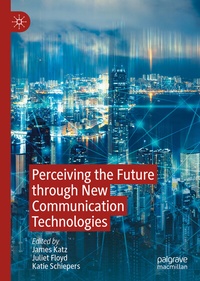
Perceiving the Future through New Communication Technologies
Description

The volume is organised into three main sections: The phenomena of new communication technology in people's lives from a contemporary viewpoint; the meaning of robots and AI as they play an increasing role in people's experience and; broader issues concerning the operational, sociological and philosophical implications of people as they address a technology driven future.
More details
Other editions
Additional editions
Persons
James E. Katz is Feld Professor of Emerging Media at Boston University's College of Communication, USA, where he directs its Division of Emerging Media Studies. His publications on the effects of artificial intelligence, social media, mobile communication, and robot-human interaction have been internationally recognized and widely translated. Among his recent volumes are Journalism and the Search for Truth in an Age of Social Media (with Kate Mays, 2019) and Philosophy of Emerging Media (with Juliet Floyd, 2015).
Juliet Floyd is Professor of Philosophy at Boston University, USA. Her publications, translated into several languages, span the history and philosophy of logic, mathematics, language, symbolism, and new media, focusing especially on the history of twentieth century philosophy and philosophical aspects of emerging media. Her recent books include Wittgenstein's Annotations to Hardy's Course of Pure Mathematics (with Felix Mühlhölzer, 2020) and Wittgenstein's Philosophy of Mathematics (2021).
Katie Schiepers is Division Administrator for Emerging Media Studies at Boston University, USA. She holds a Master of Philosophy in Classics and Master of Science in World Heritage Conservation and is currently pursuing advanced studies in educational policy.
Content
Part I Conceptual Framework.-1. Introduction.- 2. Media Are Dead, Long Live Media: Apparatgeist's Capacity for Understanding Media Evolution.- 3. Selves and Forms of Life in the Digital Age: A Philosophical Exploration of Apparatgeist.- 4. Shared Screen Time: The Role of the Mobile Phone in Local Social Interaction in 2000 and 2020.- 5. Possibility or Peril? Exploring the Emotional Choreography of Social Robots in Inter- and Intrapersonal Lives.- 6. The Artificialistic Fallacy.- Part II Future Technologies in Action.-7. Thing or No-Thing: Robots Are Not Just a Thing, Not yet a Human. An Essay in Thinking Through Media by Hermeneutics of Difference.- 8. Apparatgesit of Pepper-kun: Exploration of emerging cultural meanings of a social robot in Japan.- 9. Is it Just a Tool or is it a Friend? Exploring Chinese users' interaction and relationship with smart speakers.- 10. Likable and Competent, Fictional and Real: Impression Management of a Social Robot.- Part III Looking Back and Forward.- 11. One-Way Tele-contact: Norbert Wiener's Yesterday's Tomorrow.- 12. Future Shock Or Future Chic?: Human Orientation to the Future(s) in the Context of Technological Proliferation.- 13. Voicing the Future: Folk Epistemic Understandings of Smart and Datafied Lives.- 14. Socio-technical Issues Concerning the Future of New Communication Technology, Robots, and AI.-15. Conclusions.
