

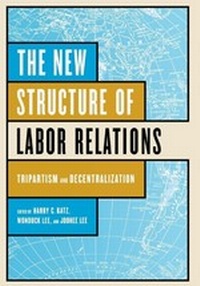
The New Structure of Labor Relations
Tripartism and Decentralization
1st Edition
Published on 5. July 2018
280 pages
978-1-5017-3143-3 (ISBN)
Description

Tripartism-the national-level interaction among representatives of labor, management, and government-occurs infrequently in the United States. Based on the U.S. experience, then, such interactions might seem irrelevant to economic performance and policymaking. The essays in this volume reveal the falsity of that assumption.
Contributors from eight industrialized countries (Australia, Germany, Ireland, Italy, Japan, Korea, the Netherlands, and the United States) examine the changing nature of labor-management relations, with a particular focus on the role of tripartism and the decentralization of collective bargaining. Although nonexistent in the United States and on the decline in Japan and Australia, tripartism flourishes in Germany, Ireland, and the Netherlands, expanding beyond traditional corporatist partners to include women's organizations, senior citizens, and other representatives of "civic society." The vibrancy of the coordinating mechanisms that help shape employment conditions and labor policy contradicts the traditional belief that an overpowering unilateral decentralizing shift is underway in labor-management interactions. The contributors show that these mechanisms are in fact increasing in the face of intensified pressures, promoting greater flexibility in work organization and working time.
Contributors from eight industrialized countries (Australia, Germany, Ireland, Italy, Japan, Korea, the Netherlands, and the United States) examine the changing nature of labor-management relations, with a particular focus on the role of tripartism and the decentralization of collective bargaining. Although nonexistent in the United States and on the decline in Japan and Australia, tripartism flourishes in Germany, Ireland, and the Netherlands, expanding beyond traditional corporatist partners to include women's organizations, senior citizens, and other representatives of "civic society." The vibrancy of the coordinating mechanisms that help shape employment conditions and labor policy contradicts the traditional belief that an overpowering unilateral decentralizing shift is underway in labor-management interactions. The contributors show that these mechanisms are in fact increasing in the face of intensified pressures, promoting greater flexibility in work organization and working time.
More details
Language
English
Place of publication
New York
United States
Publishing group
Cornell University Press
Target group
Professional and scholarly
College/higher education
Edition type
Digital original
Illustrations
13 tables, 6 charts/graphs
13 tables, 6 charts/graphs
ISBN-13
978-1-5017-3143-3 (9781501731433)
Copyright in bibliographic data and cover images is held by Nielsen Book Services Limited or by the publishers or by their respective licensors: all rights reserved.
Schweitzer Classification
Other editions
Additional editions
Harry C. Katz | Wonduck Lee | Joohee Lee
The New Structure of Labor Relations
Tripartism and Decentralization
Book
02/2004
ILR Press
€71.80
Shipment within 10-20 days
Persons
Harry C. Katz is Dean of the School of Industrial and Labor Relations at Cornell University, where he is Jack Sheinkman Professor of Collective Bargaining. He is the author of several books and the editor of Telecommunications: Restructuring Work and Employment Relations Worldwide, also from Cornell. Wonduck Lee is President of the Korea Labor Institute. Joohee Lee is a Research Fellow at the Korea Labor Institute.
Content
- Cover
- The New Structure of Labor Relations
- Title
- Copyright
- Contents
- Introduction: The Changing Nature of Labor, Management, and Government Interactions
- 1 The Irish Experiment in Social Partnership
- 2 The Netherlands: Resilience in Structure, Revolution in Substance
- 3 Collective Bargaining and Social Pacts in Italy
- 4 The Changing Nature of Collective Bargaining in Germany: Coordinated Decentralization
- 5 The Rise and Fall of lnterunion Wage Coordination and Tripartite Dialogue in Japan
- 6 Will the Model of Uncoordinated Decentralization Persist? Changes in Korean Industrial Relations After the Financial Crisis
- 7 The Changing Structure of Collective Bargaining in Australia
- 8 United States: The Spread of Coordination and Decentralization without National-Level Tripartism
- Summary: Reconstructing Decentralized Collective Bargaining and Other Trends in Labor-Management-Government Interactions
- Notes
- References
- Contributors
- Index
