

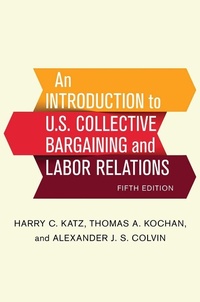
An Introduction to U.S. Collective Bargaining and Labor Relations
5th Edition
Published on 15. September 2017
496 pages
978-1-5017-1389-7 (ISBN)
Description

This comprehensive textbook provides an introduction to collective bargaining and labor relations with a focus on developments in the United States. It is appropriate for students, policy analysts, and labor relations professionals including unionists, managers, and neutrals. A three-tiered strategic choice framework unifies the text, and the authors' thorough grounding in labor history and labor law assists students in learning the basics. In addition to traditional labor relations, the authors address emerging forms of collective representation and movements that address income inequality in novel ways.
Harry C. Katz, Thomas A. Kochan, and Alexander J. S. Colvin provide numerous contemporary illustrations of business and union strategies. They consider the processes of contract negotiation and contract administration with frequent comparisons to nonunion practices and developments, and a full chapter is devoted to special aspects of the public sector. An Introduction to U.S. Collective Bargaining and Labor Relations has an international scope, covering labor rights issues associated with the global supply chain as well as the growing influence of NGOs and cross-national unionism. The authors also compare how labor relations systems in Germany, Japan, China, India, Brazil, and South Africa compare to practices in the United States.
The textbook is supplemented by a website (ilr.cornell.edu/scheinman-institute/research/introduction-us-collective-bargaining-and-labor-relations) that features an extensive Instructor's Manual with a test bank, PowerPoint chapter outlines, mock bargaining exercises, organizing cases, grievance cases, and classroom-ready current events materials.
Harry C. Katz, Thomas A. Kochan, and Alexander J. S. Colvin provide numerous contemporary illustrations of business and union strategies. They consider the processes of contract negotiation and contract administration with frequent comparisons to nonunion practices and developments, and a full chapter is devoted to special aspects of the public sector. An Introduction to U.S. Collective Bargaining and Labor Relations has an international scope, covering labor rights issues associated with the global supply chain as well as the growing influence of NGOs and cross-national unionism. The authors also compare how labor relations systems in Germany, Japan, China, India, Brazil, and South Africa compare to practices in the United States.
The textbook is supplemented by a website (ilr.cornell.edu/scheinman-institute/research/introduction-us-collective-bargaining-and-labor-relations) that features an extensive Instructor's Manual with a test bank, PowerPoint chapter outlines, mock bargaining exercises, organizing cases, grievance cases, and classroom-ready current events materials.
Reviews / Votes
What struck me most about this work is that it steers clear of the case-method approach common in many legal textbooks. Instead, the authors offer a more explanatory review of the topics discussed, using case studies throughout to illustrate concepts of particular interest. The result is a work that is highly substantive, yet accessible to a wide audience. This book works equally well as a reference tool for those familiar with labor relations and an introduction for the uninitiated.(Monthly Labor Review) For a continental European academic, this text not only offers a thorough and wellbalanced introduction into the US system of collective bargaining and industrial relations but also into the superstructure and the theoretical framework that underpins it. And it is actually a pleasure to read and therefore comes highly recommended.
(British Journal of Industrial Relations)
More details
Edition
fifth edition
Language
English
Place of publication
New York
United States
Publishing group
Cornell University Press
Edition type
New edition
Product notice
Reflowable
Illustrations
7 charts - 7 Charts
ISBN-13
978-1-5017-1389-7 (9781501713897)
Copyright in bibliographic data and cover images is held by Nielsen Book Services Limited or by the publishers or by their respective licensors: all rights reserved.
Schweitzer Classification
Other editions
Additional editions
Harry C. Katz | Thomas A. Kochan | Alexander J. S. Colvin
An Introduction to U.S. Collective Bargaining and Labor Relations
Book
09/2017
5th Edition
ILR Press
€114.09
Shipment within 15-20 days
Harry C. Katz | Thomas A. Kochan | Alexander J. S. Colvin
An Introduction to U.S. Collective Bargaining and Labor Relations
Book
09/2017
5th Edition
ILR Press
€236.21
Shipment within 15-20 days
Persons
Harry C. Katz is Jack Sheinkman Professor and Director of the Scheinman Institute on Conflict Resolution at the ILR School, Cornell University. He is coauthor of The Transformation of American Industrial Relations and Converging Divergences and coeditor of Rekindling the Movement, all from Cornell, among many other books. Thomas A. Kochan is the George Maverick Bunker Professor at the MIT Sloan School of Management and Co-Director of the MIT Institute for Work and Employment Research. He is coauthor of Healing Together, Up in the Air, and The Transformation of American Industrial Relations, all from Cornell, and author or editor of many other books. Alexander J. S. Colvin is Associate Dean for Academic Affairs, Diversity, and Faculty Development and the Martin F. Scheinman Professor of Conflict Resolution at the ILR School, Cornell University.
Content
Preface
Acknowledgments
List of Abbreviations
Part I
1. A Framework for Analyzing Collective Bargaining and Labor Relations
2. The Historical Evolution of the U.S. Labor Relations System
3. The Law and Legal Systems
4. The Role of the Labor Relations Environment
Part II
5. Management Strategies and Structures for Collective Bargaining
6. Union Strategies and Structures for Representing Workers
Part III
7. Union Organizing and Bargaining Structures
8. The Negotiations Process and Strikes
9. Dispute Resolution Procedures
10. Contract Terms and Employment Outcomes
Part IV
11. Workplace Labor Relations
12. Conflict Resolution at the Workplace
Part V
13. Collective Bargaining in the Public Sector
14. Global Pressures
15. Labor Relations in Other Countries
16. The Future of U.S. Labor Policy and Labor Relations
Glossary
About the Authors
Name Index
Subject Index
Acknowledgments
List of Abbreviations
Part I
1. A Framework for Analyzing Collective Bargaining and Labor Relations
2. The Historical Evolution of the U.S. Labor Relations System
3. The Law and Legal Systems
4. The Role of the Labor Relations Environment
Part II
5. Management Strategies and Structures for Collective Bargaining
6. Union Strategies and Structures for Representing Workers
Part III
7. Union Organizing and Bargaining Structures
8. The Negotiations Process and Strikes
9. Dispute Resolution Procedures
10. Contract Terms and Employment Outcomes
Part IV
11. Workplace Labor Relations
12. Conflict Resolution at the Workplace
Part V
13. Collective Bargaining in the Public Sector
14. Global Pressures
15. Labor Relations in Other Countries
16. The Future of U.S. Labor Policy and Labor Relations
Glossary
About the Authors
Name Index
Subject Index
