

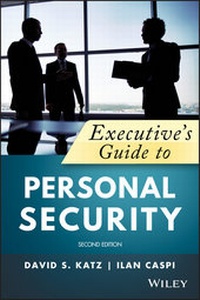
Executive's Guide to Personal Security
Description

The revised and updated second edition of Executive's Guide to Personal Security, 2nd Edition offers a strategic handbook for ensuring safety for executives, their employees, and their corporate assets. The book's lessons outline the basic rules of personal security; it shows how to recognize and prepare for the real threats faced by executives and ordinary individuals in today's often hostile world. It is filled with the necessary knowledge that can empower executives to face these threats and deal with them successfully. The methods outlined herein, formerly reserved for security professionals and government employees, are made available to the reader. Executive's Guide to Personal Security will teach you situational awareness which allows you to identify potential dangers before they become serious threats. You will learn how to analyze risks, prepare for emergencies, travel safely, and utilize counter-surveillance techniques to enable you to recognize if you are being followed or targeted. You will gain an understanding of the threats to both personal safety and corporate assets and understand how to implement the appropriate counter-measures to deal with those perceived threats.
With Executive's Guide to Personal Security, you can learn to take necessary actions to reduce your chances of becoming a target and discover how to make yourself less vulnerable. Written by two seasoned security experts, the lessons presented can be used by those in the business world as well as anyone who would like to feel more secure, including those traveling to foreign countries and individuals studying abroad. New to the second edition is:
* Information for responding to an active shooter incident
* Enhanced details for protecting IP and computers and smart phones
* Strategies for planning for emergencies at home and the office
* Approaches to safety that meet the challenges of today's world
Executive's Guide to Personal Security, 2nd Edition is the comprehensive book that contains information on physical security, principles of route selection, technical security systems, hostage situations, emergency planning, hotel and room selection, armored products, communications, bomb threats, evacuations, and local criminal hazards.
More details
Other editions
Additional editions
Persons
ILAN CASPI is a business executive, a former member of the Israeli General Security Agency, the Israeli Diplomatic Security Service, EL AL Airline, and the Israeli Air Force. He is an expert in executive protection, threat assessments, and developing comprehensive security protocols for international organizations. He received his MBA from the University of Chicago Booth School of Business.
Content
Preface xiii
Introduction xv
Chapter 1 Developing a Security Mind-set 1
Chapter 2 Planning for Emergencies in the Office 15
Chapter 3 Receipt of Suspicious Mail and Packages and Bomb Threats 47
Chapter 4 Violence in the Workplace 65
Chapter 5 Surviving an Active Shooter Incident 73
Chapter 6 Personal and Business Travel Security 91
Chapter 7 Travel to High-Risk Areas 113
Chapter 8 Hijacking and Hostage Survival 157
Chapter 9 Espionage and Fraud Protection: The Executive Perspective 169
Chapter 10 Executive Protection 185
Chapter 11 Running a Successful Security Business Function 195
Chapter 12 Breaking into a Security Career in the Private Sector 205
Chapter 13 Carrying a Firearm for Personal Protection 217
Index 227
INTRODUCTION
THERE IS A FOUNDATIONAL PRINCIPLE that applies to any serious discussion of security and it is this: Unless you are committed to developing a security mind-set, you will not be able to make use of most of the information that is provided in this book. The security mind-set is far more valuable than any technology or security procedure or protocol we can put in place; the human factor is by far the most critical element when it comes to addressing security and life safety concerns.
As you read this book, each chapter stresses a different aspect of security that is designed to greatly enhance overall safety, whether you are at work, at home, or traveling abroad. Each of the recommendations provided has been proven over the years to be effective in improving your overall security posture. However, unless you learn how to pay attention to your surroundings and identify threats before they materialize, very little of the information contained herein will be of use to you. The following is a short synopsis to what we are going to cover in this book.
Chapter 1: Developing a Security Mind-set. Your brain is your most valuable tool with respect to personal security and overall life safety so we begin by discussing how to develop the same mental skills that well-trained security professionals have. This chapter makes the case that developing proper observational skills and learning to draw the right conclusions from those observations is the single most important thing anyone can do to become less vulnerable to harm. We explain in detail the effects that stress and fear experienced during a critical incident can have on your cognitive and perceptual ability. Ideally, the goal is to teach you to recognize dangerous situations before they occur; avoiding a dangerous situation is always better been trying to extricate yourself from danger once it has begun.
Chapter 2: Planning for Emergencies in the Office. How do you handle an emergency or emerging incident in the office? What if an employee, client, vendor, or guest has a medical emergency? What about a fire in your building or on your floor? There are also many non-fire-related emergencies, ranging from severe weather, to accidents, to acts of terrorism involving weapons of mass destruction, that can threaten your safety. Do you currently have procedures in place to handle these types of incidents, or would you be forced to try to respond appropriately during a critical incident without a plan and while under extreme stress? What about protecting your business? Are there actions related to business continuity you would need to take in the event there is an evacuation or in-building relocation? How would the closure of your office or facility for an extended period affect your business?
In this chapter we teach you how to develop plans on how to respond in the event of an emergency to ensure the safety of your employees, the protection of your assets, and the continuity of your business.
Chapter 3: Receipt of Suspicious Mail and Packages and Bomb Threats. How would you handle a bomb threat at the office? Would you immediately evacuate the building or wait for the police to arrive and tell you what to do? The chance that your place of business will receive a letter or package bomb is extremely remote, but many businesses will have to deal with such a threat at one time or another so prior preparation is a necessity. Are most threats legitimate? No, most such threats are intended to disrupt your daily business activities. Does that change what your response would be?
How would you handle the receipt of a suspicious letter or package? What about an unattended item left in the office that no one can identify? What would you do if one of your employees reported receiving a letter that was leaking some sort of powder or liquid and had a strong or noxious smell?
In this chapter we cover all these issues and delve into some motivations that drive threats made to the office. These types of incidents always generate a law enforcement response, but the steps you take before the first responders arrive are critically important and are discussed in great detail in this chapter.
Chapter 4: Violence in the Workplace. According to the Bureau of Labor Statistics, homicide is the third leading cause of death in the workplace. Sometimes the threat is external; retail businesses, for example, have a risk of being robbed. However, in many other cases, the threat of harm to employees comes from other employees. Employee-generated violence in the workplace is a frightening prospect for any company, particularly because, absent the creation of the appropriate reporting system, it can be difficult to detect and address before an act of violence occurs. Companies must establish a zero-tolerance policy toward violence in the workplace and exercise vigilance in order to deal with aggressive, belligerent, and potentially violent employees. This chapter analyzes the risk posed by violent individuals in the workplace and suggests appropriate preventive measures to maintain a safe environment in the office. The chapter also addresses how to deal with acts of domestic violence affecting employees, as such violence often finds its way to the workplace.
Chapter 5: Surviving an Active Shooter Incident. FBI statistics reveal that the number of active shooter incidents is increasing. These events are unpredictable, chaotic, and happen very quickly. Organizations can never completely eliminate the risk of such an attack occurring, but they may take many actions before an attack in order to try and prevent it, during an attack to mitigate potential damage and loss of life, and after an attack to return to normal operations as quickly as possible. This chapter reviews active shooter incidents, particularly with respect to such incidents in the workplace, and provides information needed to survive an active shooter incident in the event one occurs.
Chapter 6: Personal and Business Travel Security. The type of business a company performs and the parts of the world where the work is done can also create security issues. International companies may have to deal with potential threats to their overseas business travelers and expatriate employees. Companies and their employees located in politically volatile areas may get caught up in local or regional conflicts or even terrorist attacks. In this chapter we provide valuable information on how to prepare for a trip and how to conduct yourself while overseas. This chapter addresses residing abroad as well.
Chapter 7: Travel to High-Risk Areas. Most criminal or terrorist operations are not conducted at random. Virtually all terrorist or criminal attacks are preceded by a pre-operational stage where intelligence is gathered about the intended target. Following a target in order to learn his or her daily routine is one of the most critical elements of this stage, and the objective is to identify a place and/or time where the target is most vulnerable. In this chapter we discuss how surveillance is performed in order to help you understand how to utilize countersurveillance techniques to detect whether you are being watched or followed. You learn the principles of route selection to reduce vulnerability while driving and recognize the importance of knowing the location of the nearest safe haven. If you are required to travel to potentially dangerous areas or are a high-profile individual or a security professional responsible for protecting someone, this chapter will be of extreme interest to you.
Chapter 8: Hijacking and Hostage Survival. The subjects of how to respond during a hijacking and how to survive a hostage situation are extremely complex. There are several schools of thought on what to do if you become embroiled in either or both of these situations. Because currently there is little consensus on the best ways to respond, in this chapter we share the different approaches. We discuss the pros and cons of the various approaches in order to familiarize you with the prevailing expert opinions on this topic.
Chapter 9: Espionage and Fraud Protection: The Executive Perspective. Theft of intellectual property and fraud constitute major sources of revenue and inventory loss to businesses. Counterfeit goods, pirated software, and theft of trade secrets together represent an "economic loss" to the U.S. economy of between $225 billion and $600 billion annually, according to the findings of a 2017 research report from the bi-partisan IP Commission, The Theft of American Intellectual Property: Reassessments of the Challenge and United States Policy. Despite knowing this, businesses are still making the same mistakes. Can we protect the company's most critical information from falling into the wrong hands?
Executives are often the targets of scams, both simple and complicated. Can anything be done to reduce this risk? In this chapter we cover basic fraud prevention and protection of intellectual property.
Chapter 10: Executive Protection. Protecting an individual is a very different discipline from securing a facility. Top executives can't be locked down. They are necessarily mobile, and that mobility can expose executives to a variety of risks. Over the last sixteen years, we have had the opportunity to provide security and close protection to business executives, A-list celebrities, ambassadors, political figures, and dignitaries....
