

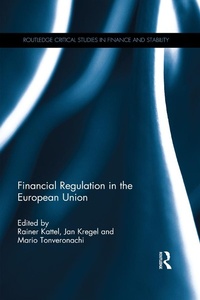
Financial Regulation in the European Union
Published on 8. October 2015
342 pages
978-1-317-42884-8 (ISBN)
Description

This collection offers a comparative overview of how financial regulations have evolved in various European countries since the introduction of the single European market in 1986. It includes a number of country studies which provides a narrative of the domestic financial regulatory structure at the beginning of the period, as well the means by which the EU Directives have been introduced into domestic legislation and the impact on the financial structure of the economy.
In particular, studies highlight how the discretion allowed by the Directives has been used to meet the then existing domestic conditions and financial structure as well as how they have modified that structure. Countries covered are France, Germany, Italy, Spain, Estonia, Hungary and Slovenia. The book also contains an overview of regulatory changes in the UK and Nordic countries, and in post-crisis USA. This comparative approach raises questions about whether past and more recent regulatory changes have in fact contributed to increase financial stability in the EU.
The comparative analysis provided in this book raises questions on whether the past and more recent changes are contributing to increase the financial stability and efficiency of individual banks and national financial systems. The crisis has demonstrated the drawbacks of formulating the regulatory framework on standards borrowed from the best industry practices from the large developed countries, originally designed exclusively for large global banks, but now applied to all financial institutions.
In particular, studies highlight how the discretion allowed by the Directives has been used to meet the then existing domestic conditions and financial structure as well as how they have modified that structure. Countries covered are France, Germany, Italy, Spain, Estonia, Hungary and Slovenia. The book also contains an overview of regulatory changes in the UK and Nordic countries, and in post-crisis USA. This comparative approach raises questions about whether past and more recent regulatory changes have in fact contributed to increase financial stability in the EU.
The comparative analysis provided in this book raises questions on whether the past and more recent changes are contributing to increase the financial stability and efficiency of individual banks and national financial systems. The crisis has demonstrated the drawbacks of formulating the regulatory framework on standards borrowed from the best industry practices from the large developed countries, originally designed exclusively for large global banks, but now applied to all financial institutions.
More details
Series
Language
English
Place of publication
London
United Kingdom
Publishing group
Taylor & Francis Ltd
Target group
College/higher education
Illustrations
8 s/w Abbildungen, 16 s/w Tabellen, 8 s/w Zeichnungen
16 Tables, black and white; 8 Line drawings, black and white; 8 Illustrations, black and white
File size
1,73 MB
ISBN-13
978-1-317-42884-8 (9781317428848)
Copyright in bibliographic data and cover images is held by Nielsen Book Services Limited or by the publishers or by their respective licensors: all rights reserved.
Schweitzer Classification
Other editions
Additional editions
Rainer Kattel | Jan Kregel | Mario Tonveronachi
Financial Regulation in the European Union
Book
06/2017
1st Edition
Routledge
€64.00
Shipment within 10-20 days
Rainer Kattel | Jan Kregel | Mario Tonveronachi
Financial Regulation in the European Union
Book
10/2015
1st Edition
Routledge
€242.50
Shipment within 10-20 days
Persons
Rainer Kattel is Program Head and Professor of Innovation Policy and Technology Governance at Tallinn University of Technology, Estonia.
Jan Kregel is a senior scholar at the Levy Economics Institute of Bard College, USA, and Director of its Monetary Policy and Financial Structure program.
Mario Tonveronachi is Professor of Financial Systems at the University of Siena, Italy.
Jan Kregel is a senior scholar at the Levy Economics Institute of Bard College, USA, and Director of its Monetary Policy and Financial Structure program.
Mario Tonveronachi is Professor of Financial Systems at the University of Siena, Italy.
Content
1. Introduction 2. Financial Regulation in France 3. Financial Regulation in Germany 4. Financial Regulation in Italy 5. Financial Regulation in Spain 6. Financial Regulation in Estonia 7. Financial Regulation in Hungary 8. Financial Regulation in Poland 9. Financial Regulation in Slovenia 10. The United Kingdom from the Big Bank to Post-Crisis Reforms 11. Crisis Management: The 1990s Experience of the Nordic Countries 12. Post-Crisis International Regulatory Standards and their Inclusion in the European Framework
