

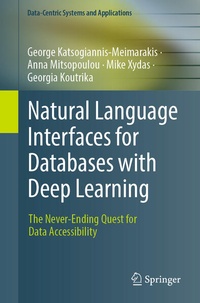
Natural Language Interfaces for Databases with Deep Learning
Description

This book covers the main research areas that aim to bridge the world of databases and SQL with the world of natural language. It provides a comprehensive coverage of the most influential work in the field that takes advantage of deep learning. Enabling users to access databases using natural language has been a longstanding goal since the inception of relational databases, that despite continued efforts remains an open challenge. However, the advancement of neural networks has given new life to this area, inspiring a new wave of works in multiple directions.
Starting with an introduction on the history of NLIDBs and a brief neural primer on deep learning architectures frequently mentioned throughout the book, the initial chapters focus on the Text-to-SQL problem. There, an overview of the problem is given, followed by a general architecture of Text-to-SQL systems and a deeper analysis of specific systems. Additionally, the reverse process of explaining an SQL query (i.e., SQL-to-Text) is examined, along with open research problems and the currently available solutions. The book continues with the multi-turn Text-to-SQL problem, that enables users to make corrections or ask follow-up questions, outlining the underlying system architectures, and introducing key representative systems. To put everything into perspective the subsequent chapter takes a broader look at the more general areas of code understanding and generation that encapsulate the problems discussed in the previous chapters. Moving on, the focus shifts on generating NL explanations and summaries of data (i.e., the Data-to-Text problem), offering an overview of the problem and its challenges as well as an overall system architecture and specific Data-to-Text systems. Then, bringing Data-to-Text closer to NLIDBs, the book dives deeper into the Results-to-Text problem that focuses on how to express the result of a query in user-friendly natural language. Finally, the book concludes by offering insights into how all the discussed research areas and systems can be brought together to create an NLIDB, along with risk and challenges that must be considered in the process.
This book is intended for both researchers and practitioners interested in NLIDBs, regardless of their prior familiarity with the topic. Readers with experience in this area will benefit from a structured overview and categorization of existing systems, along with an in-depth analysis of benchmarks, persistent challenges, and open research questions. Conversely, newcomers can explore the landscape of neural NLIDBs through an accessible presentation of the relevant subfields and key advancements, without requiring any prior background knowledge.
More details
Other editions
Additional editions
Persons
George Katsogiannis-Meimarakis is a PhD student at the University of Grenoble Alpes and Athena Research Center. His research focuses on empowering data accessibility through AI-driven solutions. He has presented multiple tutorials on Text-to-SQL and NLIDBs at top-level conference and published papers on related topics. His work has been integrated in EU-funded projects focusing on NL Search, Query Explanations, and Dataset Discovery.
Anna Mitsopoulou is a PhD student at the Department of Informatics and Telecommunications, National and Kapodistrian University of Athens, and a Research Associate at the Athena Research Center. Her research focuses on enabling database access through natural language. She has published papers in this field, and her work has been integrated into EU-funded and commercial projects on data accessibility.
Mike Xydas is a PhD student at the University of Athens, Department of Informatics and Telecommunications, and a Research Associate at the Athena Research Center. He specializes in Natural Language Interfaces to Databases, with a focus on user-friendly interpretation of query results and practical, real-world deployment. He has delivered tutorials on NLIDBs at top conferences, and his work has been implemented in EU-funded projects and commercial AI-powered data accessibility solutions.
Georgia Koutrika is a Research Director at the Athena Research Center in Greece. She held research positions at HP Labs, IBM Almaden, and Stanford University. Her work explores how artificial intelligence can transform data management, particularly through conversational interfaces and AI-driven data management techniques. She has published many scientific papers at major conferences and journals. She coordinates or participates in several Horizon Europe research projects on these topics.
Content
1. Natural Language Interfaces to Databases.- 2. Translating Natural Language Questions to SQL.- 3. Text-to-SQL Architecture.- 4. Text-to-SQL Systems.- 5. Describing SQL Queries in Natural Language.- 6. Multi-turn NLIDBs.- 7. The Code Generation and Summarization Problems.- 8. The Data-to-Text Problem.- 9. Table-to-Text Neural Architecture and Systems.- 10. The Results-to-Text Problem and Systems.- 11. Conclusions.
