

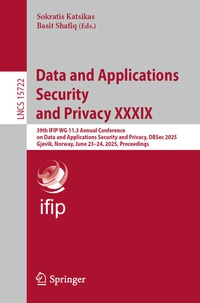
Data and Applications Security and Privacy XXXIX
Description

This book constitutes the refereed proceedings of the 39th IFIP WG 11.3 Annual Conference on Data and Applications Security and Privacy XXXIX, DBSec 2025, held in Gjøvik, Norway, during June 23-24, 2025.
The 19 full papers and 5 short papers included in this book were carefully reviewed and selected from 59 submissions. They were organized in topical sections as follows: AI applications in security and privacy; User and data privacy; Database and storage security; Differential privacy; Attackers and attack detection; Access control & Internal Controls and Audit process; and Cryptography for security and privacy.
More details
Other editions
Additional editions
Content
.- AI applications in security and privacy .
.- Jibber-Jabber!: Encoding the (Un-)Natural Language of Network Devices and Applications.
.- Automated Privacy Policy Analysis using Large Language Models.
.- Data Chameleon:~a self-adaptive synthetic data management system.
.- Operating Under Constraints: Identifying Requirements for Enhanced Cyber Resilience Management.
.- Towards the Identification of Vulnerability-Fixing Code Lines in OSS Security Patches Using Lexical Code Segmentation and LLMs.
.- Encrypt What Matters: Selective Model Encryption for More Efficient Secure Federated Learning.
.- Hallucination Detection in Large Language Models using Diversion Decoding.
.- User and data privacy .
.- Blockchain-Enhanced User Consent for GDPR-Compliant Real-Time Bidding.
.- Enabling Right to be Forgotten in a Collaborative Environment using Permissioned Blockchains.
.- P-EDR: Privacy-preserving Event-driven Data Release using Smart Contracts.
.- Performance-Efficient Anti-fingerprinting for Privacy.
.- Privacy Management in Cyber-Physical Systems: The DUCA Framework.
.- Database and storage security .
.- Bloom Filter Look-Up Tables for Private and Secure Distributed Databases in Web3.
.- Purpose Filter: A space-efficient purpose metadata storage.
.- Secure and Reliable Digital Wallets: A Threat Model for Secure Storage in eIDAS 2.0.
.- Differential privacy .
.- Facility Location Problem under Local Differential Privacy without Super-set Assumption.
.- Can Differentially Private Fine-tuning LLMs Protect Against Privacy Attacks?.
.- Attackers and attack detection .
.- Metadata Assisted Supply-Chain Attack Detection for Ansible.
.- Diffusion-based Adversarial Purification for Intrusion Detection.
.- Feature Identification and Study of Attackers' Behaviours Using Honeypots.
.- A ccess control & Internal Controls and Audit process .
.- Supporting Delegation in Outsourced ICA Process.
.- Transaction Logs in Access Control: Leveraging an Under-Utilized Data Source.
.- Cryptography for security and privacy .
.- The Privacy Impact of Dash Mixing Fee Payments.
.- Cryptanalysis and Modification of a Variant of Matrix Operation for Randomization or Encryption (v-MORE).
