

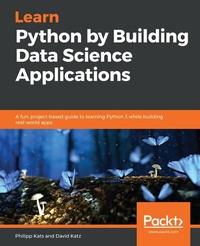
Learn Python by Building Data Science Applications
A fun, project-based guide to learning Python 3 while building real-world apps
Published on 23. September 2024
482 pages
978-1-78953-306-4 (ISBN)
Description

Understand the constructs of the Python programming language and use them to build data science projects
Key Features
Learn the basics of developing applications with Python and deploy your first data application
Take your first steps in Python programming by understanding and using data structures, variables, and loops
Delve into Jupyter, NumPy, Pandas, SciPy, and sklearn to explore the data science ecosystem in Python
Book DescriptionPython is the most widely used programming language for building data science applications. Complete with step-by-step instructions, this book contains easy-to-follow tutorials to help you learn Python and develop real-world data science projects. The "secret sauce" of the book is its curated list of topics and solutions, put together using a range of real-world projects, covering initial data collection, data analysis, and production. This Python book starts by taking you through the basics of programming, right from variables and data types to classes and functions. You'll learn how to write idiomatic code and test and debug it, and discover how you can create packages or use the range of built-in ones. You'll also be introduced to the extensive ecosystem of Python data science packages, including NumPy, Pandas, scikit-learn, Altair, and Datashader. Furthermore, you'll be able to perform data analysis, train models, and interpret and communicate the results. Finally, you'll get to grips with structuring and scheduling scripts using Luigi and sharing your machine learning models with the world as a microservice. By the end of the book, you'll have learned not only how to implement Python in data science projects, but also how to maintain and design them to meet high programming standards.What you will learn
Code in Python using Jupyter and VS Code
Explore the basics of coding - loops, variables, functions, and classes
Deploy continuous integration with Git, Bash, and DVC
Get to grips with Pandas, NumPy, and scikit-learn
Perform data visualization with Matplotlib, Altair, and Datashader
Create a package out of your code using poetry and test it with PyTest
Make your machine learning model accessible to anyone with the web API
Who this book is forIf you want to learn Python or data science in a fun and engaging way, this book is for you. You'll also find this book useful if you're a high school student, researcher, analyst, or anyone with little or no coding experience with an interest in the subject and courage to learn, fail, and learn from failing. A basic understanding of how computers work will be useful.
Key Features
Learn the basics of developing applications with Python and deploy your first data application
Take your first steps in Python programming by understanding and using data structures, variables, and loops
Delve into Jupyter, NumPy, Pandas, SciPy, and sklearn to explore the data science ecosystem in Python
Book DescriptionPython is the most widely used programming language for building data science applications. Complete with step-by-step instructions, this book contains easy-to-follow tutorials to help you learn Python and develop real-world data science projects. The "secret sauce" of the book is its curated list of topics and solutions, put together using a range of real-world projects, covering initial data collection, data analysis, and production. This Python book starts by taking you through the basics of programming, right from variables and data types to classes and functions. You'll learn how to write idiomatic code and test and debug it, and discover how you can create packages or use the range of built-in ones. You'll also be introduced to the extensive ecosystem of Python data science packages, including NumPy, Pandas, scikit-learn, Altair, and Datashader. Furthermore, you'll be able to perform data analysis, train models, and interpret and communicate the results. Finally, you'll get to grips with structuring and scheduling scripts using Luigi and sharing your machine learning models with the world as a microservice. By the end of the book, you'll have learned not only how to implement Python in data science projects, but also how to maintain and design them to meet high programming standards.What you will learn
Code in Python using Jupyter and VS Code
Explore the basics of coding - loops, variables, functions, and classes
Deploy continuous integration with Git, Bash, and DVC
Get to grips with Pandas, NumPy, and scikit-learn
Perform data visualization with Matplotlib, Altair, and Datashader
Create a package out of your code using poetry and test it with PyTest
Make your machine learning model accessible to anyone with the web API
Who this book is forIf you want to learn Python or data science in a fun and engaging way, this book is for you. You'll also find this book useful if you're a high school student, researcher, analyst, or anyone with little or no coding experience with an interest in the subject and courage to learn, fail, and learn from failing. A basic understanding of how computers work will be useful.
More details
Edition
Digital original
Language
English
Place of publication
Birmingham
United Kingdom
Target group
Professional and scholarly
US School Grade: College Graduate Student
Edition type
Digital original
File size
14,19 MB
ISBN-13
978-1-78953-306-4 (9781789533064)
Copyright in bibliographic data and cover images is held by Nielsen Book Services Limited or by the publishers or by their respective licensors: all rights reserved.
Schweitzer Classification
Other editions
Additional editions
Philipp Kats | David Katz
Learn Python by Building Data Science Applications
A fun, project-based guide to learning Python 3 while building real-world apps
Book
08/2019
Packt Publishing
€47.60
Shipment within 3-4 weeks
Persons
Kats Philipp :
Philipp Kats is a researcher at the Urban Complexity Lab, NYU CUSP, a research fellow at Kazan Federal University, and a data scientist at StreetEasy, with many years of experience in software development. His interests include data analysis, urban studies, data journalism, and visualization. Having a bachelor's degree in architectural design and a having followed the rocky path (at first) of being a self-taught developer, Philipp knows the pain points of learning programming and is eager to share his experience.Katz David :
David Katz is a researcher and holds a Ph.D. in mathematics. As a mathematician at heart, he sees code as a tool to express his questions. David believes that code literacy is essential as it applies to most disciplines and professions. David is passionate about sharing his knowledge and has 6 years of experience teaching college and high school students.
Philipp Kats is a researcher at the Urban Complexity Lab, NYU CUSP, a research fellow at Kazan Federal University, and a data scientist at StreetEasy, with many years of experience in software development. His interests include data analysis, urban studies, data journalism, and visualization. Having a bachelor's degree in architectural design and a having followed the rocky path (at first) of being a self-taught developer, Philipp knows the pain points of learning programming and is eager to share his experience.Katz David :
David Katz is a researcher and holds a Ph.D. in mathematics. As a mathematician at heart, he sees code as a tool to express his questions. David believes that code literacy is essential as it applies to most disciplines and professions. David is passionate about sharing his knowledge and has 6 years of experience teaching college and high school students.
Content
Table of Contents
Preparing the workspace
First Steps in coding variables and data types
Functions
Data Structures
Loops and other compound statements
First script: Geocoding with Web APIs
Scraping Data from the Web with Beautiful Soup 4
Simulation with Classes and inheritance
Shell, Git, Conda, and More at Your Command
Python for Data Applications
Data cleaning and manipulation
Data Exploration and Visualization
Training a Machine Learning model
Improving your Models Metrics pipelines and experiments
Packaging and testing with poetry and pytest
Data Pipelines with Luigi
Lets build a dashboard
Serving models with Rest API
Serverless API using Chalice
Best practices and Python performance
Preparing the workspace
First Steps in coding variables and data types
Functions
Data Structures
Loops and other compound statements
First script: Geocoding with Web APIs
Scraping Data from the Web with Beautiful Soup 4
Simulation with Classes and inheritance
Shell, Git, Conda, and More at Your Command
Python for Data Applications
Data cleaning and manipulation
Data Exploration and Visualization
Training a Machine Learning model
Improving your Models Metrics pipelines and experiments
Packaging and testing with poetry and pytest
Data Pipelines with Luigi
Lets build a dashboard
Serving models with Rest API
Serverless API using Chalice
Best practices and Python performance
