

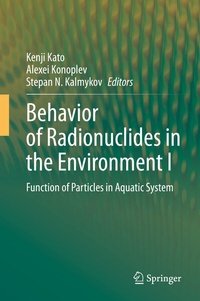
Behavior of Radionuclides in the Environment I
Description

The 3-volume set highlights the behavior of radionuclides in the environment and focusing on the development of related fields of study, including microbiology and nanoscience. In this context, it discusses the behavior of radionuclides released in areas of Lake Karachai in Ural, and those released as a result of Chernobyl accident (1986), and in Fukushima (2011).
Volume I presents the experiences gained in South Urals ("Mayak" plant, Lake Karachai), providing a scientific basis for more precise understanding of the behavior of radionuclides in complex subsurface environments. On the basis of monitoring data, it examines the pathways of radionuclide migration and the influence of the geological environment and groundwater on the migration, with a particular focus on particles from the nanoscale to microscale. It also discusses the function of microbes and microscale particles, from their direct interaction with radionuclides to their ecological role in changing the physic-chemical condition of a given environment. Lastly, the protective properties of geological media are also characterized, and mathematical modeling of contaminant migration in the area of Lake Karachai is used to provide information regarding the migration of radionuclides.
More details
Other editions
Additional editions
Persons
Shizuoka University
Faculty of Science
Shizuoka, Japan
Alexei Konoplev
Fukushima University
Institute of Environmental Radioactivity
Fukushima, Japan
Stepan N. Kalmykov
Lomonosov Moscow State University
Radiochemistry Division
Moscow, Russia
Content
1 Microbial ecological function in migration of radionuclides in groundwater.- 2 Microbial diversity and possible activity in nitrate- and radionuclide-contaminated groundwater.- 3 Function of microbes on chemical species transformation of radionuclides.- 4 Direct detection of denitrifying bacteria in groundwater by GeneFISH.- 5 Difference in the solid-water distributions of radiocesium in rivers in Fukushima and Chernobyl.- 6 Function of colloidal and nanoparticles in sorption of radionuclides.- 7 Application of electron microscopy to understanding colloid-facilitated transport of radionuclides at the Mayak Production Association facility, near Lake Karachai, Russia.- 8 Numerical analysis of migration of nitrate ions in the groundwater system of Lake Karachai Area, Southern Ural, Russia.- 9 Commentary on the function of micro- to nano-scale particles in radionuclide migration through groundwater.
